




Beginnings: 2001 to 2004
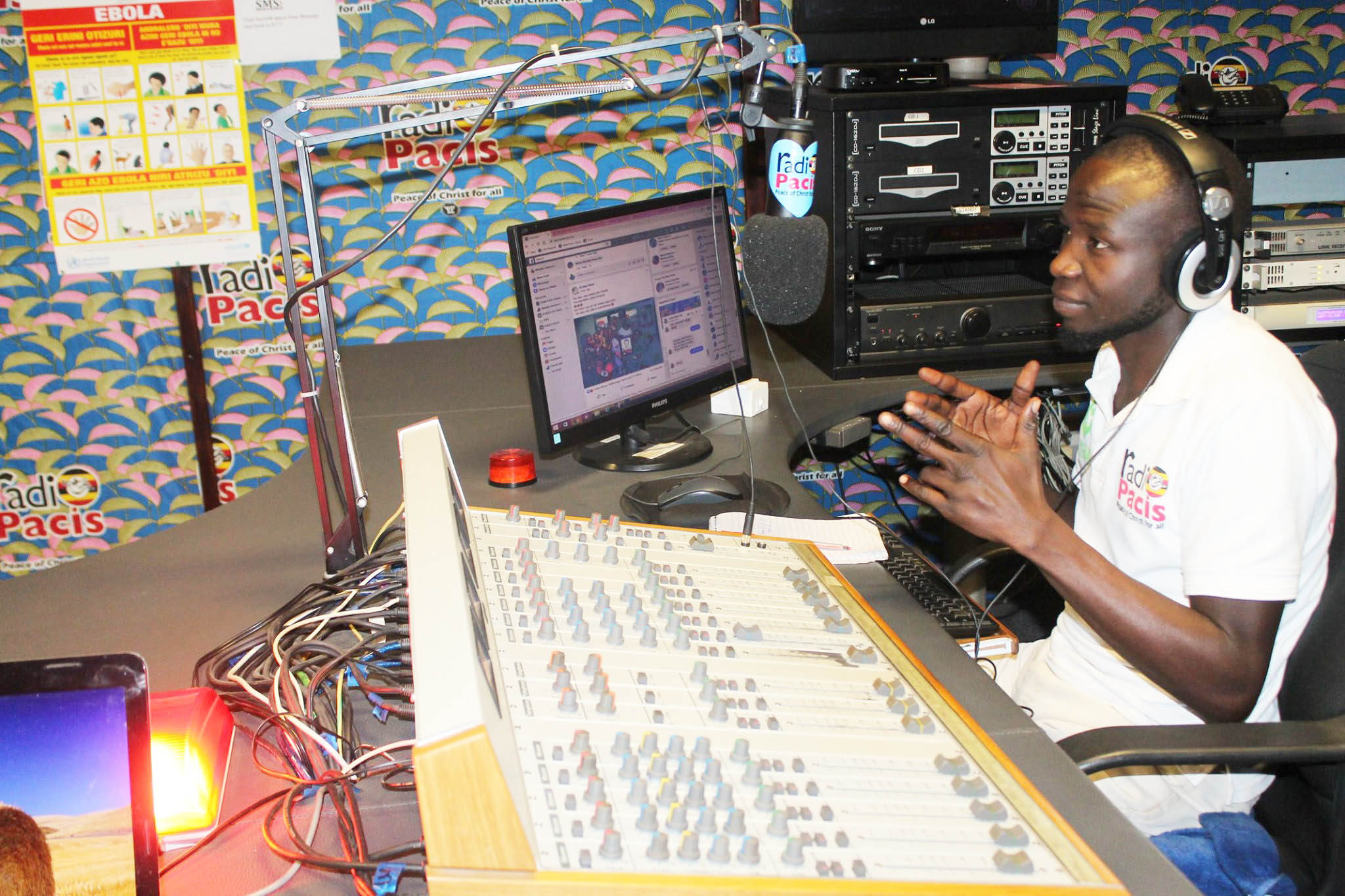
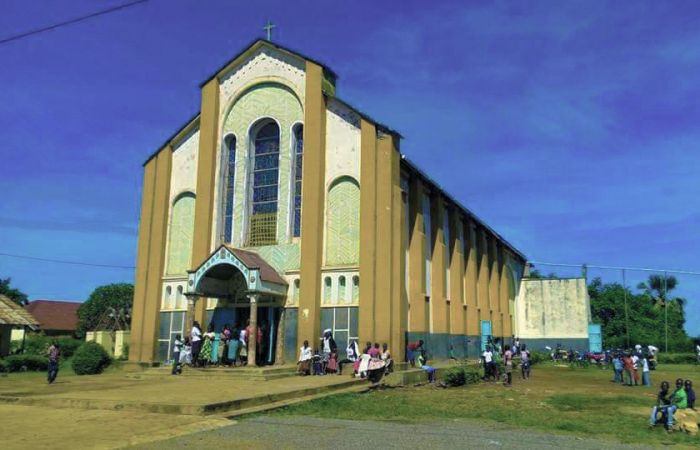
The call for an FM radio station echoed in every diocesan synod (1989, 1994, 1999). In 2001, Bishop Frederick Drandua appointed two missionaries to diocesan posts with the mandate to initiate the radio station. Fr. Tonino Pasolini, a Comboni missionary who had served the diocese for nearly 40 years, was appointed by the overall director of the media centre as the communications coordinator for the diocese. A lay missionary, Ms. Sherry Meyer, who had worked in Arua Diocese for more than 12 years in the pastoral coordinator’s office was appointed as assistant. They began their work by seeking advice and preparing grant requests to fund the project. They consulted with the diocesan pastoral council and with the diocesan departments about their vision for the radio. The bishop allocated a tract of land near the cathedral for the development of a diocesan media centre and named the radio “Radio Pacis” (a Latin word meaning peace).
Major donors for the project construction and purchase of equipment and training included:
- Dreikönigsaktion, the Development cooperation agency of the Catholic Children's Movement in Austria.
- Missio Aachen and Missio Munich: Catholic organizations in Germany.
- Manos Unidas: a development organization in Spain.
- CEI: the Episcopal Conference of Italy.
- BBM/Miva: a logistics and transportation organization in Austria
- Horizont3000: a development organization in Austria offering technical assistance through personnel.
- Pontifical Missionary Society of the Holy Childhood (Germany).
- Mission Office of the Diocese of Bolzano (Italy).
- Comboni Missionaries of the Italian Province, the German-speaking Province, the North American Province and the Ugandan Province.
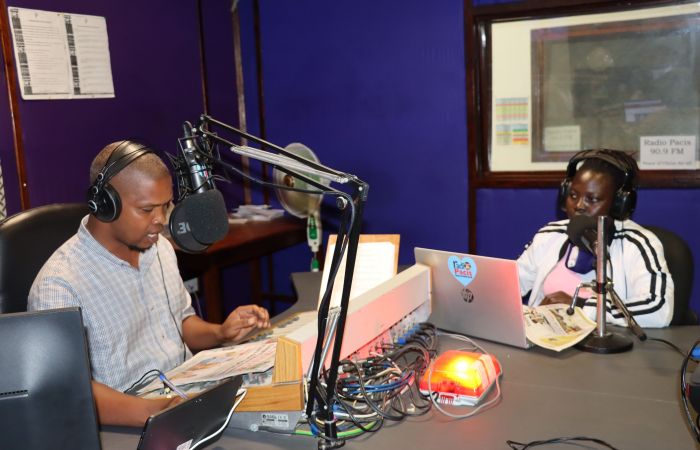
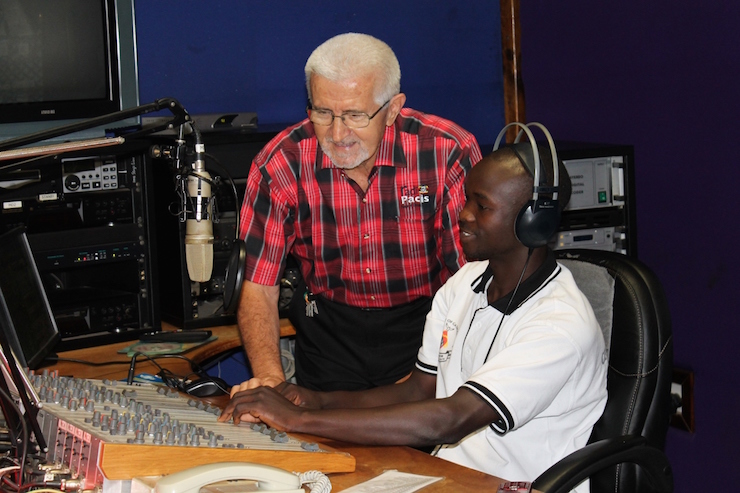
Construction of the Arua Diocese Media Centre began slowly with a residence and a temporary office in 2002. The three major buildings—office block, studio block, and printing block—were completed in 2004. During the construction period serious consultation was done with the stakeholders of the diocese about the radio programme content and mission. Consultation was also done abroad about technical equipment, studio design and programme management. Through an Austrian development organization called Horizont3000, four development workers were provided in the areas of radio technology, radio programming and administration with the goal of training local personnel. Staff members were hired in March/April 2004 with interview teams made up of diocesan personnel. From May to September 2004, the newly hired radio staff trained with the professionals provided by Horizont3000 and professionals contracted from Uganda and beyond. In October 2004 on-air testing began. Licensed by the Uganda government with a frequency of 90.9, Radio Pacis went on air on October 25, 2004 and was officially launched on November 26.
The road to finally hearing Radio Pacis on air was a very long one. But during the years of construction and waiting for the license, the “ownership” of the radio increased. The people of West Nile, and Arua Diocese in particular, never gave up hope and frequently asked about the radio they called “our radio”.
Radio Pacis is a community based radio and so it differs from other commercial radio stations in the Arua area. As a community based radio, the programming is designed for the integral development of the listeners. The programmes seek to entertain as well as educate and to provide information in creative ways that are attractive to the listeners.
Radio Pacis signal has a radium of about 200 Km. Besides the two Catholic dioceses in West Nile (Arua and Nebbi) we reach parts of Eastern Congo and Southern Sudan. Within the government-defined boundaries, we serve the districts of Arua, Nebbi, Koboko, Yumbe, Nyadri, Moyo, Adjumani, and parts of Gulu and Masindi. More than 5 million people can tune to Radio Pacis.
First Year: 2004 -2005
In its first year of operation, Radio Pacis received recognition nationally and internationally. From an independent "Listener Survey" published in June 2005 organized by FIT-SEMA and sponsored by ILO (International Labour Organization – a UN organization) Radio Pacis came up as the radio that has the highest number of listeners in West Nile. Also in June 2005, SIGNIS-Africa held its Assembly in Kampala just before the AMECEA Bishops’ plenary (AMECEA region comprises 8 countries). SIGNIS organized an exposé of the media activities in the region for the bishops. SIGNIS wanted to give the AMECEA bishops a dynamic display of the capability of Catholic media. RADIO PACIS was awarded the first prize in that exposé.
In the national newspaper THE NEW VISION on September 27, 2005 there was a result of a survey about radio listenership carried out by Target Group Index in Uganda and Radio Pacis resulted, out of 115 radio stations, at the 6th place at national level!!
Broadcasting on 90.9, Radio Pacis offered quality programming 19 hours a day, seven days a week.
Second Year: 2005-2006
In its second year of operation, Radio Pacis hosted national leaders. On the 6th December the President of Uganda, Yoweri Museveni came to Radio Pacis for a 2-hour talk show. A month earlier, on 7 November 2005, Dr. Kizza Besigye, a presidential candidate, was in our studios for a 2-hour talk show.
In December 2005, Radio Pacis increased its broadcasting to 24 hours a day, seven days a week. Programming in four languages: English, Lögbara, Ma’di and Kakwa was supplemented occasionally with other languages such as Alur, Lingala and Kiswahili.
The majority of the programming was produced in the Radio Pacis studios. Only three programs were broadcast from other sources: Daybreak Africa from Voice of America (VOA), English for Africa from Radio Vatican, and Focus on Africa from BBC. The locally produced programmes included news bulletins, features and magazines. Daily news was presented in English, Lögbara, Ma’di and Kakwa languages. A daily news journal and a press review were also part of the regular programming. In addition to news, several magazines presented topics of religion, education, health and interpersonal relationships.
The Catholic identity of the radio was strong and ran throughout the programming. In addition, the Sunday Mass was broadcast on Sunday afternoons. Daily, a Scripture Moment invited the listeners to reflect on the readings of the day. The diocesan departments and parishes were an essential part of the programming. The Bishop’s Round Table, an hour-long discussion was broadcast every Monday evening featuring Bishop Frederick Drandua. In the same hour on Tuesday, the social teaching of the church was presented in a live talk show by the financial administrator and others from the Caritas Department. Wednesday’s evening talk show featured the diocesan health department. Thursday evening, the education department was live in the studios. On Friday evening the youth department addressed the listeners about issues related to youth. The weekly programme called Catechist Hour featured the pastoral coordinator, Fr. Aquilino Acidri and some catechists preparing the Sunday liturgy with hints for lectors, homilists and song leaders. Local choirs were busy in the production studios of Radio Pacis recording music that is used in the programming. More than 1,100 songs were recorded!
Two particular programmes targeted the children: Bible for the Kids and Amazing Life. Women were targeted every morning on Monday through Friday in a programme called Life as We Know It. Perhaps the most entertaining feature was the locally produced drama series. The programming was rounded out by the usual greetings and announcements and music. Special programming was prepared for Christmas, Easter, the death/funeral of Pope John Paul II and the election/inauguration of Pope Benedict XVI.
A major setback in February 2006 was the destruction of the battery back-up system in the power scheme that supports the radio. A combination of events caused the batteries one by one to explode sending acid throughout the battery room of the power house. No one was hurt or injured. Once again, the donors assisted in the replacement of batteries and repair of the power house.
An initial goal was realized when Bishop Drandua appointed the members of the board of governors who sat for their first meeting in May 2006.
Third Year: 2006-2007
Radio Pacis continued its unique style of programming, broadcasting 24 hours a day. Goals were set by the Core Management Team to improve and stabilize all the departments, especially the technical department, the IT department and the financial department. The news department and the production department, through continuous evaluation of the radio personalities, sought to improve the quality of every broadcast. A candidate-mentor programme was introduced in October 2006 as a way to attract and train potential radio journalists and radio presenters.
In December 2006, Radio Pacis entered a competition sponsored by the BBC for English-speaking radio stations in Africa. We entered in the category of “new radio station”. In February 2007, the judges selected Radio Pacis as the best new radio station in the East Africa region. As such, the station was a finalist for best new radio station in all of Africa. In May 2007, the director, station manager, programme manager, assistant programme manager, and assistant news editor traveled to Nairobi for the BBC awards ceremony where Radio Pacis was named the best new radio station in all of Africa. It was a huge achievement for the station and the community it serves.
In April 2007, the chief news editor traveled to the USA on a scholarship from the United States Embassy. He participated in a study tour conducted by the Southern Illinois University at Carbondale. Radio Pacis was chosen by the embassy for the scholarship based on our good performance in the field of news broadcasting.
The power system was further strengthened by the donation of a second generator in March 2007.
A process was begun in early 2007 to plan for a second frequency. The core management team set strategies for each phase of the process. Funding was provided by Missio Aachen, Propaganda Fide through SIGNIS, and the Italian Province of the Comboni Missionaries. In September 2007 the license for broadcasting on 94.5 was granted by the government.
The marketing department made great strides in reaching its goal of making the radio self-sufficient.
Fourth Year: 2007-2008
In its second year, the candidate-mentor program was strengthened with more classroom teaching.
In November and December 2007, the new programming for 94.5 and 90.9 was finalized. Lögbara and Kakwa became the anchor languages of 90.9; Alur and Ma’di became the anchor languages of 94.5; both frequencies included English programming as well. Both frequencies continued the mission of Radio Pacis and both frequencies offered the same quality programming that had become the hallmark of the community based Radio Pacis.
In January 2008, the studio of 94.5 was furnished and equipped. The new transmitter was installed. The new frequency was ready for launch because of the generosity of the donors. In February 2008, 94.5 began broadcasting along side its sister frequency 90.9. With 48 hours of broadcasting, seven days a week, Radio Pacis was now able to offer its listeners more vernacular language programming.
In June and July 2008, a process was begun to research the feasibility of putting another mast in Gulu in order to relay the programming of 94.5 to that area of northern Uganda since much of the programming is in a Luo based language.
In July and August 2008, a solar park was installed at the Media Centre in order to reduce the consumption of diesel by the generators. Funding was provided by the continuing support of the donors: DKA of Vienna, Missio Munich, Unibanca Cesena, and Comboni Missionaries Generalate. Consisting of 340 solar panels on trackers, the solar park was able to provide enough power during the daylight hours to support the radio and the entire Media Centre, a great savings in terms of the environment and the financial capacity of the radio.
The marketing department increased its agencies and its agents to the point that the locally generated income met the goals set by the donor agencies.
Fifth Year: 2008-2009
In its third year, the candidate-mentor program was continued with both classroom teaching and practical mentoring. However, it was revised so that successful candidates began a two month probationary period during the months of December and January.
In November and December 2008, the programming for 94.5 and 90.9 was reviewed. Lögbara and Kakwa continued to be the anchor languages of 90.9; Alur and Ma’di continued to be the anchor languages of 94.5; both frequencies included English programming as well. Both frequencies continued the mission of Radio Pacis and both frequencies offered the same quality programming. Only a few adjustments were made when the new programming year began in February 2009. The second frequency, 94.5, steadily grew in popularity with listeners and partners/clients.
In February 2009, a satellite studio was furnished and equipped within Moyo Multipurpose Centre, a diocesan institution within Moyo Vicariate. Though the studio could not do live broadcasting, it offered a way for those of the region to record talk shows, announcements and other audio bytes. A radio journalist was trained for one month at Arua Diocese Media Centre and then installed at the Moyo site. She was able to collect regional audio for such programs as Farmers Talk and Cultural Perspectives.
The process of putting another mast in Gulu in order to relay the programming of 94.5 to that area of northern Uganda delayed. However, the plans continued to take shape and a new target of December 2010 was set for operation.
The solar park installed at the Media Centre functioned well but the local utility provided very little electricity as it was not functioning for many time periods. Thus, the cost savings produced by the solar energy was consumed by the costs of running our own generators at night.
Several new partners and alliances strengthened the capacity of Radio Pacis and brought new awards and recognition. In a country-wide competition, the BBC World Service Trust selected six radios in Uganda for a capacity-building project in reporting local governance issues and human rights. Radio Pacis was selected; we benefited from several months of training by an on-site mentor, Patricia Oyella from WBS Kampala. Several audience researches were conducted and staff members trained in how to lead the focus groups for future research. As part of the project they also conducted two training sessions in Arua. Both were two-day events at the Christus Centre. One targeted local leaders and the other targeted our marketing team. Local leaders were trained in how to deal with the media. The marketing team was trained in techniques for improving the financial sustainability of the radio. The promised €21,000 worth of broadcasting equipment was delayed. Radio Pacis participated in the International Day of Broadcasting with its Amazing Life programs. Those media houses who participated were part of a competition. We entered the competition in several categories with a variety of our children’s programming. Radio Pacis won a national award for creativity in children’s broadcasting.
UMDF (Uganda Media Development Foundation) is a partner organization of Konrad-Adenauer-Stiftung (KAS). For the last 14 years, KAS and UMDF have been conducting training programmes for journalists in different parts of Uganda. Together with KAS, UMDF has trained regional media networks on a number of reporting and media management areas. In July Radio Pacis sent three participants (Ojok Emmanuel, Achan Irene and Anguyo Kizito) to a week-long training in “Promoting Peace Journalism in Uganda through Radio”, which targeted radio presenters and journalists with an objective of improving peace reporting and programming. Based on the performance of our participants and the performance of our radio in the region, Radio Pacis was selected as the one radio station from our region for additional training. Konrad-Adenauer-Stiftung and Rhodes University’s Sol Plaatje Institute for Media Leadership sponsors an Africa Media Leadership Conference each year. The 2009 conference was held October 4-7 in Accra, Ghana. From across Africa, 60 media leaders were chosen to participate. One of those chosen was Radio Pacis station manager, Sherry Meyer. It was another opportunity for Radio Pacis to grow with African counterparts across the continent.
PANOS Eastern Africa is a south-led, regional information and communications for development, not-for-profit, non-governmental organization that believes quality information is a right for all and a tool for development. Radio Pacis is one of ten radio stations in Uganda selected to be part of their Rural Radio Debate Project. Three of our journalists (Abiria May Grace, Adrapi Gabriel and Ojok Emmanuel) and two of our managers (Anecho Sam and Acidri Ernest) were trained in sessions in Mbarara. Further training with our staff will be on-going through a regional editor for the project, by names David Rupiny. The station received one desk top computer and two field recorders. Facilitation of UGX 50,000 per show is provided by the project to the station for the costs of transportation and production. The project involves organizing and recording debates on relevant topics in rural areas; those recordings are then edited into weekly shows.
IWPR (Institute for War and Peace Reporting) is another NGO partnering with Radio Pacis. “Facing Justice” is IWPR’s new 25-minute radio production discussing issues of human rights and justice in northern Uganda. Broadcast twice a month, the IWPR Uganda radio project produces the programme in English and two local languages: Luo and Ateso. “Facing Justice” is part of IWPR’s efforts to provide reliable and objective information on issues affecting the daily lives of Ugandans in the north of the country. The radio show comprises in-depth reports from IWPR-trained reporters across northern Uganda, in Gulu, Soroti, Lira and Arua. One of our journalists, Pascal Orwoth-wun, was trained by IWPR to do this work. The station received a lap-top computer and a field recorder, as well as facilitation funds each month. “Facing Justice” welcomes listeners’ questions and comments on the programme and opinions and concerns will form the basis of discussion in future shows.