
KING OYO LAID TO REST AT KARAMBI ROYAL TOMBS, BRINGING AN END TO A 31-YEAR REIGN
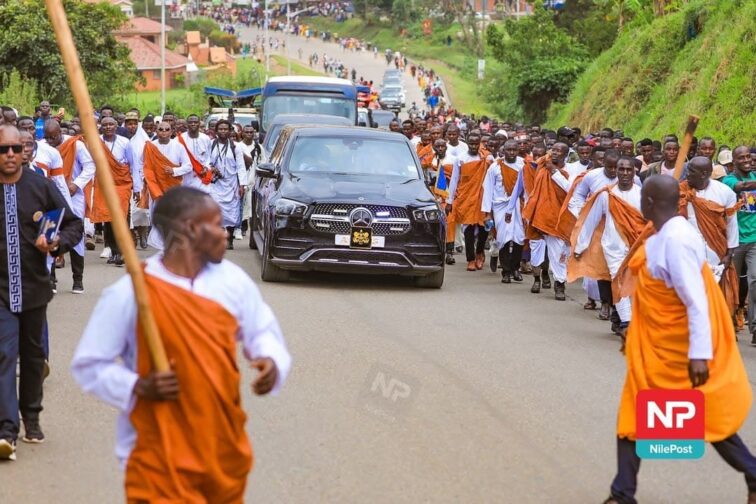
The procession heading to Karambi Royal Tombs.
NILE POST
Tooro’s King Oyo Nyimba Kabamba Iguru Rukidi IV has been laid to rest at the Karambi Royal Tombs in Fort Portal, bringing to an end a 31-year reign that began when he was just three years old.
The final chapter in the extraordinary life and reign of Tooro’s King Oyo Nyimba Kabamba Iguru Rukidi IV has been written, as the fallen monarch was laid to rest at the sacred Karambi Royal Tombs in Fort Portal on Saturday, September 12, 2026.
For the people of Tooro, the day carried a profound historical irony. September 12 was the very day King Oyo ascended the Tooro throne 31 years ago as a three-year-old boy. What was once a day of celebration and royal hope became a day of mourning as his subjects gathered to escort him to his final resting place.
King Oyo died at the age of 34 after battling cancer while receiving treatment in the United States. His death brought to an end a reign that began when he was barely old enough to understand the weight of the crown he inherited.
On Saturday, thousands of mourners, cultural leaders, government officials, members of the royal family and visitors gathered in Fort Portal to bid farewell to a king whose childhood coronation made him one of Uganda’s most recognizable traditional leaders.
The final funeral service was held at St John’s Cathedral in Fort Portal before mourners embarked on the solemn journey to Karambi, where Tooro kings have traditionally been laid to rest.
The procession from the cathedral to the royal tombs was not merely a funeral march. It was a symbolic farewell from the people who had watched Oyo grow from a young boy into a monarch who carried the name and identity of Tooro onto the international stage.
At Karambi, the atmosphere shifted from public mourning to sacred royal tradition.
The royal tombs, also known as Amagasani, hold deep historical and cultural significance for the Babiito royal clan. It is here that generations of Tooro kings rest, making King Oyo’s burial a return to his ancestors and the royal lineage from which he came.
His final rites were conducted under traditional protocols reserved for a Tooro king, combining cultural customs with the Christian funeral service that preceded the burial.
The burial also marked the formal end of Oyo’s reign, even as questions surrounding the future of the monarchy remained a subject of public discussion.
Oyo’s death has been followed by a dispute over succession, with members of his immediate family maintaining that the late king had identified a biological son as his heir, while the royal clan selected another member of the royal family to succeed him. The disagreement has added another layer of complexity to an already emotional period for the kingdom.
But on Saturday, the focus at Karambi was on the man whose reign had come to an end.
King Oyo’s story was unlike that of most monarchs.
Born into the Tooro royal family, he became Omukama following the death of his father, Patrick Olimi Kaboyo III, on August 26, 1995. On September 12, 1995, the three-year-old prince was enthroned, instantly attracting international attention as one of the world’s youngest reigning monarchs.
For many Ugandans, images of the tiny king surrounded by royal officials became a defining picture of a new generation of traditional leadership.
Yet behind the historic title was a child who had to grow into the responsibilities of a throne under intense public scrutiny.
Over the years, Oyo transitioned from the celebrated “boy king” into an adult monarch who represented Tooro at home and abroad.
His reign coincided with a period in which Uganda’s traditional institutions regained greater prominence in cultural preservation, tourism, youth empowerment and community development.
Although traditional kings in Uganda do not exercise constitutional political power, Oyo became an important cultural symbol for the people of Tooro and beyond.
His public profile also took him beyond Uganda, where he interacted with international leaders and personalities and became associated with causes including HIV/AIDS awareness and youth development.
As news of his death spread, tributes poured in from across Uganda and beyond. For the Batooro, however, the loss was deeply personal.
Oyo was not simply a king whose name appeared in history books. He was the monarch many of them had grown up knowing.
A generation of Batooro had known no other Omukama.
They saw him ascend the throne as a child, watched him grow into adulthood and followed his journey as he assumed the responsibilities of leadership.
His death therefore represented the loss of a familiar presence and the closing of an important chapter in Tooro’s modern history.
Queen Mother Best Kemigisa, who had remained closely associated with her son throughout his reign, expressed deep grief following his death, while members of the royal family called for respect for the mourning period as the kingdom prepared to give him a dignified farewell.
The nine-day period of mourning preceding the burial brought thousands of people to Karuziika Palace, where the king’s body lay in state and mourners came to pay their final respects.
The government also played a major role in the funeral arrangements, supporting the repatriation of the king’s remains and preparations for his official burial.
On Saturday morning, the final journey began.
The royal casket left Karuziika Palace and was taken to St John’s Cathedral for the final prayers before the procession continued towards Karambi.
As the funeral procession moved through Fort Portal, the grief of the kingdom was visible.
For some mourners, it was the last opportunity to see the king they had known for decades. For others, it was a moment to reflect on a remarkable reign that began with a child on the throne and ended with a young man being returned to the ancestors.
At Karambi, the public farewell gave way to the private and sacred rituals of royal burial.
The doors of the royal tombs closed on a king whose life had been intertwined with the history of modern Tooro.
King Oyo’s burial also closed a remarkable circle.
He was crowned on September 12, 1995.
He was laid to rest on September 12, 2026.
The same date that once announced the beginning of his reign has now marked its final chapter.
For the people of Tooro, September 12 will forever carry two memories: the day a three-year-old boy became their king, and the day, 31 years later, they returned him to his ancestors.
At Karambi, King Oyo now rests among the kings who came before him.
His story, however, remains part of the history of Tooro, Uganda and the wider world — a story of a child who inherited a crown, grew into a monarch, carried the hopes of a kingdom and finally made his last journey home.
Rest in peace, Omukama Oyo Nyimba Kabamba Iguru Rukidi IV.
Upcoming on 90.9 FM
Upcoming on 94.5 FM
Upcoming on 101.4 FM
Upcoming on 104.8 FM


Comments
This post currently has no comments.