
ZAWADI SHUTDOWN SPARKS DEBATE OVER GOVERNMENT SUPPORT FOR STRUGGLING BUSINESSES IN WEST NILE
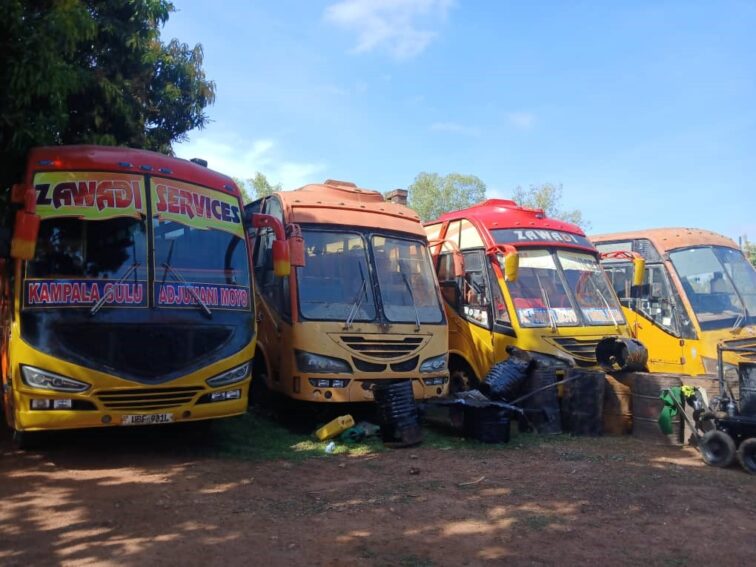
Zawadi Bus Services has parked buses at its parking yard in Adjumani Town council. Photo// Esther Gune
By Dramadri Federick
Arua city
The shutdown of Zawadi Bus Services, a major transport operator linking West Nile to Kampala and other parts of Uganda, has triggered calls for government intervention and renewed debate over how the state supports viable businesses facing financial distress.
Zawadi grounded its remaining fleet on Monday, September 14, 2026, following a directive from Stanbic Bank over an outstanding loan of Shs1.7 billion as stated by the company owners.
The closure has disrupted passenger and cargo transport, particularly along the Adjumani–Arua–Kampala corridor, with workers, travellers, traders and businesses that depend on the company now seeking alternatives.
For more than 17 years, the locally owned company has been a key transport link between West Nile and other parts of Uganda.
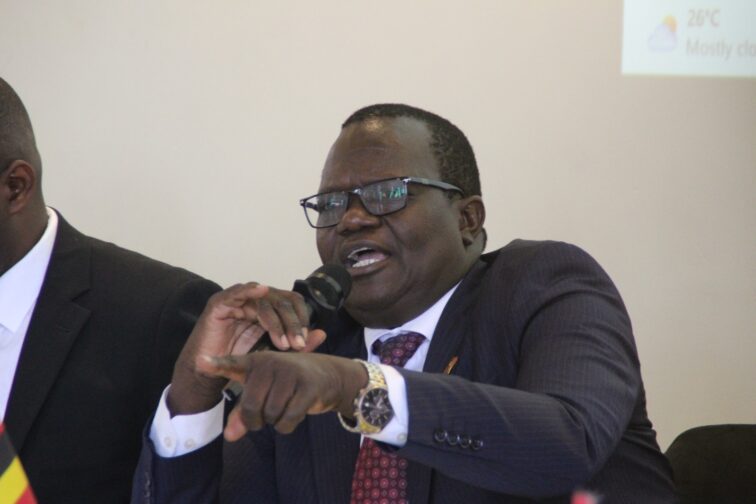
The Obongi Constituency Member of Parliament and the West Nile Parliamentary Caucus Chairperson Hassan Kaps Fungaroo is calling for government intervention to help the company overcome its financial difficulties.
Fungaroo says Zawadi is an important regional business that provides employment while facilitating the movement of people and goods.
He argues that government has previously intervened to support struggling companies, citing Roko Construction Company, and says viable businesses in West Nile should receive similar consideration.
“Where is the rescue for West Nile? Where is it? Many companies are closing here in West Nile, Zawadi bus is closing now now ,Califonia Bus is also going off, KKT bus closed and you find Gaagaa also closed, Why does the government give bailout packages to companies outside West Nile region, where is the fairness?” Fungaroo argued
Fungaroo says the collapse of Zawadi would have consequences beyond the company itself, affecting employees, passengers, suppliers and other businesses that depend on its operations.
He wants government to engage Zawadi’s creditors and relevant tax authorities to develop a sustainable recovery plan rather than allow the company to collapse.
The Zawadi Group says it employs 350 people, including 150 workers directly attached to the bus company.
COVID-19 and mounting debt
Zawadi management attributes much of its financial pressure to the COVID-19 lockdowns, when its fleet was grounded while interest on its bank loan continued to accumulate.
Managing Director Simon Amajuru and co-owner Emmanuel Amaza say the accumulated financial obligations eventually forced the company to comply with the bank’s directive.
According to the company’s financial account, Zawadi borrowed Shs2.857 billion in 2019 to purchase eight new buses.
The loan was scheduled for repayment over five years through monthly instalments of Shs83.216 million, with the total repayment, including interest and taxes, projected at Shs4.993 billion.
Zawadi says it had paid Shs5.742 billion by 2025 and had also sold seven buses in 2025 to raise additional funds to service the debt.
Despite these payments and asset sales, a disputed balance of Shs1.7 billion remains at the centre of the standoff with Stanbic Bank.
Zawadi management is appealing to President Yoweri Museveni for government intervention, including assistance in addressing the outstanding loan and related tax obligations, to enable the company to resume operations.
A history of government support
The calls for intervention come against a history of government assuming, supporting or writing off tax obligations involving private companies.
In 2017, Parliament scrutinised government payments to the Uganda Revenue Authority on behalf of private companies after the Ministry of Finance paid about Shs77.2 billion in the 2016/17 financial year for seven companies. Parliament’s Budget Committee questioned the legal basis and supporting agreements for some of the payments.
A broader assessment reported that between financial years 2009/10 and 2016/17, government paid about Shs198 billion in taxes in support of hotels, hospitals, textile companies, steel manufacturers, palm-oil businesses and tertiary institutions. A further Shs102.81 billion was reported in similar tax-support measures in 2017/18.
Then in May 2019, Parliament approved the writing off of nearly Shs500 billion in tax arrears involving at least 34 private companies and government agencies. The government argued that the arrears arose partly because it had committed to meet tax obligations on behalf of entities involved in strategic projects and counterpart-funding arrangements but had not budgeted or provided the money to settle those obligations.
Among the beneficiaries were Cipla Quality Chemicals, with about Shs57 billion; Oil Palm Uganda, Shs41.06 billion; another Oil Palm project, Shs134.7 billion; Southern Range Nyanza, Shs86.8 billion; Steel and Tube Industries, about Shs20 billion; Liao Shen Industrial Park, Shs26 billion; and Roko Construction, Shs10.8 billion.
Other beneficiaries included Arab Contractors, which received a Shs28.33 billion tax commitment linked to the Mulago Women Hospital project, and Dott Services, with Shs8.3 billion.
More recently, on September 8, 2026, Deputy Speaker of Parliament Thomas Tayebwa, representing President Museveni at the burial of former Bushenyi District Woman Member of Parliament Edna Kentaro Baryaruha, announced that government was set to write off more than Shs35 billion in tax arrears owed by tea factories as part of measures to revive Uganda’s struggling tea industry.
The repeated interventions raise questions about the criteria government uses when deciding which struggling businesses qualify for tax relief, debt restructuring or other forms of support.
They also raise a question for West Nile: can viable regional businesses facing exceptional financial shocks receive comparable consideration?
Civil society calls for deeper investigation

Feni Twaib, Chief Executive Officer of the West Nile Regional Civil Society Network challenge government to rescue businesses. Photo// Dramadri Federick
To shield businesses from financial collapse and loan defaults caused by COVID-19 lockdowns, the Government of Uganda implemented a series of monetary and fiscal interventions. Backed by funding from the World Bank and the International Monetary Fund (IMF), these strategies targeted liquidity constraints, debt relief, and capital optimization.
However Feni Twaib, Chief Executive Officer of the West Nile Regional Civil Society Network, observes that there’s either uneven distribution of these opportunities to the targeted business enterprises or bureaucracies involved affecting accessibility of the funds. He says government should investigate why locally initiated transport businesses in the region struggle to expand and, in some cases, eventually collapse.
Twaib says the decline of local businesses do not only affect the investors but also threatens employment, investment and the wider regional economy.
“Deeper analysis must be done to establish why these businesses are failing and what better intervention can be done by government” Feni stated
He says government should look beyond individual companies and address structural challenges affecting businesses in West Nile, including access to finance, taxation, and infrastructure and market opportunities.
Government response

Moses Ssonko, Principal Economist at the Ministry of Finance, Planning and Economic Development speak shortly after a budget conference in Arua. Photo//Dramadri Federick.
During the COVID-19 recovery period, government established the Shs200 billion Small Business Recovery Fund to provide affordable financing to businesses affected by the pandemic. Government later acknowledged that uptake of the fund was low.
Government also introduced tax-relief measures, including waiving interest and penalties on certain tax arrears and allowing businesses more time to meet tax obligations. In the 2020/21 financial year, tax exemptions increased by Shs1.371 trillion, while tax deductions and allowances increased by Shs1.592 trillion.
However, questions remain about whether such interventions have adequately reached viable businesses outside Uganda’s major economic centres.
Moses Ssonko, Principal Economist at the Ministry of Finance, Planning and Economic Development, says government is seeking to establish the circumstances surrounding the closure of Zawadi Bus Services.
“We had asked banks to restructure the loans aware of the fact that these businesses were struggling out of the Covid-19 lockdowns but also we should also be mindful that the road infrasture in the region is bad and other reasons that we are yet to establish” Ssonko noted
The suspension has left passengers and cargo operators looking for alternative transport, while dozens of employees face uncertainty over their jobs and incomes.
For West Nile leaders and civil society actors, the Zawadi case has therefore become part of a larger debate about government support for regional businesses.
The immediate question is whether government, Zawadi’s creditors and tax authorities can negotiate a sustainable recovery arrangement that protects jobs and restores an important transport link without creating an open-ended burden on taxpayers.
The wider question is whether viable businesses in West Nile receive the same opportunity for government intervention and recovery support that has previously been extended to strategically important companies elsewhere in Uganda.
Upcoming on 90.9 FM
Upcoming on 94.5 FM
Upcoming on 101.4 FM
Upcoming on 104.8 FM






Comments
This post currently has no comments.