
HEALTH MINISTRY PLANS VALIDATION OF ALL HEALTH WORKERS TO WEED OUT QUACKS
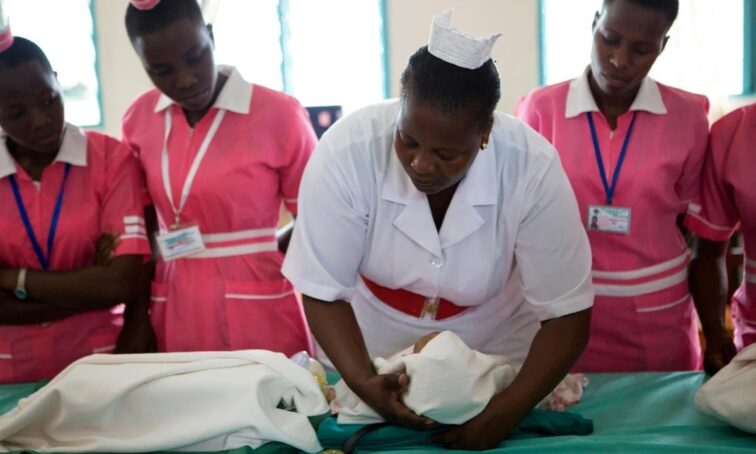
Nurses attending to a baby.
NILE POST
The Ministry of Health is preparing reforms to verify and validate health workers across Uganda in a bid to eliminate unqualified practitioners from public and private health facilities while improving accountability and quality of care.
The Ministry of Health says it is preparing reforms to verify and validate health workers across Uganda as part of efforts to eliminate unqualified practitioners from both public and private health facilities.
Director General of Health Services Charles Olaro says the reforms will require health workers to clearly identify themselves by name and professional title, rather than relying solely on white coats or titles such as doctor or professor.
“We are working to see how we are going to do validation of all the health workers in this country,” Olaro said.
He acknowledged that quack health workers remain a concern in the health system and said the planned verification will cover both public and private health facilities.
Olaro said the reforms are intended to make it easier for patients to know who is providing their care and what qualifications that person holds.
The Ministry is also considering changes to the practice of patients moving around with intravenous cannulas to receive treatment at different facilities.
Olaro warned that the practice exposes patients to infection risks and said patients requiring intravenous therapy should ideally be admitted and treated within a health facility.
He also called for a shift from a health system that largely focuses on treating illness to one that promotes prevention and routine screening.
Olaro said many Ugandans only seek medical attention after becoming sick rather than routinely checking their health. “We have not developed the aspect of wellness as key. We have looked at the aspect of curative,” he said.
He encouraged the public to embrace regular health checks and self-care practices, including monitoring blood pressure and blood sugar where appropriate.
Olaro also highlighted emerging approaches such as HIV self-sampling and self-sampling for some cancer screening services, which he said could make preventive services more accessible.
The Ministry is also looking at digitalization of the health system to improve accountability and monitor prescribing practices.
Olaro said a fully digital health system would enable authorities to identify inappropriate prescribing, including polypharmacy, and assess prescription patterns across the health sector. “We can be able to tell who those who are doing polypharmacy are,” he said.
He added that digital systems could also support adherence to prescribing guidance, including the use of antimicrobial susceptibility information when selecting medicines.
According to Olaro, digitalization will therefore be used not only for accountability and performance monitoring but also to improve the quality of care and prescribing practices.
Upcoming on 90.9 FM
Upcoming on 94.5 FM
Upcoming on 101.4 FM
Upcoming on 104.8 FM









Comments
This post currently has no comments.