
FEATURE: GULU’S YOUNG CLIMATE CHAMPIONS TAKING ACTION
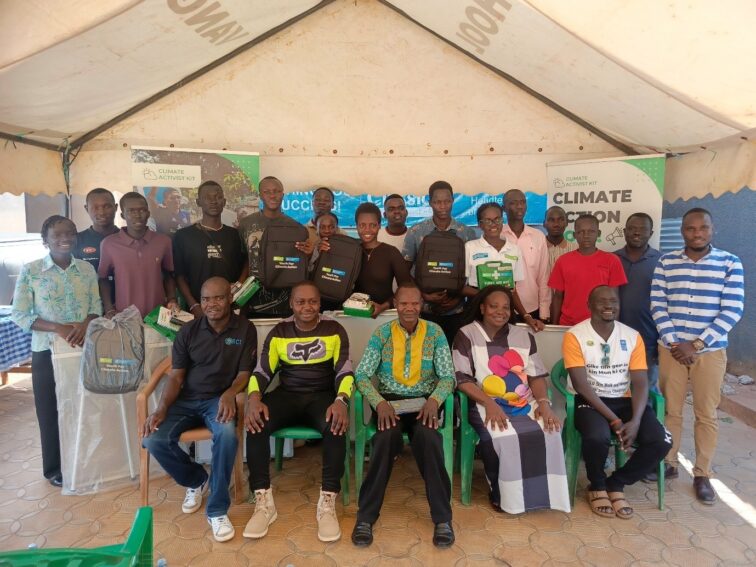
Young Climate Activists pose for a group photo during a stakeholders’ engagement organized by SOS Children’s Villages Uganda at Vanguard Primary School.
By Proscovia Achomo
Gulu City
In Gulu City, a growing group of young people is refusing to leave environmental protection to the next generation. They are turning concern about plastic waste, environmental degradation and climate change into action—recycling, cleaning their communities, raising awareness and creating opportunities for themselves and others.
They are students, but they are also recyclers, environmental educators, community mobilisers and advocates. In their schools and communities, they are collecting plastic waste, making useful products, organising clean-up activities and encouraging others to think differently about how they treat their surroundings.
Among them is Denis Leviticus Ogenrwot, a student at Bishop Angelo Negri College, whose concern about the environment grew from repeatedly seeing plastics thrown carelessly and people seemingly unconcerned about the waste around them. He says he often felt bad whenever he saw such behaviour. Denis had always been passionate about environmental conservation, but he did not know where to begin. “I have been passionate about the environment but I had nowhere to start from,” Denis says.
His starting point came through environmental workshops supported by SOS Children’s Villages Uganda under the Eco Champions Project. The training gave Denis and other young people the knowledge and confidence to turn their concerns into practical action.
Today, Denis and the young people he works with collect plastics and polythene bags and transform some of the waste into useful products, including shopping bags. The work has also created an opportunity for Denis to earn an income from products made out of plastic waste and polythene.
But for Denis, recycling is only part of the solution. He and the young people he works with also go into communities to sensitise people about the dangers of careless waste disposal. They use online platforms to share environmental messages and encourage other young people to become part of the solution. “After making the product, we normally go out and sensitise people about the dangers of disposing rubbish anyhow, like plastics,” he says.
His advocacy has also taken him to the airwaves. Denis was hosted on Radio Pacis to speak about his project and create awareness about environmental conservation, giving him an opportunity to explain his work and reach a wider audience with his message.
For a young person who once felt he had nowhere to start, Denis is now using recycling, community sensitization, online platforms and radio to make his voice heard.
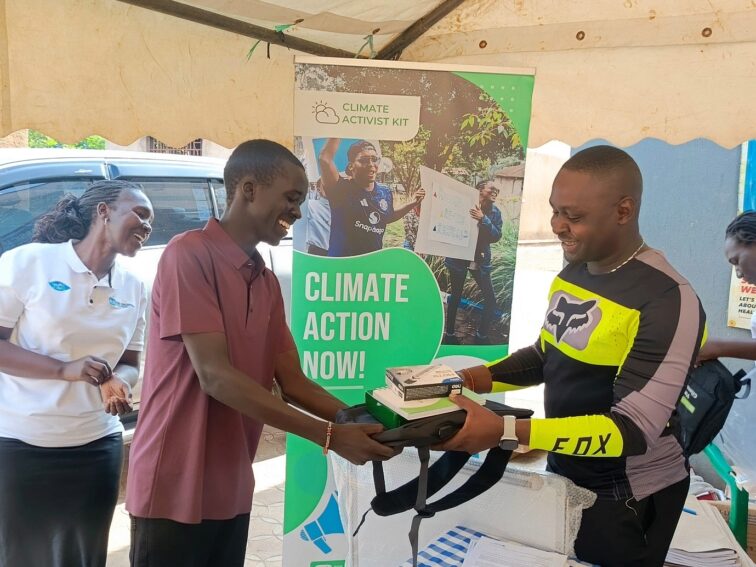
Denis, wearing a maroon shirt, joyfully receives a climate action kit to support his work as a climate activist.
At Sacred Heart Senior Secondary School Gulu, Monalisa Angel Lawino is also turning her concern for the environment into action.
Her interest was strengthened after she witnessed people throwing plastic bottles from a bus while travelling. The behaviour disturbed her, particularly because she had also noticed similar practices at school, where some students would throw rubbish carelessly even when dustbins were available.
Rather than simply complain about it, Monalisa decided to act.
In 2023, she founded the GAIA Guardians Environmental Club, with the aim of promoting proper waste disposal and environmental conservation. Since then, the club has organised road clean-ups, sensitisation activities in markets, dustbin-making activities and regular cleaning of the school compound.
“We have done a number of activities like sweeping the roads, awareness in the markets among others,” Monalisa says. “We were given some money to support us in awareness and making dustbins.”
During weekends, students clean the school compound, while environmental messages are sometimes shared during school assemblies. Monalisa says she has seen changes since the club began, and the school has continued to support her initiative.
Her environmental work has also contributed to an opportunity in her own education. Monalisa is studying under a bursary associated with her environmental initiative, allowing her to continue her studies while pursuing the work she started.
For Denis and Monalisa, environmental conservation is not simply something discussed in the classroom. It has become part of their everyday lives and a responsibility they are encouraging others to embrace.
Their work is taking place against a much larger environmental challenge.
Uganda continues to face significant environmental pressures, including deforestation, habitat loss, land degradation, pollution and depletion of natural resources. Climate change is adding to these pressures, with changing weather patterns, floods and prolonged dry spells affecting communities and livelihoods, particularly those that depend on agriculture.
Waste management remains another major concern. Uganda generates about 1.2 million tonnes of solid waste annually, yet less than half is collected and properly disposed of. Kampala alone generates more than 2,000 tonnes of waste every day.
Plastic waste presents an additional challenge. More than 135,000 tonnes of plastic waste have been generated in the Kampala Metropolitan Area, with about 42 percent left uncollected. Some of this uncollected waste ends up in water systems, creating further environmental concerns.
Recent 2026 reporting estimates that Gulu city generates between 120 and 137 tonnes of solid waste every day, with only about half of this waste being collected. The challenge is also reflected in official statistics: the Uganda Bureau of Statistics’ 2025 Specialised Municipal Solid Waste Survey estimated Gulu’s waste generation at 243.3 tonnes per day, while only 31.3 tonnes per day were recorded as collected.
These figures illustrate the scale of the waste challenge facing Uganda’s growing urban areas. They also help explain why the actions of young people such as Denis and Monalisa matter at community level.
Environmental conservation is not only about planting trees. It is also about changing everyday behaviour—how people dispose of waste, how plastics are used, how trees and wetlands are protected and how communities respond to environmental challenges.
For Beatrice Akello, Coordinator of the Climate Action Project at SOS Children’s Villages Uganda, young people must be part of that response.
She says the Eco Champions Project was established to support youth participation in climate action because children and young people can be particularly affected by climate change due to their limited adaptive capacity and dependence on adults during climate-related crises.
“The focus of the Eco Champions Project has been to support youth participation in climate action because we believe they are the future generation,” Akello says.
The project seeks to amplify the voices of children and young people and support innovative ideas aimed at addressing environmental and climate challenges. The first phase ended in 2025, while the second phase is supporting eight young people from across Uganda to develop and implement their climate action initiatives, with four based in Gulu City.
To help turn ideas into practical action, SOS Children’s Villages Uganda has introduced the Climate Activists Kits, providing young environmentalists with materials including bags, tablets, flip charts, markers, first-aid kits, notebooks and other resources. The initiative also provides financial support to help young people implement environmental activities in their schools and communities.
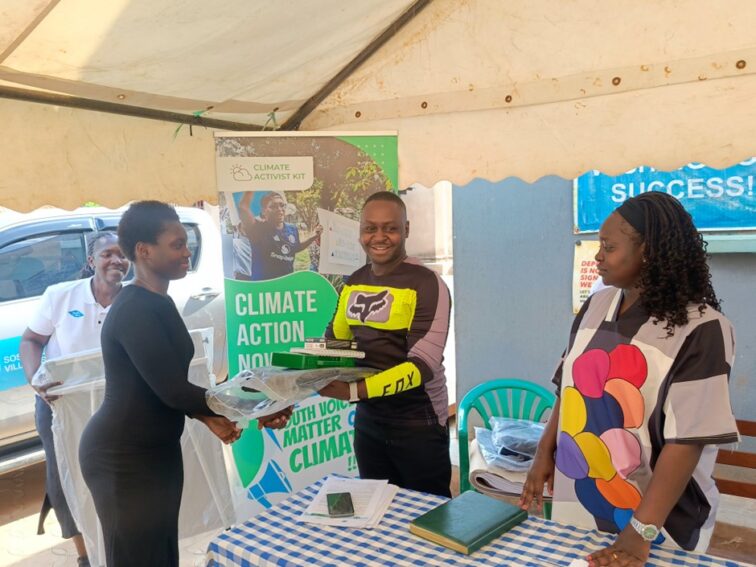
Monalisa in a black dress receives a Climate Activists Kits with support from SOS Children’s Villages Uganda, presented by Gulu City Principal Environment Officer, Michael Christopher Ocan.
At Bishop Angelo Negri College, Director of Studies Moses Ocitti thanked SOS Children’s Villages Uganda for supporting young people and called for the initiative to reach more students and schools.
Ocitti says he has supported students during environmental activities, including an exercise in which they collected plastic waste in the For God area. He believes schools have an important role to play in encouraging young environmental leaders and giving them the space to put their ideas into practice.
Community leaders are also recognising the importance of youth participation. Sam Kilama, LCI of Kanyagoga A Cell, pledged to support young people whenever they carry out environmental activities in his area.
For Gulu City authorities, the contribution of young environmentalists is also becoming increasingly visible.
Michael Christopher Ocan, Principal Environment Officer for Gulu City, commended the young people for their contribution to keeping the city clean and said the city plans to work more closely with them.
Ocan said the city is developing its environmental and climate action work plans and plans to establish a recognition mechanism for young people who are making a contribution to environmental conservation. He said recognising their efforts would encourage more young people to participate in environmental activities and strengthen collaboration between the city and youth-led initiatives.
The young environmentalists are also contributing to a wider environmental effort that has earned Gulu City national recognition.
In 2024, Gulu City was among the local authorities recognised during the inaugural National Environment Sustainability Awards organised by the National Environment Management Authority.
Two years later, the city’s environmental efforts received further recognition. At the 2026 National Environment Sustainability Awards held in Kampala, Gulu City was named first runner-up in the Urban Authorities category, behind Kampala Capital City Authority.
NEMA cited several initiatives in its assessment of Gulu City, including its partnership to address wetland degradation around the Oyitino Valley Dam, tree-planting campaigns, the “Keep Gulu City Clean” movements that have involved volunteers and young people in clearing urban garbage and drainage channels, and the establishment of a “Road Gang” system for continuous sanitation work.
For the young environmentalists in Gulu, such recognition adds visibility to the work they are already doing in schools and communities. Their clean-ups, recycling activities and awareness campaigns form part of a broader effort to make the city cleaner and more environmentally responsible.
Ocan says the city wants young people to remain part of that effort and believes closer collaboration can help strengthen climate action and environmental conservation in Gulu.
But for Denis and Monalisa, environmental conservation is not about awards or recognition. It is about what they see around them every day—the plastic bottle thrown on the roadside, the rubbish discarded where a dustbin should be used and the waste that could be recycled but is instead left to pollute the environment.
They have chosen to do something about it.
Denis is turning plastic waste into useful products while earning an income and using community sensitisation, online platforms and radio to spread his message. Monalisa is mobilising students through the GAIA Guardians Environmental Club, organising clean-ups and awareness activities while receiving support that has also contributed to her educational journey.
Their actions will not solve Uganda’s environmental challenges on their own. But their stories demonstrate what can happen when young people are given knowledge, resources, support and the opportunity to lead.
Sometimes climate action begins with something simple: refusing to litter, collecting a plastic bottle, cleaning a school compound, planting a tree or explaining to another person why responsible waste disposal matters.
For Denis, it began with feeling troubled by the sight of plastic waste being thrown carelessly.
For Monalisa, it began with seeing people throw bottles from a bus and noticing similar behaviour at school.
Both chose to step forward.
They are not waiting for the future to arrive before they act. They are already working to shape the environment they will inherit.
Upcoming on 90.9 FM
Upcoming on 94.5 FM
Upcoming on 101.4 FM
Upcoming on 104.8 FM















Comments
This post currently has no comments.