
GOVT PLANS TO TARMAC ROADS CONNECTING RELIGIOUS, OTHER INSTITUTIONS IN YUMBE
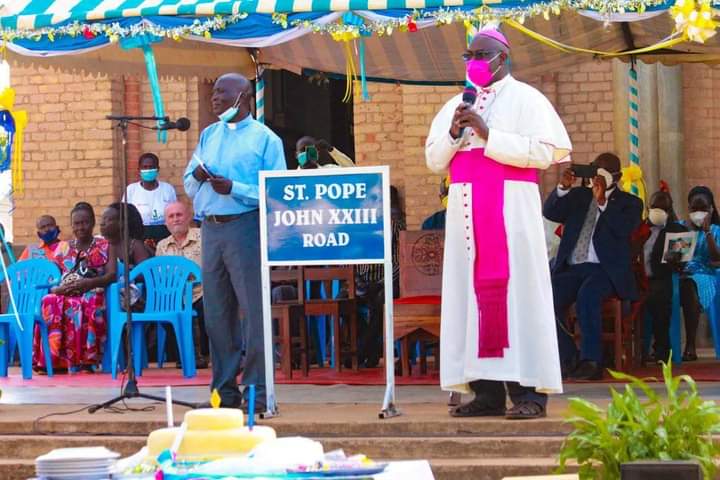
The Bishop of Arua Diocese Rt Rev Sabino Ocan Odoki (right) and Rev Fr Emmanuel Asega (left) the former Priest of Lodonga minor Basilica unveiling the name of one of the roads leading to the Basilica to the pilgrims in the recent function. PHOTO/ROBERT ELEMA
By Robert Elema
Yumbe
Every week, worshippers in Lodonga Town Council, Yumbe District, make their way to churches and mosques along roads that have long tested their patience.
For some, the journey is routine. For others, particularly the elderly, children and people travelling from distant villages, reaching their destination can be an exhausting experience.
Dust rises behind motorcycles during the dry season, while rain can turn sections of the roads into muddy stretches.
But residents now hope that this experience will soon change.
The Minister of Works and Transport Fred Byamukama in his recent tour to the West Nile region pledged to tarmac roads serving Lodonga Minor Basilica, Mosques and other key institutions, raising expectations among residents who have waited for better connectivity.
He said the government would tarmac 6km road in Lodonga Town council following a request by the state minister for ICT Mr Yorke Alioni Odria.
Residents and other local leaders urged the minister to ensure the pledge is fulfilled.
More than a road
For the people of Lodonga, the proposed road is not merely about easier driving/riding. It is about access.
But the impact would extend beyond religion. Schools, health facilities, businesses and households located along the roads could all benefit from improved connectivity.
Ms Christine Ayikoru, a Christian who prays at the Basilica says, a good road would allow them to reach the Basilica more easily for worship and major religious celebrations.
“We have been facing a lot of challenges due to the poor road network. We sometimes reach the church very dirty due to dust and muddy conditions of the road,” she said.
She said, the bad condition of the road sometimes makes them reach late for prayers.
A shared benefit
The proposed road improvements could therefore become a shared benefit for both Christian and Muslim communities.
During major religious events, visitors often travel from different parts of Yumbe and neighboring districts.
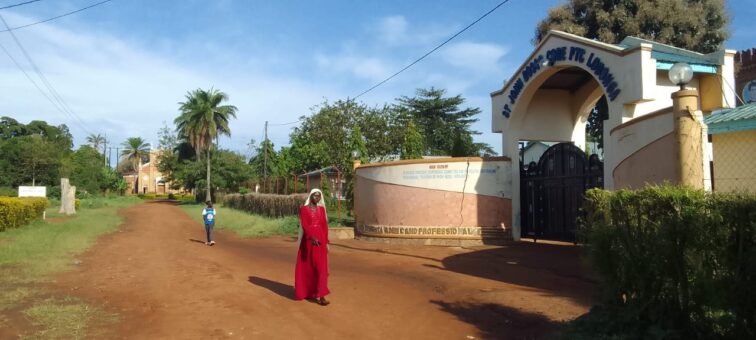
Residents walk past the road connecting to Lodonga Minor Basilica on Tuesday. PHOTO/ROBERT ELEMA
Rev Fr Constantine Avaga the Parish Priest of Lodonga Minor Basilica said, the community of the area named the two roads connecting the Basilica as St Pope John XXIII Road and Fr Sartori Benardo Road.
He said the roads were named after the two religious leaders because they did tremendous work in the history of the Basilica.
“These roads are named after these people so as to remember them because of their contribution to the development of the Basilica. For example, St Pope John XXIII was the one who wrote a letter to declare Lodonga as a Basilica in 1961 and Fr Sartori Benardo built the Basilica,” he said.
Rev Fr Avaga said, the program of tarmacking the two roads was discussed a long time ago but they are waiting for the contractors to begin the work because inspection was already done.
“We receive a big number of pilgrims every year on December 8. That means improving the road network will make it easier for pilgrims to access the Basilica because during the rainy season, the marram roads leading to the Basilica become slippery and narrow,” he said.
Equally, Sheikh Swaib Alahai Aciga, the Yumbe District Khadi congratulates the Works and transport minister for his commitment in improving the roads connecting the religious institutions in Lodonga Town council.
“The roads that connect the religious institutions are rough. If these roads are tarmacked it would be easy to access such religious institutions because we receive visitors in such institutions frequently,” he said.
He said, a road that is too dusty and muddy gives them shame when they receive visitors in such places.
Mr Abdulmutalib Asiku the Yumbe District chairperson said: “We are grateful for this initiative and…We want to commit that we are going to do mobilization of our people under different government programmes so that they are transformed economically.”
Mr Byamukama said as the government is committed to improving the roads, the community should ensure that they go to the gardens to keep goats, grow coffee and fruits so that they can use the roads to transport the agricultural products to the markets.
“We no longer want poverty in your homes, and that’s why we are making these roads to transport your agricultural products into the markets,” he said.
However, roads alone will not automatically transform the economy of the people. There is a need for reliable electricity, water, telecommunications, financial services, skills training and effective local government services to implement the infrastructure. Authorities will also have to ensure roads are properly maintained after construction.
Upcoming on 90.9 FM
Upcoming on 94.5 FM
Upcoming on 101.4 FM
Upcoming on 104.8 FM





Comments
This post currently has no comments.