
GULU EDUCATION STAKEHOLDERS WARN THAT SCHOOLS MAY STRUGGLE WITHOUT PARENTAL SUPPORT FOLLOWING BALAAM’S PTA CRACKDOWN
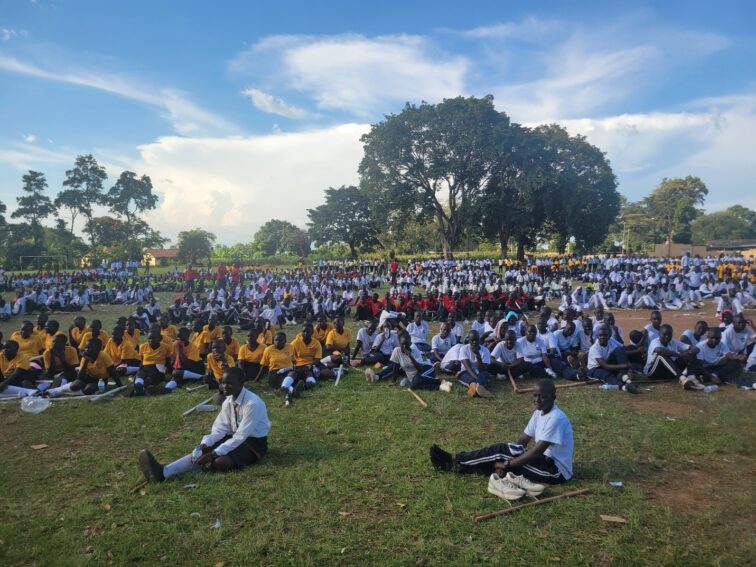
Students from 22 schools in Gulu city during the pass out of patriots
By Biko Rombe
Gulu City
The growing national dispute over parental contributions in government-aided schools has reached Gulu, with education and local government leaders warning that a strict ban on parental contributions could leave some schools struggling to meet basic operational needs.
The debate comes amid a nationwide campaign by Minister for Local Government Balaam Barugahara, who has been inspecting government-aided schools and challenging schools that impose fees and other charges on learners under the Universal Primary Education (UPE) and Universal Secondary Education (USE) programmes.
In recent months, Barugahara has ordered investigations and halted disputed charges at several government-aided schools.
At Bududa Secondary School, for example, the minister intervened after allegations that learners were being charged up to Shs150,000 despite the school being government-aided. The Ministry of Local Government said the school’s head teacher reported that parents had agreed to contribute Shs50,000 each towards a stalled school project.
At Nkoma Secondary School in Mbale City, parents complained about fees ranging from Shs100,000 to Shs190,000. Barugahara directed the school to halt the disputed collections while the matter was addressed.
At Kololo Public Secondary School in Maracha, the minister’s inspection resulted in the arrest of the head teacher and School Management Committee chairperson over alleged irregular collection of Shs80,000 from students, reportedly intended to pay teachers who were not on the government payroll.
The crackdown has now generated a wider debate over the difference between illegal compulsory fees and the voluntary or agreed contributions that schools have historically depended on to supplement government funding.
Educationists have warned that restricting PTA contributions without addressing schools’ unfunded needs could worsen teacher shortages and other operational problems. Recent reporting by Daily Monitor quoted education stakeholders warning that some public schools use PTA funds to hire additional teachers and meet other costs not covered by government.
That national debate was reflected strongly at the Gulu City Secondary Schools’ Joint Patriotism Pass Out 2026 held at Gulu High School on the 7th October 2026.
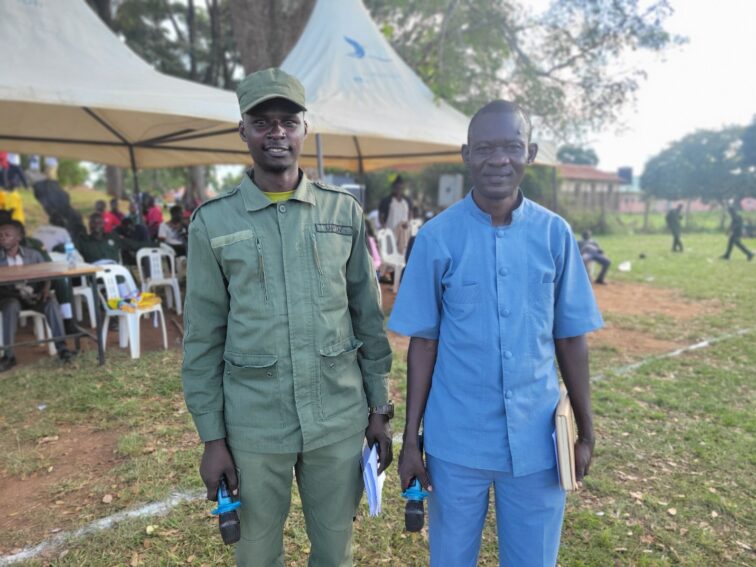
Ochaya Anthony patriotism coordinator (in blue clothe) and Akena Amos one of the instructors during the pass out of 6057 patriots in Gulu city
Ochaya Anthony, Patriotism Coordinator for the Acholi Sub-region and Gulu City, told the gathering that schools in northern Uganda are already experiencing serious challenges because of reduced parental support.
Anthony said his visits to schools had shown him the practical consequences.
He cited Pawel Lalem Primary School in Amuru District, where he said the school had an enrolment of 1,060 pupils but only 11 teachers
He said one teacher had died, reducing the number further, and that after accounting for administrative responsibilities, the number of teachers available for direct teaching was even smaller.
Anthony said the situation demonstrated the strain schools face when they lack additional support.
He also cited Lukome Secondary School in Gulu District, a day school that had established a hostel for learners coming from distant areas.
According to Anthony, the hostel was closed after parental contributions stopped, forcing girls and boys who had been staying there to find accommodation in nearby villages.
He said teachers had also previously been provided with lunch through parental contributions, but the arrangement was affected.
Anthony warned that government cannot meet every education cost without limitations.
“There is no any government in the country that can meet the cost of education 100% perfectly without any limitation,” he said.
He said this is particularly serious in northern Uganda, where the education system is still recovering from the effects of the more than two decades of LRA conflict.
“For us who do not have education throughout the 20 years of LRA wars, education in northern Uganda is still waking up,” Anthony said.
He called on Gulu City leaders to take a position on the issue and consider the impact of the restrictions on parents’ contributions.
The concerns were echoed by Lambert Alex Akena, Speaker of Gulu City Council.
Akena told the students to communicate the message to their parents and support schools where contributions are needed.
“Please go back home, tell your parents to make those contributions,” he said.
He said the city council would discuss the matter and make its position known.
Akena argued that schools need resources to feed learners, support teachers, provide security and undertake other essential activities.
“In schools, we need to eat. If the teachers cannot eat, the gate men are not there, security people are not there, other developments cannot be done,” he said.
He also referred to the Education Act and argued that parents have a role alongside teachers in supporting education.
“We are going to pronounce ourselves on the contributions from parents. We do not want education killed,” he said.
But Angela Ngoma Okwir, Secretary for Education, Health, Gender and Social Services of Bar-dege-Layibi City Division, approached the issue from another angle.
She argued that parents cannot completely transfer responsibility for their children to government.
Okwir said patriotism must begin with parents taking responsibility for raising, guiding and investing in their children.
“You cannot produce a child and you just leave it for the government to do whatever they want to do with your child,” she said.
She said parents have to invest in their children if they want them to have a brighter future after education.
The national policy debate, however, is not simply about whether parents should contribute. Government’s position is that schools should not impose illegal compulsory charges on learners under UPE and USE.
The State House Education Desk recently warned government-supported schools against imposing illegal charges, including fees disguised as development, examination and other compulsory payments. The Education Desk said government supports UPE and USE schools through infrastructure, teacher recruitment, teaching materials and other interventions.
The Ministry of Education has also backed the crackdown. Education officials have said Balaam did not break the law by directing action against head teachers accused of collecting fees from learners under UPE and USE.
The issue has become contentious because schools say government allocations do not always cover all their actual costs.
Recent reporting has shown that government-aided schools are struggling with expenses including teachers who are not on the government payroll, infrastructure maintenance, utilities, learning materials and feeding.
The policy has also triggered resistance from some parents and schools.
At Dr Obote College in Lira City, parents recently rejected a proposal to stop paying school fees, arguing that a large proportion of the school’s operational resources comes from parents and that removing the contributions could affect the quality of education.
A similar dispute emerged in Kaliro, where parents, school administrators and religious leaders questioned how schools would meet costs not covered by government if additional parental contributions were prohibited.
The national debate has therefore exposed a difficult gap between the principle of free universal education and the practical costs faced by schools.
A 2023 National Planning Authority report on education policy noted that the abolition of PTA charges under UPE increased access to schooling but also created challenges for schools that had previously relied on PTA resources for infrastructure, additional teachers and other costs. The report also noted that some parents misunderstood the abolition of PTA charges as meaning they had no further role in supporting their children’s education.
For Gulu’s education stakeholders, that tension is now particularly important.
Anthony says schools in northern Uganda cannot afford another disruption to a sector still recovering from years of conflict.
Akena says parents have a role in keeping schools operational.
Okwir says parents have a responsibility to invest in their children’s future.
And the government position, represented by Balaam’s nationwide inspections and the State House Education Desk, is that children enrolled under UPE and USE should not be subjected to illegal compulsory charges or sent home because their parents cannot pay.
The challenge for Gulu, and Uganda more broadly, is how to protect the principle of universal access to education while ensuring schools have enough resources to function effectively.
Upcoming on 90.9 FM
Upcoming on 94.5 FM
Upcoming on 101.4 FM
Upcoming on 104.8 FM



Comments
This post currently has no comments.