
TAX APPEALS TRIBUNAL IN ARUA RECORDS ONLY THREE CASES IN 13 YEARS

The new members of the Tax Appeals Tribunal (TAT) Arua registry court user committee pose for a photo moment during a meeting on Tuesday- Photo by Morish Dramadri
The Tax Appeals Tribunal in Arua has struggled to achieve its intended purpose of addressing taxpayers’ grievances in the West Nile sub-region, largely due to low uptake of its services, with only three complaints registered in the region over the past 13 years.
Established under the Tax Appeals Tribunals Act to fulfil Article 152(3) of the 1995 Constitution, the tribunal’s regional registry in Arua was opened in 2013 to decentralize services and provide an independent, impartial and specialized quasi-judicial forum for resolving tax disputes between taxpayers and the Uganda Revenue Authority (URA). However, more than a decade later, the tribunal is yet to realize its full potential in the region.
Moses Abiku, the officer in charge of the Tax Appeals Tribunal’s Arua registry, revealed this while addressing the Court Users Committee on Tuesday, October 27, 2026, noting that the region continues to register low engagement with the tribunal.
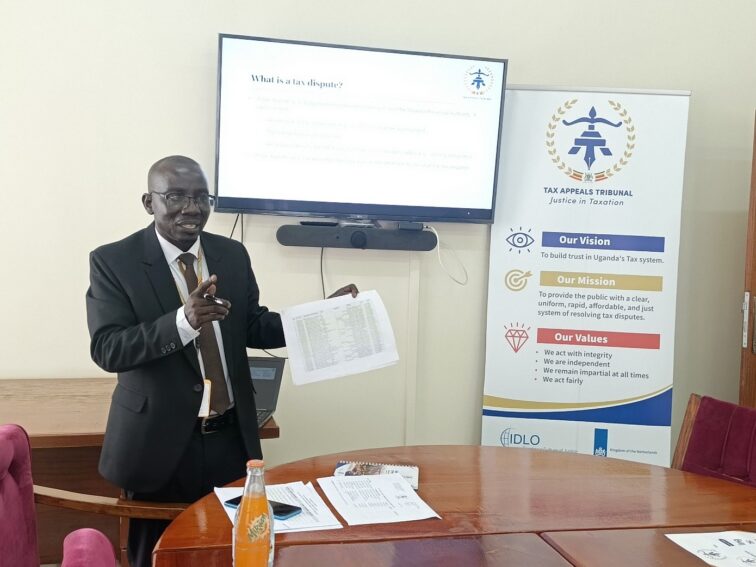
Counsel Moses Abiku, the officer in charge of the Tax Appeals Tribunal’s Arua registry pointing the status quo of the regions uptake of TAT service – Photo by Morish Dramadri
“Since this office was opened in 2013, more than 12 years ago, we have only received three cases, and they were all decided in favour of the taxpayers. The cases we have listed for rulings in October and November are all from outside West Nile. Are we saying our businessmen are doing well with taxes? Are we saying URA is doing the right work?” Abiku asked.
The Tax Appeals Tribunal is currently handling 463 pending tax dispute cases nationally following the close of the 2025/2026 financial year, with no cases reported from the West Nile sub-region.
Eseza Alupo, a tax agent with Aluris Tax Trade Limited, attributes the tribunal’s low uptake in the region to limited awareness among taxpayers about their rights and reluctance to challenge the Uganda Revenue Authority. She says the situation is partly driven by fear and the perception that the authority is difficult to confront.
“We have all seen URA closing people’s shops. They just wake up one day and close them. We have normalized things, but they are not normal. Why would you close someone’s business that has operated for three years because of three million shillings? The Tax Appeals Tribunal itself, we need to see you out there because there is a lot of ignorance among taxpayers,” Alupo said.
Meanwhile, Silas Anguzu, the chairperson of the Uganda National Chamber of Commerce and Industry, Arua branch, attributes the limited use of the tribunal to the largely informal nature of businesses in the region. He is urging the business community to formalize their operations and take advantage of available legal mechanisms to resolve tax disputes.

Silas Anguzu, the chairperson of the Uganda National Chamber of Commerce and Industry, Arua branch stressing the value of business formalization during the court user committee meeting – Photo by Morish Dramadri
“We are still perturbed by the informal nature of the business community here in West Nile. If our aspirations are to grow, then we have to change that. We are not here to tell people not to pay taxes, but to advocate for fairness,” Anguzu said.
Over the years, traders and business owners in Greater Nebbi and Arua have frequently raised concerns about high presumptive taxes and what they describe as forced or inflated tax assessments by the URA. However, despite these persistent complaints, few have pursued formal channels to challenge the assessments and seek redress.
The low number of cases filed before the tribunal raises questions about taxpayers’ awareness of available dispute-resolution mechanisms, their confidence in the system and the accessibility of legal remedies for businesses in the West Nile sub-region.
Upcoming on 90.9 FM
Upcoming on 94.5 FM
Upcoming on 101.4 FM
Upcoming on 104.8 FM









Comments
This post currently has no comments.