
CLERGY, STAKEHOLDERS RAISE ALARM OVER FOOD INSECURITY IN WEST NILE

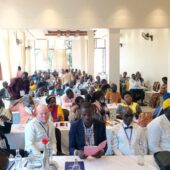
The Clergy during a prayer service inside Ediofe Cathedral church. Photo Credit// Arua Diocese
By Martin Anguyo
Arua City
The Clergy in Arua Diocese have joined other stakeholders in re-echoing the need for people in the West Nile sub-region to embrace a culture of food security, warning that growing dependence on food purchases, limited household agricultural production and poor farming practices could leave families vulnerable to hunger and malnutrition.
The leaders say food security should go beyond having money to purchase meals, emphasizing that households must develop a culture of growing their own food, preserving harvests and making proper use of available agricultural resources to sustain themselves throughout the year.
Rev. Fr. Alex Andrua, the curate of Ediofe Parish, says families should not entirely depend on markets for their daily food requirements, arguing that household food production is one of the practical ways of reducing the burden of feeding families, particularly during periods of economic hardship.
He notes that even households with relatively small pieces of land can participate in food production by growing crops that can sustain their families, adding that farming should be considered an essential household responsibility rather than an activity reserved for commercial farmers.
“People should not wait until they have money to go to the market to buy food. Every household should have something growing in the garden, even if it is just a small portion of land. When you grow your own food, you reduce the cost of feeding your family and avoid unnecessary dependence on the market,” Fr. Andrua says.
Equally, Rev. Fr. Richard Eneku, the rector of Pokea Seminary, urges people in the region to take agricultural production seriously, saying communities must appreciate the relationship between hard work, food availability and household welfare.
Fr. Eneku observes that the tendency to neglect farming while depending on purchased food could expose families to unnecessary difficulties, particularly when food prices rise or household incomes become unstable. He therefore calls for a change in attitude towards agriculture, encouraging communities to utilize available land and other resources productively.
“God has given us land and the ability to work, but we cannot continue leaving our gardens idle and expect to have food throughout the year. We must change our attitude towards farming and appreciate that food security begins with individual households,” Fr. Eneku says.
Gloria Amviko, a farmer in Arua District, says embracing farming and diversifying food production can help households become more self-reliant. She explains that growing different food crops not only ensures food availability but also reduces the amount of money families spend on purchasing food, leaving them with resources to address other household needs.
“When a family grows different crops, it is easier to have something to eat even when one particular crop fails. We should not concentrate on only one type of food because different crops mature at different times and can help families maintain food supplies throughout the year,” Amviko says.
Meanwhile, Julius, the National Project Coordinator for the Uganda Multisectoral Food Security and Nutrition Project under the Ministry of Agriculture, Animal Industry and Fisheries, says government is implementing interventions aimed at strengthening food production, improving household nutrition and building resilience among farming communities.
He explains that the interventions are intended to improve farmers’ capacity to produce sufficient and nutritious food while promoting agricultural practices that can sustain household food supplies and improve livelihoods.
“Food security is not simply about producing large quantities of food; it is also about ensuring that households have access to nutritious meals and can maintain food availability throughout the year. Farmers need to adopt better production, handling and storage practices to minimize losses and improve household nutrition,” Julius says.
However, stakeholders say improving food security requires more than increasing agricultural production. They emphasize the importance of proper food storage, dietary diversity, access to agricultural knowledge and the involvement of households in planning and managing their food supplies.
The call comes at a time when food security remains central to Uganda’s development agenda, with agriculture continuing to provide livelihoods for a significant proportion of the population.
According to the Uganda Bureau of Statistics, agriculture employs a substantial share of Uganda’s working population, making improved household food production an important pathway towards reducing poverty and improving nutrition.
Upcoming on 90.9 FM
Upcoming on 94.5 FM
Upcoming on 101.4 FM
Upcoming on 104.8 FM



















Comments
This post currently has no comments.