
JUSTICE DELAYED: OBONGI LEADERS DEMAND FULLY OPERATIONAL COURT SERVICES

Obongi residents marching on the streets marking the 2026 Obongi day – Photo by Morish Dramadri
By Morish Dramadri
Arua City
Human rights advocates in Obongi District have called on the government and the Judiciary to ensure the full operationalization of magistrate court services in the district to promote constitutionalism, protect human rights and improve access to justice for the local population.
Since its establishment as an independent district, having been carved out of Moyo District in July 2019, Obongi has continued to face challenges in accessing regular judicial services, with residents relying on limited court services, judicial officer deployments and mobile court sessions.
Although Obongi was listed as a magisterial area under the 2024 Judiciary reforms, concerns remain over the accessibility, staffing and effective delivery of court services to its largely rural and geographically isolated population.
Hon. Kaps Hassan Fungaroo, the Obongi County Member of Parliament, is demanding a fully functional judicial system in the district, arguing that its remoteness makes it difficult to expose and address human rights violations.
“Obongi district has been an isolated place where suffering of the people is hidden from the ordinary cameras. There are people who have been killed, people who have been massacred, and people who have been buried alive here. During elections, people are killed, people are beaten. Obongi has police but the judiciary is missing. There’s no court, there are no judges here. Why don’t we put a complete judicial system here in Obongi?” Hon. Fungaroo questioned.
His concerns come against the backdrop of Uganda’s wider challenge of operationalizing gazetted courts. According to the Auditor General’s report on the Judiciary for the financial year 2024/2025, Uganda had 696 gazetted Grade I Magistrates’ Courts, but only 140 were operational. Similarly, of the 157 gazetted Chief Magistrates’ Courts, only 91 were operational, highlighting the gap between the establishment of courts and their actual delivery of services.
In late October and early November 2026, a mobile court session conducted by the Uganda Law Society Legal Aid Project, alongside UGANET and the Judiciary, concluded nine criminal and human rights-related cases in Obongi.
The cases handled included defilement, domestic violence, cattle theft and attempted aggravated defilement, among other offences, demonstrating the demand for accessible judicial services in the district.
Ssentungwe Yassin Munagomba, a representative of the Foundation for Human Rights Organization, a non-governmental organization working in the area, says limited access to regular magistrate court services undermines the right to a fair hearing and the broader principles of constitutionalism.
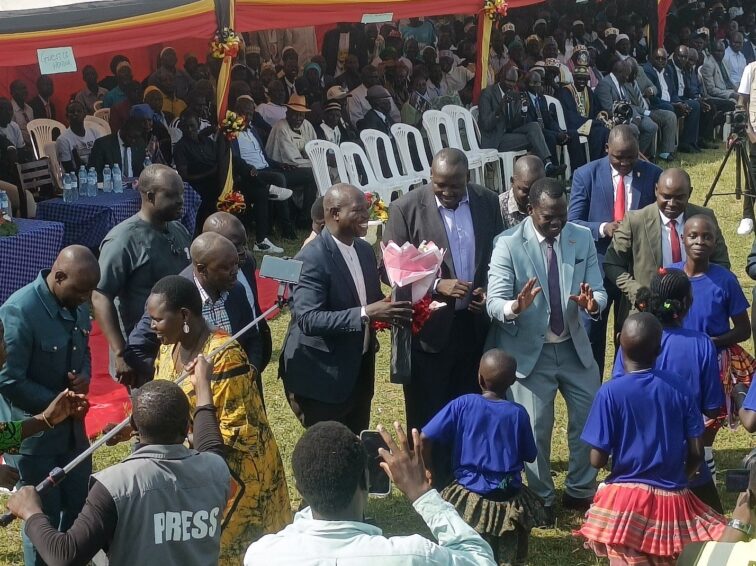
Dancing in the middle, Hon. Fungaroo(in blue suite and Hon. Leku James Pili the Adjumani West MP, Hon. Musa Noah holding flower bouquet, and other dignitaries during the 2026 Obongi day celebration – Photo by Morish Dramadri
He urged the government and the Judiciary to prioritize effective judicial service delivery in Obongi to ensure residents enjoy the same access to justice as other Ugandans.
“We cannot talk about constitutionalism, we cannot talk about security, and we cannot talk about the right to a fair hearing in the absence of a magistrate in the district. We call upon the Judiciary to ensure that Obongi district is served like all other districts in this country,” Ssentungwe said.
Meanwhile, Hon. Musa Noah, the Koboko North Member of Parliament and West Nile regional parliamentary whip, while representing the Minister for Northern Uganda during the 2026 Obongi Day celebrations, pledged to engage the government on the concerns raised by the district.
“As the regional whip for this region, I am going to work to see that we engage the Office of the Government Chief Whip to see that we address the issues of Obongi,” Hon. Musa pledged.
Uganda’s Magistrates Courts are established under the Magistrates Courts Act, Cap. 19, which provides for the administration of justice through subordinate courts. The law provides for the handling of criminal cases, civil disputes, bail applications and remand proceedings, among other judicial functions.
The Magistrates Courts (Amendment) Act, 2026, which commenced on May 8, 2026, further amended the law, including provisions on the designation of magisterial areas and the ranks of magistrates.
With human rights advocates and political leaders raising concerns over access to justice, the people of Obongi are now calling for more than a gazetted court area: they want a fully functional judicial system capable of delivering timely, affordable and accessible justice.
Upcoming on 90.9 FM
Upcoming on 94.5 FM
Upcoming on 101.4 FM
Upcoming on 104.8 FM
















Comments
This post currently has no comments.