
GO GREEN: GULU UNIVERSITY TURNS GROUNDNUT WASTE INTO CHARCOAL
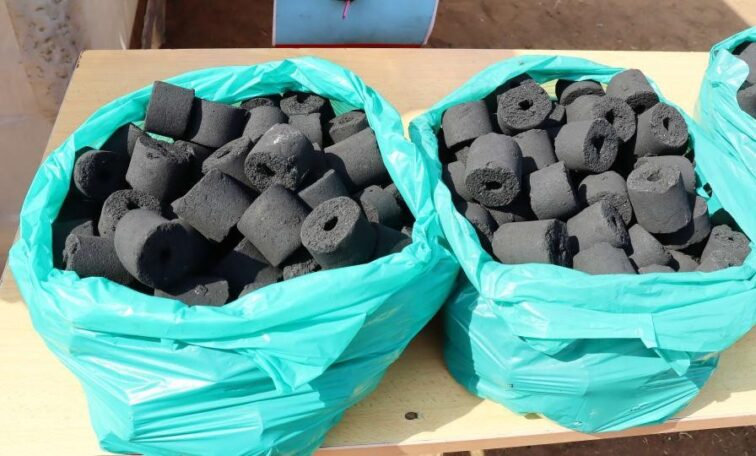
The Green charcoal made from groundnut shells by Gulu University.
By Proscovia Achomo
Gulu City
Agricultural waste, often discarded or burnt after harvest, is becoming an unexpected source of energy and economic opportunity in northern Uganda, as Gulu University turns materials such as groundnut shells into green charcoal in an initiative aimed at promoting environmental conservation and creating livelihoods.
The innovation offers a potential alternative to conventional charcoal, whose production contributes to deforestation, while addressing the challenge of agricultural waste disposal in farming communities. It also demonstrates how locally developed research can be transformed into practical solutions that benefit communities and support sustainable development.
At the centre of the initiative is Gulu University’s effort to equip young people and refugee communities with technology and skills to convert readily available agricultural residues into alternative fuel, turning what was previously considered waste into a potentially valuable commercial product.
Dr. Collins Okello, Dean of the Faculty of Agriculture and Environment at Gulu University, says the project was developed in response to the large quantities of agricultural waste generated in farming communities, much of which is often discarded or burnt in the open.
“We have a lot of agricultural waste which we normally destroy and burn in open fires. We have developed simple technology using machinery fabricated locally at Gulu University, and we have now established a commercial activity in Amuru, where there is a lot of agricultural waste,” Okello said.
He points to groundnut shells as one of the major raw materials being used, noting that large quantities are often discarded in farming communities across Amuru District.
“If you drive along the Amuru Road, you will find heaps of groundnut shells. Now we are empowering young people in Amuru District and refugees in Adjumani to utilise that technology and produce fuel that can replace conventional charcoal,” he added.
The approach offers communities an opportunity to earn from materials that would otherwise go to waste while contributing to efforts to reduce dependence on conventional charcoal.
The green charcoal innovation is part of a wider research initiative known as UPCHAIN (Unlocking the Potential of Green Charcoal Innovations to Mitigate Climate Change in Northern Uganda).
Launched in 2022, the project received approximately UGX 6 billion in funding from Denmark’s Ministry of Foreign Affairs and is implemented through a partnership involving Gulu University, Aalborg University and the University of Copenhagen.
The initiative explores how agricultural residues, including groundnut shells, rice husks and maize cobs, can be converted into alternative energy products while creating sustainable economic opportunities for communities in northern Uganda.
One of its major milestones was the establishment of a Green Charcoal Living Laboratory in Pabbo, Amuru District, officially launched in February 2025.
The facility provides a practical platform for local communities to acquire production skills, experiment with technologies and develop enterprises around the use of agricultural waste.
The project also seeks to strengthen the green charcoal value chain, from collecting raw materials and processing them into briquettes to developing markets and encouraging household adoption.
By connecting research with community participation and enterprise development, the initiative seeks to demonstrate how universities can contribute to environmental protection while supporting local economic transformation.
For Gulu University, the initiative represents more than an effort to develop an alternative cooking fuel. It reflects the institution’s broader commitment to environmental conservation, responsible use of natural resources and sustainable development.
David Obol Otori, the University Secretary, says the university is deliberately embracing environmentally friendly technologies as part of its contribution to addressing environmental challenges.
“At Gulu University, environmental conservation is central to what we stand for. We are committed to championing green technology and promoting innovations that protect our natural resources, address environmental degradation and ensure that development does not come at the expense of our environment,” Otori said.
The university’s involvement in green charcoal production demonstrates its intention to ensure that research and innovation respond to real environmental and economic challenges facing communities.
By promoting the productive use of agricultural residues, the institution is seeking to demonstrate that environmental conservation and economic development can complement each other.
The initiative also highlights the role universities can play in developing locally appropriate technologies rather than relying entirely on imported solutions, while equipping communities with skills to establish income-generating enterprises.
For the university, the bigger ambition is to make research a practical tool for transformation, ensuring that innovations developed within academic institutions translate into tangible benefits beyond university campuses.
The green charcoal initiative comes at a time when government is pushing universities and research institutions to move beyond academic publications and turn their discoveries into commercially viable products that can address societal challenges, create employment and contribute to economic growth.
During a recent visit to Gulu University, Eng. Jonard Asiimwe Akiiki, Minister in the Office of the President in charge of Science, Technology and Innovation, challenged the institution to embrace commercialization and position itself as a driver of economic transformation.
He emphasized the need for communities to embrace alternative sources of energy instead of indiscriminately cutting down trees for conventional charcoal production, noting that agricultural waste such as groundnut shells can be transformed into valuable products.
“Groundnuts can now be used to make many things. We should not just go around cutting down trees anyhow when we have alternatives. Instead, we should collect materials such as groundnut shells and turn them into useful products. This is the kind of innovation we want to see commercialized because it can protect our environment, create opportunities and contribute to economic development,” Akiiki said.
He also challenged universities to embrace change and ensure their research translates into practical solutions and economic opportunities for the next generation.
“Gulu University may be a modest institution today, but with a strong focus on research commercialization, it has the potential to surpass many others. Universities must be willing to embrace change and adapt to new opportunities. If we do not transform our institutions and create opportunities locally, we risk seeing more of our young people leave the country in search of better prospects in places such as India and the United Kingdom among others,” Akiiki said.
His remarks underscore the growing expectation that universities should not only generate knowledge but also translate their innovations into products and services that can compete in the market.
Despite the growing number of research and innovation initiatives across Uganda, translating academic discoveries into commercially successful products remains a major challenge.
Figures presented by the Uganda National Council for Science and Technology indicate that less than five per cent of the country’s research outputs are commercialised or adopted by industry.
The low uptake has prompted government to push universities and research institutions to strengthen partnerships with the private sector, develop viable business models and ensure innovations reach consumers.
The green charcoal initiative at Gulu University provides an example of how research can move beyond academic publications and laboratories into practical community applications.
However, its long-term success will depend on expanding production, securing reliable markets, maintaining consistent product quality and ensuring the briquettes are affordable and competitive with conventional charcoal.
For communities in northern Uganda, the opportunity is significant. Agricultural waste that was once discarded could become a source of income, while young people and other community groups gain opportunities to participate in an emerging green economy.
As Uganda seeks to commercialise more of its research and strengthen its response to environmental challenges, Gulu University’s green charcoal project offers an example of how locally developed innovations can turn everyday problems into opportunities for sustainable development.
Ultimately, the real measure of its success will be how many livelihoods it supports, how widely the alternative fuel is adopted and how much it contributes to reducing pressure on the country’s natural forests.
Upcoming on 90.9 FM
Upcoming on 94.5 FM
Upcoming on 101.4 FM
Upcoming on 104.8 FM




















Comments
This post currently has no comments.