
FEATURE: GULU UNIVERSITY PROBES MOLDY MAIZE LINK TO NODDING SYNDROME
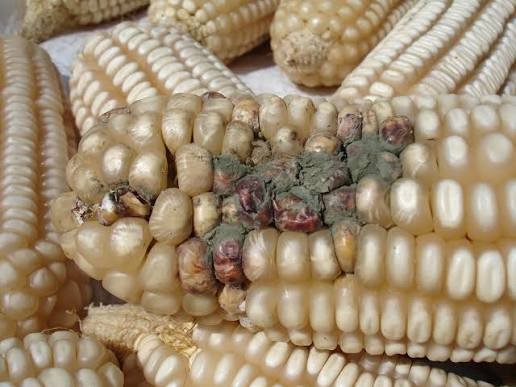
A dry maize cob that developed molds
By Proscovia Achomo
Gulu City
An experiment at Gulu University has raised fresh scientific questions about the possible role of contaminated food in Nodding Syndrome after laboratory rats fed mould-contaminated maize reportedly developed repetitive head movements and seizure-like symptoms resembling those observed in affected children.
During a demonstration at the university, one of the laboratory rats was observed making repetitive head movements similar to the nodding episodes associated with the human condition, illustrating the unusual behaviour researchers say they recorded during their experiments.
Dr Richard Echodu, director of Gulu University’s Multifunctional Research Laboratories, said the animals exposed to contaminated maize displayed behaviour resembling symptoms associated with Nodding Syndrome, a neurological condition that has particularly affected children in northern Uganda.
The experiment involved dividing laboratory rats into two groups, with one group fed maize contaminated with particular mould species while the other received clean maize.
According to Echodu, the researchers observed repetitive head-nodding movements and seizure-like behaviour among the rats that consumed the contaminated maize.
“When we gave the rats the mouldy maize, they started exhibiting symptoms similar to nodding. That is where we established a very close association between eating this mould-contaminated maize and the symptoms,” he said.
The research team is now seeking to identify the specific substances responsible for the observed changes and establish whether similar exposure could affect humans.
Echodu, who has investigated possible causes of Nodding Syndrome since 2008, said the latest research was conducted in collaboration with a Japanese PhD student as part of efforts to explore possible risk factors beyond previously investigated associations with _Onchocerca volvulus, the parasite responsible for river blindness.
The researchers collected mould samples from maize gardens in Omoro, Pader and Kitgum districts, some of the areas that have previously reported cases of the neurological condition.
Laboratory examinations reportedly revealed elevated levels of particular amino acids in maize contaminated with certain mould species. The findings prompted further experiments to establish whether the substances could produce neurological effects.
The team has also extended its investigations to sorghum after preliminary observations indicated the presence of similar amino acids in the cereal.
However, Echodu cautioned that the findings are not yet conclusive. Researchers still need to establish the exact chemical composition of the substances, their concentrations and the levels of exposure that could potentially trigger neurological complications in humans.
The investigation comes against the background of previous scientific studies documenting fungal toxins in food grains consumed in northern Uganda.
A 2021 study titled _Mycotoxin Profile of Staple Grains in Northern Uganda: Understanding the Level of Human Exposure and Potential Risks_, published in the journal _Food Control_, examined 400 grain samples collected from nine districts in northern Uganda.
The study, which included maize, sorghum, groundnuts and millet, tested for four groups of mycotoxins: aflatoxins, fumonisins, ochratoxins and deoxynivalenol.
The researchers found that only seven per cent of the samples were free from the tested mycotoxins, meaning the vast majority contained at least one of the fungal toxins examined.
Sorghum showed particular susceptibility to contamination, with some samples containing multiple mycotoxins. The researchers also identified potential dietary exposure concerns, particularly among populations whose diets rely heavily on sorghum.
The study was co-authored by Echodu, alongside researchers from Gulu University and Ghent University in Belgium.
Another study published in _Toxicology Reports_ in 2019 examined 105 food-grain samples collected from households in Kitgum and Lamwo districts.
The researchers investigated contamination by aflatoxins, ochratoxins and deoxynivalenol, finding that 46.5 per cent of the sorghum samples exceeded Uganda’s national regulatory limit for aflatoxin.
However, the study’s dietary risk assessment concluded that the estimated exposure levels did not indicate a health risk from the mycotoxins examined, based on the hazard indices calculated.
Although the studies highlight food-safety challenges associated with cereal production, handling and storage, neither establishes that mycotoxins cause Nodding Syndrome.
The renewed investigation comes against the background of the devastating impact of Nodding Syndrome on communities in northern Uganda.
A review of Uganda’s Ministry of Health records documented 3,094 children affected by the condition and 170 deaths in Kitgum, Pader and Lamwo districts.
The figures, drawn from historical records from 2012 and published in a 2016 study in _Health Policy and Planning_, included 1,278 affected children in Kitgum, 1,488 in Pader and 328 in Lamwo.
The disease is characterised by repetitive, involuntary head movements and is often accompanied by epileptic seizures, neurological complications and developmental challenges.
Despite years of scientific investigations, its exact cause remains unknown.
The historical disease burden has continued to raise questions about the environmental, nutritional and infectious factors that could contribute to the condition, making further scientific investigations particularly important.
Despite the experimental observations, Echodu said the university faces a major equipment shortage that could delay efforts to obtain more detailed scientific evidence.
He said the research team needs a mass spectrometry machine estimated to cost more than Shs200 million to identify and accurately measure the amino acids and proteins found in contaminated food samples.
The laboratory’s existing equipment can detect the substances but cannot provide the detailed chemical profiling required to establish their precise composition and concentrations.
Echodu said acquiring the machine would enable researchers to investigate the substances more thoroughly and establish how they might interact with the brain and nervous system.
The university’s request for advanced laboratory equipment comes amid the government’s push for research institutions to develop scientific innovations that address practical challenges affecting communities.
During his visit to Gulu University, Hon. Eng. Jonard Asiimwe Akiiki, Minister in charge of Science, Technology and Innovation in the Office of the President, emphasised the importance of translating research findings into practical solutions rather than limiting scientific work to academic studies.
The minister’s visit on November 6, 2026, focused on strengthening research infrastructure, innovation and the translation of university research into practical solutions.
Akiiki assured the university’s researchers of government support for scientific innovation and research, although a specific funding commitment towards the requested mass spectrometry machine has not been confirmed.
For Gulu University, the proposed investment would strengthen its ability to investigate health and food-safety challenges affecting communities and generate scientific evidence that could guide practical interventions.
While investigations continue, Echodu has urged farmers and households to improve grain handling and food-processing practices to reduce exposure to mould-contaminated cereals.
He warned that failure to separate damaged grains from healthy ones could allow potentially harmful substances to enter household food supplies.
He said some families, particularly those facing financial difficulties, sometimes mix mouldy maize with healthy grains instead of discarding the contaminated portions.
“When maize is brought in from the garden and sorted before processing, mouldy grains should be removed. However, because many households are struggling financially, some people mix the good grains with the mouldy ones, allowing contaminated maize to enter the food chain,” he said.
He emphasised the importance of proper sorting, drying and storage to minimize fungal contamination.
For Gulu University’s researchers, the immediate priority is to establish exactly what substances are present in the affected cereals and whether they have any role in neurological complications.
Although the rat experiment has provided a new research lead, further laboratory analysis, independent scientific validation and human-focused studies will be necessary before contaminated maize can be implicated in the development of Nodding Syndrome.
Upcoming on 90.9 FM
Upcoming on 94.5 FM
Upcoming on 101.4 FM
Upcoming on 104.8 FM



















Comments
This post currently has no comments.