
FEATURE: WHY YUMBE MANGO FACTORY CONTINUES TO LIE IDLE

A worker inspects one of the equipment installed in the factory recently. Photo by Robert Elema
BY ROBERT ELEMA
YUMBE
Farmers in Yumbe district have continued to lose mangoes due to the non-operationalization of the mango factory in the district.
The construction of the factory had raised hopes among the farmers that the factory would help in adding value to the mangoes because the number of mangoes consumed every year is very little but the bigger percentage is wasted.
According to the farmers, Aringa Fruit Farmers’ Cooperative Society in late April, 2024 went on ground to mobilize farmers assuring them that they would buy mangoes in the recent past season but nothing happened yet the works at the factory have been accomplished.
In an interview on Monday, Mr. Mohammad Anule a farmer in Barakala Town Council said, following the mobilization of the farmers, they waited for the buyers in vain. ‘’We were fully prepared to sell mangoes to feed the factory through the Aringa Fruit farmer’s cooperative but after the mobilization meetings conducted by them, they never came back. We also want the cooperative to liaise with the local people so that they are briefed about the mango season because their plan to buy mangoes last year was late as the mangoes were almost getting finished,’’ he said.
‘’I have about 60 mango trees but when I harvested and sold the mangoes this year, I earned little money because a sack of mangoes, when sold locally, fetches less than shs10, 000. We are badly waiting for the operationalization of the mango factory,’’ he added.
Mr Noah Acikule, a farmer in Kei Sub County said, when a project is started, it should be finished in time so that the local people can benefit from it. “The work of the factory has dragged on for long and we continue to lose mangoes every year. When we start something, it’s necessary to have mobilization and preparation skills for such a project but what I know is, the project has been politicized and it’s making the operationalization of the project too long,’’ he said.
He said, such a project needs a very strong private sector foundation and if not, in 30-40years, the local community will remain as usual and the mangoes will continue to rot.
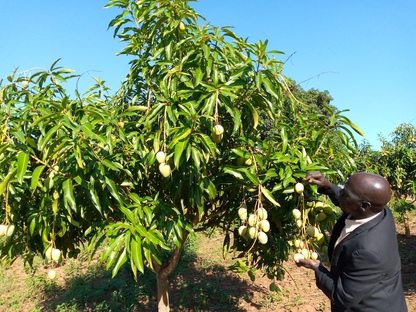
Mr Muhammed Anule, in Barakala town council checking some ripe mangos on his tree in
March. Photo by Robert Elema
Ms Khadijja Nakakande, the Public Relations Officer (PRO) for National Agricultural Advisory Services (NAADs) said, as NAADs, they did their part in constructing the facility and handed it over to a private company (NileZila) that’s managing the factory. ‘’We are not in charge of managing the factory. The responsibility given to us was to ensure the equipment was installed which we did and additional work of constructing the store, perimeter wall fence, the compound was given to us and when all those were done, we handed over the facility to NileZila that’s currently managing the factory,’’ she said.
About NileZila company
NileZila is a company formed by three shareholders of Uganda Development Cooperation (UDC), Food and Nutrition Solution (FoNuS) and Aringa Fruit Farmers’ Cooperative Society Ltd where FoNuS has 41 shares, UDC has 39 and Aringa Fruit Farmers’ cooperative Society has 20 shares.
The mandate of NileZila is to handle the issues of the factory, processing the mangoes while the cooperative is mandated to mobilize the farmers and supply mangoes to the factory through the established chain.
Mr Yashin Angua the manager of Aringa Fruit Farmers’ Cooperative Society Limited said, the farmers had hopes after the cooperative mobilized and assured them that they would buy mangoes to be processed at the factory in the past season and everybody was waiting. ‘’We prepared the farmers but we are sorry that we didn’t buy mangoes last time, the season came and passed due to technical challenges so, we need to apologize to the mango owners for that. In one way or the other, I am requesting them to be prepared for the coming season that will be next year,’’ he said.
He said, the factory crushes 5tonnes of mangoes per hour and there will be both day and night shifts which the factory is going to work upon. ‘’The emphasis now is, our farmers who have mango trees should begin preparing themselves and maintain the mango trees for the next season. The extension workers are already moving on ground to form associations at parish and sub county levels and that’s how we shall be able to move the local material to the collection centers,’’ he said.
He said, the issue of pricing of mangoes per kilogram will come in the next 2-3months after the NileZila board pronounces itself on the pricing of the mangoes.
Mr. Yassin Taban the director of Aringa Fruit Farmer’s Cooperative Society and also a board member of NileZila said, the factory is ready but for it to function well, it needed other requirements that were not yet in place but they arrived in West Nile when the mango season was off. ‘’We had pending issues with certification with UNBS including items like the aseptic bags, drums that are needed to store the pulps among others. These items are necessary because when you extract the pulp, it has to be packaged in those aseptic bags and drums to prevent bacteria from invading the pulp that would spoil it,’’ he said.
He said, since the items are not manufactured within Uganda, they are to be ordered for so, during this process, materials are delayed and that’s what made them not process mangoes this year. ‘’As of now, some of the aseptic bags and drums are already at the factory and by December, if the mangoes are available, people will be selling their mangoes to the factory through the cooperative. Other things have already been set including the human resource so, it was only the absence of the aseptic bags and drums that delayed us,’’ he added.
Prof William Kyamuhangire, the Chief Executive Officer (CEO) of NileZila Company said, the mango season for this year started on time but they didn’t last as long as they normally last. ‘’What I have learned that came as a surprise was, this year the mangoes ran out by the first week of June and I have never seen that before. Remember, we tasted mangoes in 2019, bought mangoes in the first week of July, what happened this year? We had planned that at least, by mid-June, we should have done one week of processing but the mangoes were not there, it was totally dry,’’ he said.
He said, the other problem is that, they haven’t been studying these mangoes to establish how they behave, their varieties and there is completely no data about mangoes and that he had only been hearing that the mangoes start to ripen from Adjumani proceeding to other districts in West Nile then up to DR Congo but this didn’t happen this season. ‘’It’s time we start doing the mango business, do research and documentaries about the mangoes. When you look at other Agro processing industries, they are parked by research work and backed by studies so, who is studying our mangoes? Now we are standing alone as a factory without backup,’’ he said.
‘’When you look at Coffee and Cotton, there are organizations for it, every crop has an organization to support it, so, what are we doing about mangoes? This enterprise we have set up is an eye opener for us and we really need capacity. We can’t continue working in the dark,’’ he added.
He said, they are going to try their best to do trials at the end of this year and then next year, they will be in full operation if the May-June season is a proper season.
Upcoming on 90.9 FM
Upcoming on 94.5 FM
Upcoming on 101.4 FM
Upcoming on 104.8 FM



















Comments
This post currently has no comments.