
HOW SOLAR POWERED IRRIGATION IS BOOSTING FARMING IN YUMBE
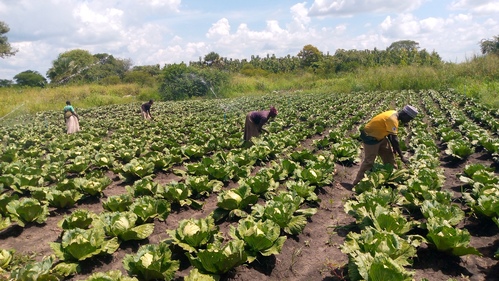
Members of Umaruku Field school harvesting cabbages in the field recently. PHOTO/ROBERT ELEMA
By Robert Elema
Yumbe
Mr. Yassin Ayimani, 43, a resident of Rakatura village in Kululu subcounty, in Yumbe district is a member of Umaruku Farmer Field School that started engaging in group farming in 2021.
He says the group consists of 30 members and besides farming, the group members also participate in Village Savings and Loan Association (VSLA).
Mr Ayimani says they first selected cassava production as their main enterprise but the project was not doing well and sometimes dried off due to the long dry spell that hits the area every year.
“Since I was born, we have always depended on the rain water to grow crops. Due to the persistent dry spell experienced in the area, we had been working at a loss because our area is water stressed and couldn’t support irrigation,” he said.
Mr Ayimani’s hope was restored, when Welthugerhilfe, an organization working in Bidibidi refugee settlement shared a plan with Umaruku Farmer Field School members of motorizing a borehole they had drilled in the village to provide water for production.
He said, the group later shifted from growing cassava to vegetable growing such as tomatoes and cabbages.
“Since i was born, we have always depended on the rain to grow crops because of this, none of us especially in our family really embraced vegetable production because vegetables like cabbages and tomatoes require a lot of watering and yet previously, we didn’t even have a nearby water point where we can just fetch in Jerrican and water the garden. This made us grow crops like cassava that survive even in hot sun as long as they sprout well,” he said.
“When Welthugerhilfe brought the idea of motorizing our borehole, we were very excited because they also shared the plan of supporting us with irrigation equipment if we secured an acre piece of land near the water point. Our group members quickly sat for a meeting and one of the members offered an acre of land near the water point,” he added.
He said, the irrigation system is making them to benefit alot because the vegetables can be planted at anytime and there is ready market for them and that it’s now one year that they have engaged in vegetable growing adding the beauty with the vegetables is that, in a year, it can be planted for 2-3 times which is better than cassava production.
“In the first harvest, we realized Shs 6.5million from the sales of tomatoes and cabbages and the money has been put in our VSLA so, we have about Shs 14million including our money for the savings. The money has helped us a lot in fighting poverty, payment of school fees, construction of shelter among others, “he said.
According to Mr Ayimani, they have a plan of expanding their project by increasing the acreage of the land since land is still available near the water point.
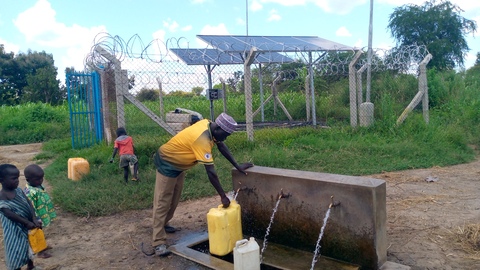
The high yielding borehole that was motorized using solar power to
provide water for production. PHOTO/ROBERT ELEMA
Ms Zumura Viko, another member of the group says, before a borehole was drilled in the area, they struggled a lot to access water for domestic use and farming.
“To get clean water, you would have to walk about 10km away from the village or if someone wanted to get water from a nearby valley, they would go about 3kms to get that water. We would look at watering crops as a wastage of water,” she said.
“Apart from cassava and Simsim production, I tried to plant some tomatoes and onions around my home twice but because of the unreliable rainfall patterns, they all dried up and I got nothing because I couldn’t water them due to the challenges of getting water,” she added.
She said, the borehole irrigation system has boosted production in the area and it has improved their livelihood status where they sell the vegetables they grow and use the money for school fees, stocking animals, medication among others.
However, due to the high pressure at the water source, the pipes for the extension of the water to the garden continues to burst but the group is requesting for a reserve tank for the system to store water including solar batteries because during bad weather, pumping of water becomes a problem.
Mr William Omara the project manager of Welthungerhilfe(WHH) at Yumbe sub-office said, they drilled a borehole that was meant to provide access to safe water for the members of this village but after realizing that the yield of the borehole was good enough, they motorized it to produce water for production.
“We started promoting water for production during off season in this dry belt of Yumbe where we sat with the community for a meeting and agreed to optimize the borehole which is already there and then the community gave us land and our work was to motorize it and also build the capacity of the community and provision of the Agricultural inputs for the first phase so, as we talk now the system has been motorized and the community has access to safe water and water for production in the garden,” he said.
He said, the community has already seen the benefit of the outcome of this production and currently, they are replicating it on their own but they continue to give backstopping exercises in terms of technical areas through the Agricultural extension workers.
Upcoming on 90.9 FM
Upcoming on 94.5 FM
Upcoming on 101.4 FM
Upcoming on 104.8 FM












Comments
This post currently has no comments.