
FEATURE: GOAT FARMING GETS A NEW LEASE OF LIFE AS CAGOV PROJECT CLOSES IN WEST NILE
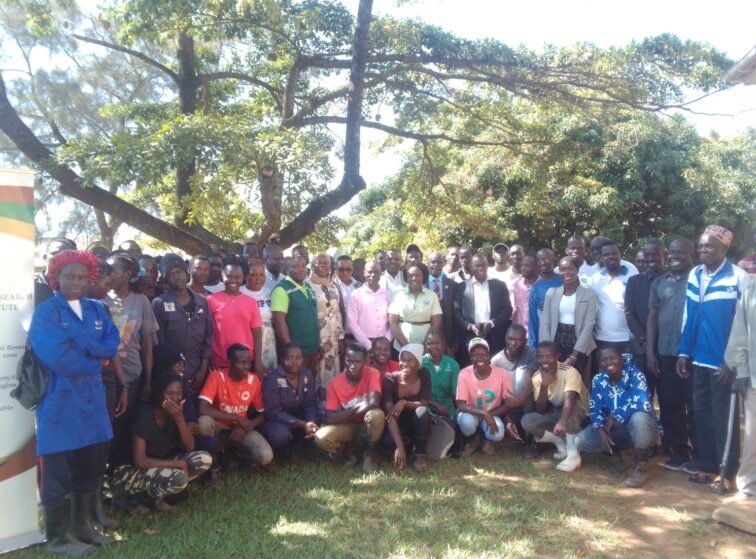
Researchers, farmers and other stakeholders pose for a group photo (Photo by Martin Anguyo)
By Martin Anguyo
Arua City
Abi Zonal Agricultural Research and Development Institute (Abi ZARDI) has recorded success in the Catalyzing Goat Value Chains (CAGOV) project, with beneficiaries reporting improved knowledge and practices in goat rearing. The $120,335 (about 500 million Ugandan shillings) project, funded by the Government of Uganda, began in July 2022 and ended in June 2026, focusing on increasing climate resilience, incomes and assets of smallholder farmers and urban youths in West Nile.
Speaking during the end-of-project workshop, Dr Moses Biruma, the Director of Abi ZARDI, challenged beneficiaries to turn the knowledge and skills acquired during the four-year intervention into daily farming practices, saying the sustainability of the project will depend on what farmers do after its closure.
Biruma urged farmers not to treat the end of the project as the end of the knowledge-sharing process, but instead use the skills acquired to improve goat production and strengthen household incomes.
He said continued application of improved farming practices would be important in helping communities cope with climate-related challenges while making livestock farming a more reliable source of livelihood.
“It doesn’t make sense when it remains with us, it is for you to benefit from and as we benefit from and as we benefit from, we contribute to the nation” he said.
Research at the center of goat value chain
The CAGOV project brought together researchers, farmers and other stakeholders with the aim of addressing some of the challenges affecting goat production in West Nile.
Farouk Semwogerere, Senior Research Officer in Animal Production at Abi ZARDI, commended the stakeholders for their cooperation throughout the project period.
Semwogerere says the collaboration between farmers, researchers and other partners provided an opportunity to identify challenges affecting goat keepers and develop practical approaches that could be applied at household level.
“Within the short time, we have done a lot together with the extension workers, with meat processors and with farmers” he noted.
The project also strengthened the partnership between Abi ZARDI and Makerere University, particularly in research focusing on animal production and range sciences.
Dr Kamatara Kanifa, Head of the Department of Animal and Range Sciences at Makerere University, says the university remains committed to supporting farmers through research and innovation even after the project has ended.
Kanifa says research institutions have a responsibility to ensure that scientific knowledge is translated into solutions that can be understood and adopted by ordinary farmers.
She says continued engagement between researchers and farming communities will be important in addressing emerging challenges such as climate change, livestock diseases, poor breeds and limited access to appropriate animal husbandry knowledge.
“When you give us an opportunity as Makerere University to come and support the West Nile farmers, we don’t take it for granted” Kamatara said.
Farmers begin seeing changes
For farmers who participated in the project, the intervention provided an opportunity to move away from traditional goat-rearing practices towards more informed management.
Gule Sam, a farmer in Yumbe District, says the project has improved his understanding of proper goat rearing, including how to manage the animals more effectively.
Gule says the knowledge gained has given him a better understanding of goat production and the importance of applying recommended practices to maintain healthy animals.
His experience reflects the wider objective of CAGOV—to make goat farming more productive and capable of contributing to household livelihoods.
“We got to learn and introduced to this project and that’s when I got to know that the little little goats I have been rearing were having no value.
Goat farming as a livelihood opportunity
Goat farming is increasingly becoming an important economic activity for smallholder farmers because goats can provide households with meat, income and an asset that can be sold when urgent financial needs arise.
For young people in particular, improved goat production can provide an entry point into agriculture without requiring the large amounts of land and capital needed for some other livestock enterprises.
But experts caution that increased goat numbers alone may not translate into higher incomes unless farmers improve animal health, feeding, breeding, housing and marketing practices.
This is where the knowledge generated through CAGOV is expected to remain relevant beyond the project period.
The challenge after CAGOV
As the project closes, the biggest test will be whether the practices introduced can be sustained without direct project support.
Dr Biruma’s call for beneficiaries to continuously implement what they were taught points to the need for farmers to take ownership of the interventions and share knowledge within their communities.
There is also a need for continued collaboration between research institutions, local governments, extension workers and farmers so that emerging challenges in goat production can be addressed before they affect household incomes.
The project therefore leaves behind not only trained farmers, but also research partnerships and lessons that could inform future interventions targeting livestock production and climate resilience in West Nile.
Four years of investment
The CAGOV project was implemented for four years, from July 2022 to June 2026, with over 500 million Ugandan shillings from the Government of Uganda.
Its focus on smallholder farmers and urban youths in West Nile placed goat production within a broader effort to strengthen climate resilience, household incomes and productive assets.
The end of CAGOV may mark the conclusion of the project, but for farmers, its real measure of success will be whether the knowledge acquired can continue translating into healthier goats, better production and improved household livelihoods long after the project has closed.
Comments
Upcoming on 90.9 FM
Upcoming on 94.5 FM
Upcoming on 101.4 FM
Upcoming on 104.8 FM



















anti-violence-218800
18 August 2026 at 8:16 AM
[584329]supplies professional anti-violence equipments and solutions for the whole world with strong and perfect production capacity. anti-violence.org