
FEATURE: OUTDATED BRAILLE MACHINES LEAVES VISUALLY IMPAIRED LEARNERS IN GULU STRUGGLING
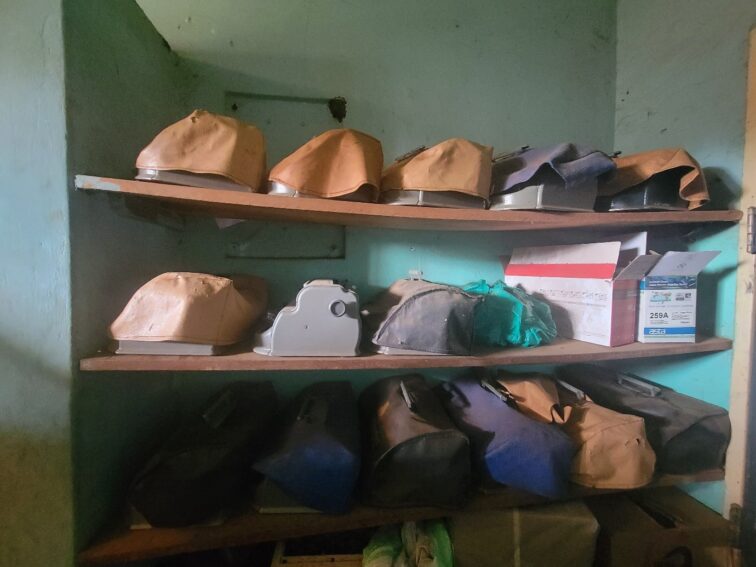
15 nonfunctional braille machines lay in dust at Gulu high school stores (Photo by Biko Rombe)
By Biko Rombe
Gulu City
For a learner who can see, a pen and exercise book are ordinary tools of education. For a learner with visual impairment, a Braille machine can mean the difference between keeping up with classmates and being left behind.
But in some schools in Gulu city, these essential learning tools are old, frequently breaking down and increasingly difficult to repair, raising concerns about how visually impaired learners will cope with classroom work and examinations.
The concern was brought into focus during the annual induction of the Uganda National Students Association (UNSA), held last month at Gulu Central High School, where leaders called for greater government attention to learners with disabilities.
Kamba Amir, the Deputy Resident City Commissioner for Bardege-Layibi City Division, said the problem goes beyond the availability of machines.
He said some of the Braille machines being used in schools are so old that even after repair, they may only function for a short period before breaking down again. He says these machines date back to colonial era.
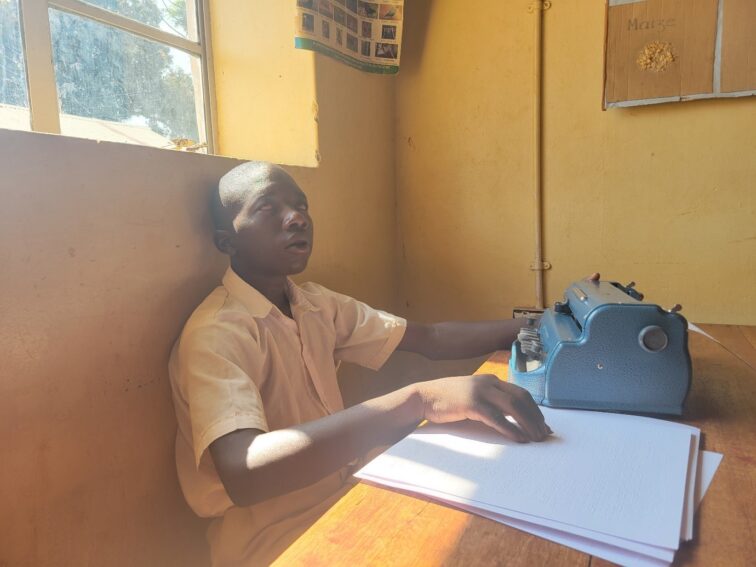
A visually impaired P.7 pupil doing exams at Gulu primary school (Photo by Biko Rombe)
Kamba said he had raised the matter with the Ministry of Education and Sports, calling for the government to consider providing new Braille machines instead of repeatedly repairing machines that have been in use for decades.
He also appealed to the ministry to provide technical expertise to verify new machines that may be donated by organisations, arguing that schools and local leaders may not have the technical knowledge to determine whether the machines are suitable.
For learners, however, the problem is already affecting their day-to-day education.
At Gulu Primary School, one of the schools supporting learners with visual impairment in Northern Uganda, the challenge is visible in the numbers.
The school currently has 64 learners with disabilities. Of these, 21 are Braille users, 40 have low vision and use large-print materials, while two learners have physical disabilities. But the school has only 43 Braille machines.
According to Anywar Kennedy Robert, the Deputy Headteacher of Gulu Primary School, only 21 of the machines were repaired during a recent major repair exercise.
That number has since fallen to about 15 working machines after some of the repaired machines broke down again. The shortage means learners who depend on Braille machines sometimes have to share them. This becomes particularly difficult during lessons and examinations, when every learner needs reliable access to a writing device.
The school has a maintenance arrangement in which the machines are serviced at different points in the term, including before examinations. But keeping the machines working is itself expensive.
Paraffin is used in cleaning the machines, while a specialised lubricant is difficult to obtain locally and is usually sourced from Kenya. The locally available grease, according to the school, attracts dust and can create additional problems for the machines.
The school has received some support.
A local organisation, Seaford, has provided learning materials, including a new Braille machine, which the school has reserved for Primary Seven candidates. The organisation has also supplied devices such as Orbit Readers used by visually impaired learners for writing and accessing information.
But one new machine is not enough to address the wider shortage.
The situation is also evident at Gulu High School, which currently has about 39 learners with visual impairment.
Okello Patrick Jimmy, a Braille technician at the school, said the institution has about 36 Braille machines, but the number is misleading because many are no longer functional.
More than 20 machines have reportedly been set aside because spare parts are difficult to obtain. As a result, fewer than 20 machines are currently functioning.
The technician said repairs have become almost a daily activity because machines frequently develop faults after being issued to learners.
Some of the machines have been in service for decades. According to him, some of the teachers at the school used these machines while they were still students years back.
Okello explained that Perkins Braillers can last for many years when properly maintained, but the age of many of the machines currently in schools has made them increasingly difficult to keep operational, particularly because replacement parts are no longer readily available.
Cost of replacing them also presents another barrier.
Okello estimates that a new Perkins Brailler currently costs about 5.8 million shillings, a price that is beyond the reach of many families.
And the Braille machine is only one part of the cost of educating a learner with visual impairment.
Schools also need Braille paper, embossing paper and assistive technologies such as Orbit Readers and computers fitted with screen-reading software.
A box of 1,000 sheets of Braille paper, for example, costs about 370,000 shillings, according to the Gulu High School technician.
For families already struggling with school expenses, these additional costs can make education even harder to sustain.
Sheila Ainembabazi, the UNSA President, says the situation should not be treated as a matter for schools and parents alone.
She argues that Uganda already has structures for supporting persons with disabilities, from the national level to districts, and that resources meant for these programmes should reach the learners who need them.
Anembabazi said UNSA would follow up with the Permanent Secretary of the Ministry of Education and Sports after the concerns were raised during the induction.
She also challenged leaders to look beyond promises and ensure that learners with disabilities have the tools they need to participate fully in education.
The problem is not only about machines.
Both school officials and disability advocates say social attitudes continue to keep some children with visual impairment away from school.
Anywar says some parents still assume that because a child cannot see, the child cannot learn.
He is urging parents to take children with visual impairment to school, insisting that blindness does not mean a lack of intelligence or ability.
At Gulu Primary School, the evidence is already there.
The school has learners using Braille from Primary One through Primary Seven, while others with low vision use large-print materials. The school says these learners are capable of learning alongside their peers when they are provided with the right support.
At Gulu High School, the same principle applies.
Okello describes a Braille machine as being as important to a visually impaired learner as a book and pen are to a sighted learner.
Without it, the learner may be physically present in class but effectively denied one of the basic tools needed to learn. The immediate solution, therefore, is not simply another round of repairs.
Schools need reliable, modern Braille machines, regular access to spare parts and specialised technicians, alongside adequate Braille paper and other assistive technologies.
For Kamba Amir, the government should take responsibility for finding a lasting solution rather than waiting for old machines to fail before intervening.
For UNSA, the issue is one of inclusion and equal opportunity.
And for the schools, the need is immediate: learners preparing for examinations cannot afford to wait for machines to be repaired at the last minute.
As Uganda continues to promote inclusive education, the experience of learners in Gulu presents a simple test of that commitment.
The question is no longer whether visually impaired learners can learn. Schools such as Gulu Primary and Gulu High school have already demonstrated that they can.
The challenge is whether the education system will provide them with the tools to do so.
Comments
Upcoming on 90.9 FM
Upcoming on 94.5 FM
Upcoming on 101.4 FM
Upcoming on 104.8 FM






Okello Patrick Jimmy
19 August 2026 at 10:44 AM
Well done. Thank you the management of Radio Pacis for your involvement in sentisizing the masses and being our voice, the school. Lot of loves