
EBOLA RESPONSE UNDER ATTACK IN DRC AS MOB DESTROYS AMBULANCES IN BUNIA
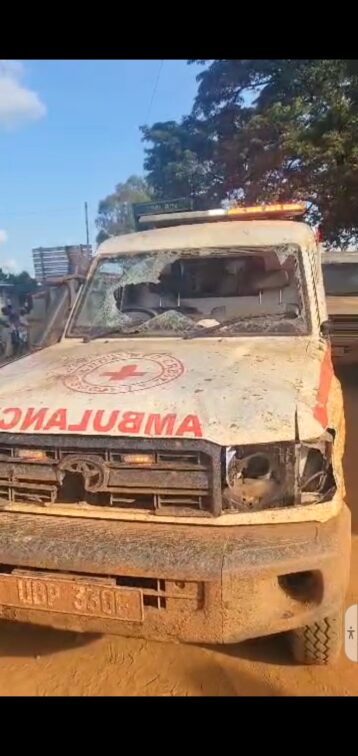
One of the vehicles destroyed. (Photo by Vurra Custom Police)
By Martin Anguyo
Arua City
The fight against Ebola in the Democratic Republic of Congo has taken a worrying turn after an angry mob in Bunia, the provincial capital of Ituri, attacked humanitarian workers involved in the response, accusing them of promoting a disease that some residents claim does not exist.
The incident, which occurred on Tuesday August 18, 2026 at around 4:00pm, reportedly saw seven ambulances destroyed, two of them set ablaze, while drivers were beaten as the crowd turned against Ebola response teams.
The attack has raised fresh concerns about the growing mistrust, misinformation and hostility confronting health workers at the frontline of one of the most serious Ebola outbreaks recorded in the Democratic Republic of Congo.
Bunia has become a major coordination centre for the response to the Bundibugyo strain of Ebola, with ambulances and humanitarian teams playing a critical role in transporting suspected and confirmed patients, conducting surveillance and supporting communities affected by the outbreak.
The violence is particularly concerning because response teams depend heavily on community cooperation to identify suspected cases, trace contacts and ensure patients receive care before the disease spreads further.
Speaking during an online interview, Professor Charles YAP Boum II, the Regional Epidemic Coordinator for the Africa Centres for Disease Control and Prevention in the DRC, called for concerted efforts involving political, religious, community and health leaders to address what he described as negative perceptions surrounding the Ebola response.
“The response cannot succeed through medical interventions alone. The importance of rebuilding confidence between communities and the teams working to contain the outbreak” he said.
His call comes at a time when health authorities are increasingly warning that mistrust and delayed care are contributing to the rapid spread of the virus.
The World Health Organization and Africa CDC have also emphasized that communities must be placed at the centre of the response, with trusted local leaders expected to help explain the disease, encourage early reporting of suspected cases and address fears surrounding treatment and safe burials.
The latest violence is not an isolated challenge for Ebola responders in Bunia.
Africa CDC has previously documented resistance to Ebola response activities in parts of Ituri, including threats against the establishment of response infrastructure and demands from community leaders for greater consultation before response activities are introduced.
In June, Red Cross volunteers involved in safe and dignified burials in Bunia were also attacked and physically assaulted while carrying out their humanitarian duties.
The International Red Cross and Red Crescent Movement condemned that incident, warning that attacks against humanitarian workers threaten both their safety and efforts to control the outbreak.
The International Federation of Red Cross and Red Crescent Societies has similarly stressed that fear, uncertainty and frustration within communities must be addressed through continuous dialogue and engagement.
The violence has also heightened concern on the Ugandan side of the border, particularly among communities whose livelihoods and social activities involve frequent interaction with people from the DRC.
The Resident City Commissioner for Arua, Rtd Major Betty Akello Otekat, pledged that “security agencies will remain alert and provide the necessary security to protect communities and respond to any emerging threats associated with the situation across the border”.
The concern comes despite Uganda having successfully contained its own Bundibugyo Ebola outbreak. Uganda recorded 20 confirmed cases and two deaths before declaring the outbreak over on July 28, 2026.
WHO and Africa CDC have since urged Uganda to maintain surveillance and cross-border preparedness because continued transmission in the DRC leaves neighboring countries at risk.
As of August 16, 2026, the DRC had recorded 4,945 confirmed Ebola cases and 2,325 deaths, making the current outbreak the deadliest in the country’s history. It has now surpassed the 2,299 deaths recorded during the 2018–2020 Ebola outbreak.
The outbreak is being driven by the Bundibugyo species of Ebola, for which there is currently no approved vaccine or proven treatment. Health experts say delayed diagnosis, weak surveillance, insecurity and resistance to response activities are making containment increasingly difficult.
The World Health Organization has warned that the outbreak is entering a period of intense transmission, with Ituri accounting for nearly 90 percent of confirmed cases in the country.
Public health experts say the destruction of response vehicles and attacks on frontline workers could have consequences beyond the immediate loss of equipment.
Ambulances are essential for moving patients and samples, while response teams depend on mobility to conduct contact tracing, surveillance and community engagement.
When such operations are disrupted, suspected cases may remain in communities for longer, increasing the possibility of further transmission.
The challenge, therefore, is not only to provide medical supplies and personnel but also to rebuild trust among communities that have become suspicious of the response.
The Africa CDC and WHO have emphasized that local, religious, women and youth leaders have a critical role in helping communities understand the disease and participate in surveillance, referrals, treatment and safe and dignified burials.
By the time of compiling this report, efforts to obtain a response from the Uganda Red Cross Society and Ituri provincial authorities had been unsuccessful, as repeated phone calls and WhatsApp messages went unanswered.
With thousands of people already infected and more than 2,300 deaths recorded, health authorities now face a race against time to contain the outbreak — while simultaneously confronting a second battle on the ground: winning back the trust of the communities they are trying to protect.
Upcoming on 90.9 FM
Upcoming on 94.5 FM
Upcoming on 101.4 FM
Upcoming on 104.8 FM














Comments
This post currently has no comments.