
OVER 70% OF FOOD IN ARUA MARKET COMES FROM OUTSIDE WEST NILE.
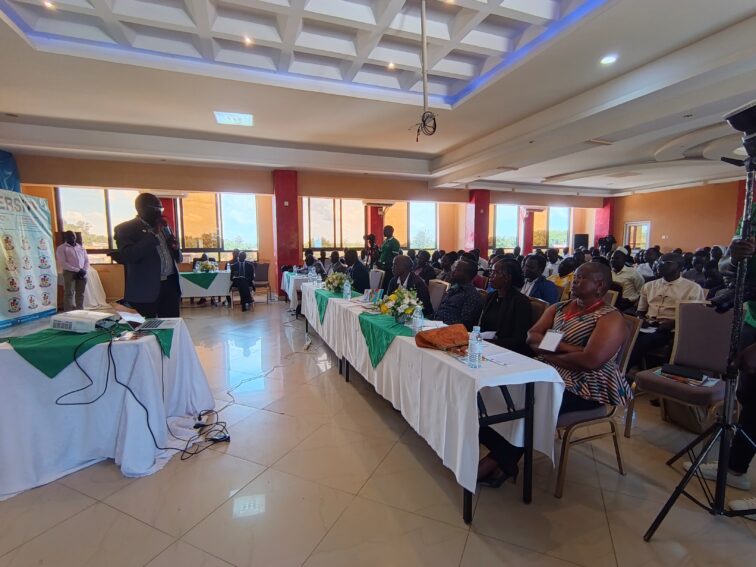
Participants Attending the Research Dissemination Conference 2026 at Desert Breeze Hotel. Photo// Dramadri Federick.
By Dramadri Federick
Researchers from Muni University are warning that low agricultural productivity and heavy reliance on food supplies from outside the region is threatening food security in West Nile.
A research report published earlier this year indicates that more than 70 percent of the food sold in West Nile Markets come from outside the sub-region, despite the availability of vast arable land suitable for agriculture.
The findings were disseminated to leaders and other stakeholders today during the launch of a two-day Research Dissemination Conference 2026 organized by Muni University, with researchers calling for urgent interventions to boost local food production.
Professor Robert Kajobe, the Director of Graduate Training, Research and Innovations at Muni University, says research conducted by the university’s Faculty of Agriculture and Environmental Sciences identified soil conditions and climate-related challenges among the factors affecting food production.
Kajobe says only about 30 percent of the region’s arable land is under productive use, while crop yields remain below the national average. He adds that approximately 80 percent of rural households depend on subsistence farming.
“This Region Imports over 70% of the Tomatoes from outside West Nile region, what west Nile is doing in terms of tomatoes is only 28% which is embarrassing, in all the other food items like cassava, beans, onions and the rest are coming from outside the West Nile sub region. The university is now positioning itself to work with other institutions to ensure that this is reversed”. Kajobe says
Meanwhile, records from Muni University’s Directorate of Graduate Training, Research and Innovations indicate that the institution produces an average of 200 research reports annually.
Dr Moses Kibirai, the Vice Chairman of the Muni University Council, says although climatic conditions affect agricultural production, farmers’ attitudes and farming practices also need to change to improve productivity.
“One thing that we have identified is the high rates of drug and alcohol abuse and this needs to be addressed by the local government, the second issue is that our culture of hard work is drifting away”. Kibirai says
Moses Biruma, the Executive Director of the ABI Zonal Agricultural Research and Development Institute under the National Agricultural Research Organisation, NARO, says there is also a need to review policies governing agrochemical use, food security and climate change.
Biruma says appropriate policies and interventions are necessary to strengthen agricultural production and help farmers respond to emerging challenges.
“There’re so many police reforms that need to be followed up to have research for impact”. Biruma explains
The two days conference is expected to provide a platform for researchers, policymakers and other stakeholders to discuss research findings and identify practical solutions to development challenges affecting West Nile.

Comments
This post currently has no comments.