
HER WORTH FOUNDATION SUPPORTS PERSONS WITH DISABILITIES WITH SOME SANITARY PADS.

By Komakech Jimmy
Gulu City
As one of its efforts in fighting Menstrual Health stigma against young girls in Acholi subregion Her Worth Foundation has supported some young disabled ladies with reusable sanitary pad.
Ms. Monica Prudence Apiyo, the cofounder of Her Worth Foundation, who is also a girl child rights` activist in Gulu City said that lack of sanitary pads has contributed to the dropping out of school of many young ladies in the subregion and the situation is worse for young disabled ladies.
However, she notes that with their intervention, the situation has started to improve since they are offering free sanitary pads to those young vulnerable ladies in both in the community and at school. "We are also teaching the young girls on how to make reuseable pads, this we are doing it I partnership with other organizations", she remarked. "our Foundation is currently involved in an innovative venture of producing reusable pads that can last up to two years, safe, and eco-friendly" she added.
Furthermore, Ms. Apiyo revealed that they are also selling some of the sanitary pads to raise money for the continuity of their project
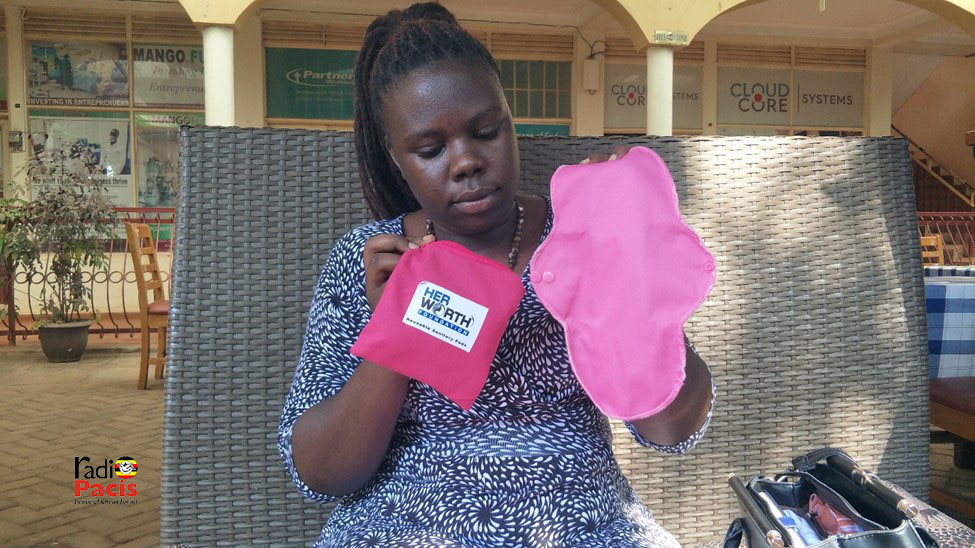
Ms. Monica Prudence Apiyo, the cofounder of her Worth Foundation displays a sample of the reusable pads they are producing
Rafael Okot Aboga, the Her Worth Foundation's program coordinator, disclosed that the reason behind their call for action was the high rate of adolescent pregnancies in the community and schools, which was caused by the majority of them not having access to menstrual products. "In order to prevent them from developing the idea of requesting money from men, which would expose them to sexual risks, we want to provide them for free in the community and in schools," he said.
According to Okot, the program has helped more than 2,000 young girls in the districts of Pader, Agago, Gulu, Amuru, and Gulu City who are enrolled in school.
Grow Together Project Coordinator and Communications Officer, Faith Nabunya, of the Center for Health and Human Rights (CEHURD) revealed that as part of their project-related program, they are targeting the Teso and Karamoja regions with awareness-building and menstrual hygiene services through their partners on the ground.
According to her, they are using the partners' local community conversations to inform a national advocacy that would then make it simple to hold the responsible ministries and duty bearers accountable. "Menstrual hygiene is always sponsored by the commercial sector, non-governmental organizations, and development partners", Nabunya asserted.
She stressed that this narrative needs to change and that the government should start implementing more sustainable programs rather than relying on donor funding. "I think the government and public agencies need to take full responsibility because these projects have time lines and the girls would get back to default setting when they end." She said
Menstrual hygiene for women and girls should be given priority as a crucial component of reproductive health, according to Dr. Joseph Magero a reproductive health expert. "This menace not only causes physical discomfort but also anxiety and mental disruption, particularly in early adolescence and school-aged children", Dr Magero remarked.
According to a UNESCO research, inequality and stigma cause about 10% of girls in Sub-Saharan Africa to miss school when they are menstruating. Every school term, a girl who is on menstruation loses 13 learning days in school on average. In addition, with the onset of menstruation, an estimated 23% of teenage females between the ages of 12 and 18 discontinue their education.
Girls in Uganda deal with a variety of difficulties when it comes to managing their menstrual health. The urgent need for assistance is shown by alarming figures about the school dropout rates among girls who are menstruation related. One of the biggest obstacles preventing many girls from completing their education because of period-related difficulties is the lack of menstrual hygiene products in schools.
COVER PHOTO: Ms. Monica Prudence Apiyo, a cofounder of Her Worth Foundation, at the extreme right poses for a group photo with some persons with disabilities holding sanitary pads By Komakech Jimmy
Upcoming on 90.9 FM
Upcoming on 94.5 FM
Upcoming on 101.4 FM
Upcoming on 104.8 FM





Comments
This post currently has no comments.