
ARUA CITY STAKEHOLDERS CALL FOR BYE-LAW TO CURB OPEN DEFECATION
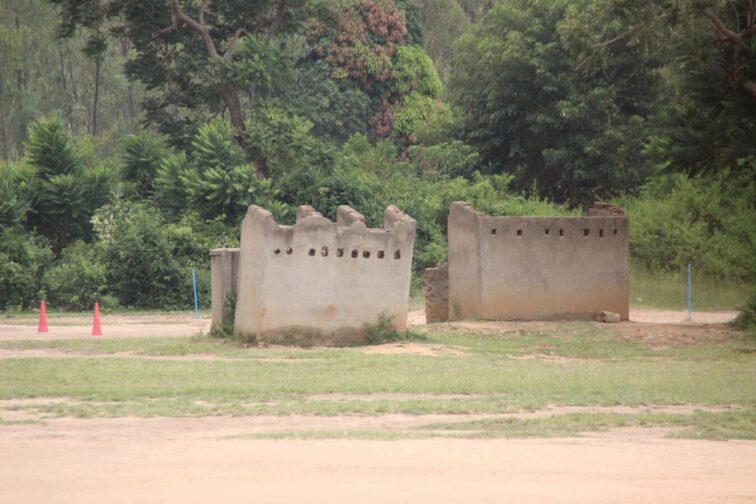
Dilapidated and abandoned toilet facilities at Inzikuru Stadium, Barifa, in Arua City. Photo by Dramadri Federick.
By Dramadri Federick
Residents and local leaders in Arua City are calling on city authorities to enact a specific bye-law to address the growing problem of open defecation, which they say is undermining sanitation standards and exposing communities to preventable disease outbreaks.
The concerns come amid persistent challenges in household access to decent toilet facilities, with some residents reportedly resorting to defecating in polythene bags before disposing of the waste in drainage channels, trenches, garbage collection points and other public spaces.
Residents say the practice, coupled with poorly maintained and dilapidated household latrines, is contributing to unhygienic neighbourhoods and increasing the risk of contamination of the urban environment.
Alatiru Gatruede, a resident of Oli D Cell in Arua Central Division, says open defecation is becoming increasingly common, particularly among households without functional toilet facilities.
She warns that the indiscriminate disposal of human waste could expose residents to sanitation-related disease outbreaks if the city does not take urgent action.
“You will find that most of the people who do not have toilets now carry Kavera (polythene bags) in their pockets, hide to defecate and throw them into trenches or even by the roadside. A few years ago, we experienced a cholera outbreak in Oli Division because of poor sanitation. If you move to garbage collection points, the smell is mostly human urine mixed with faecal matter, sanitary pads and diapers, which are dangerous to human health,” Alatiru explains.
She argues that improving sanitation requires more than public sensitisation, urging city authorities to strengthen household compliance with public health requirements and ensure that people have access to safe and usable toilet facilities.
Her concerns are echoed by Ijaga Muzamil, the Secretary General of the Arua City Local Councils Association, who says many households have toilet structures that are either dilapidated, poorly constructed or lack adequate privacy.
According to Ijaga, the condition of some household latrines discourages their use, forcing residents to seek alternative and unhygienic ways of disposing of human waste.
“Most households have toilets which are dilapidated. If somebody goes to ease themselves, the person can be seen from outside. Out of 100 households, perhaps only three or five per cent in Arua City have toilets in good condition. I see passers-by defecating in Kaveras (polythene bags) and throwing them into people’s compounds. I think we need a law, and we must be serious about its enforcement and penalties,” Ijaga says.
Sanitation figures raise concern
The concerns are supported by sanitation statistics presented by Arua City Biostatistician Mikail Adam during the city’s annual health performance review.
The report indicates that during the 2025/2026 financial year, only 61 per cent of Arua City’s estimated population of 391,243 had access to pit latrines, while just 16 per cent had access to improved pit latrines.
More concerning, the report estimates that only about 30 per cent of residents effectively use toilet facilities, leaving approximately 70 per cent, equivalent to more than 273,000 people, practising open defecation.
The figures point to a significant sanitation challenge for a rapidly growing urban centre, where population expansion, inadequate household sanitation infrastructure and poor waste disposal practices continue to place pressure on public health services.
Health experts warn that improper disposal of human waste can contaminate water sources, food and the surrounding environment, increasing the risk of diarrhoeal diseases, including cholera and other sanitation-related infections.
City moves to strengthen sanitation laws
In response to the growing concerns, Arua City authorities are developing a waste management law intended to strengthen regulation of improper waste disposal, including open defecation.
Henry Odama, the Arua City Senior Legal Officer, says the proposed legislation is currently undergoing consultations following its first reading and will introduce penalties targeting individuals who violate sanitation requirements.
Odama says the proposed law provides for a fine of up to two currency points, equivalent to 40,000 Ugandan shillings, for a first-time offender. Repeat offenders will face doubled penalties and possible imprisonment.
“We are working on the law, and repeat offenders shall face it the hard way. A first offender will be fined a maximum of two currency points, an equivalent of 40,000 shillings, but for a repeat offender, this will be doubled, with imprisonment not exceeding six months,” Odama explains.
The proposed legal framework is expected to provide city authorities with additional enforcement powers to address indiscriminate waste disposal and compel residents to observe proper sanitation practices.
However, stakeholders say the effectiveness of the proposed law will depend on consistent enforcement, public awareness and the availability of affordable sanitation facilities, particularly for low-income households and residents in densely populated neighbourhoods.
World Toilet Day highlights global sanitation challenge
The concerns in Arua City coincide with the annual observance of World Toilet Day on November 19, established by the United Nations to highlight the importance of safe, private and accessible sanitation facilities.
The observance draws attention to the role of proper sanitation in protecting public health, safeguarding the dignity and safety of women and girls, and advancing Sustainable Development Goal 6, which seeks to ensure access to clean water and sanitation for all.
According to the United Nations, approximately 3.4 billion people globally lack safely managed sanitation services, while about 1.7 billion people lack basic handwashing facilities at home, including access to soap and water.
The global figures underscore the scale of the sanitation challenge, particularly in rapidly urbanising communities where infrastructure development often struggles to keep pace with population growth.
Currently, Arua City authorities rely on public health notices, community sanitation campaigns and enforcement provisions under the Public Health Act to compel households and public establishments to construct and maintain proper toilet facilities.
However, local leaders and community members argue that existing interventions have not adequately addressed the problem, calling for a stronger local legal framework with clearly defined penalties and sustained enforcement.
As consultations on the proposed waste management law continue, residents say the city must balance enforcement with practical interventions, including improved access to affordable household toilets, rehabilitation of public sanitation facilities and regular monitoring of sanitation standards.
For Arua City, the challenge is not simply about enacting another law, but ensuring that every household has access to a safe, functional and private toilet, while those who deliberately expose others to health risks through improper disposal of human waste are held accountable.

Comments
This post currently has no comments.