
ACHOLI LEADERS SOUND ALARM OVER RISING ELEPHANT ATTACKS, HUNGER AND LAND DISPUTES IN AGAGO AND KITGUM
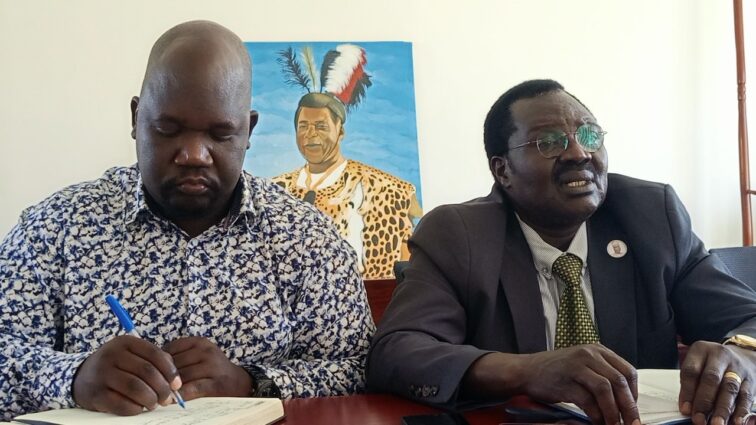
Deputy prime minister Ker kwaro Acholi Martin Okumu in coat and Okello Okuna the minister for information and communication.
By Odong Stephen
Gulu City
Acholi cultural leaders have called for urgent government intervention to address escalating human-wildlife conflicts, food insecurity, cattle raids and ancestral land disputes affecting communities in Agago and Kitgum districts.
The appeal follows growing concerns over destruction of crops and community property by elephants straying from Kidepo Valley National Park, leaving hundreds of households vulnerable to hunger and loss of livelihoods.
Speaking on behalf of the Paramount Chief, Rwot David Onen Acana II, during a press conference organised by Ker Kwaro Acholi on Monday, November 23, 2026, the cultural institution’s Deputy Prime Minister, Martin Okumu, said communities in eastern Acholi were facing increasingly difficult living conditions.
The affected areas include Paimol, Lapono, Umia-Pachua, Greater Lira-Palwo and other communities bordering Kidepo Valley National Park and the Karamoja sub-region.
According to findings presented by Ker Kwaro Acholi Project Officer Francis Ocheng, approximately 600 acres of crops have been destroyed by wild animals in Agago District since June 2026.
The report further indicates that more than 500 households are food insecure, with widows, orphans, elderly people and other vulnerable groups bearing the greatest burden.
Previous Report Documents Extensive Elephant Destruction in Kitgum
The latest concerns raised by cultural leaders are consistent with earlier reports from Kitgum District Local Government documenting extensive destruction of crops and community property by stray elephants.
In a report dated April 22, 2025, Kitgum District’s Department of Production and Marketing documented the movement of a herd of more than 100 elephants from Kidepo National Park into community settlements and farmlands in Namokora North Sub- County.
The elephants reportedly destroyed crops, woodlots, houses and granaries, leaving affected households facing potential food shortages and loss of income.
Agricultural Officer and Wildlife Focal Point Officer Jerry Nyeko, who compiled the report, said affected farmers reported destruction of crops including maize, sorghum, rice, sesame, sunflower, cassava, sweet potatoes, beans, pigeon peas, green grams and cowpeas.
Some crops were trampled and uprooted, while others were completely consumed, resulting in total yield losses.
Fruit trees, including jackfruit and mangoes, were also affected.
The report noted that the destruction had increased household food insecurity, reduced agricultural incomes and undermined families’ ability to afford essential services such as education, healthcare, housing and clean water.
It also raised concerns about the psychological consequences of repeated wildlife attacks, including anxiety and mental health challenges among affected households.
Five People Killed by Elephants in Agago

Francis Oceng ker kwaro Acholi project officer
According to Francis Oceng the project officer at Ker Kwaro Acholi the fact-finding report indicates that five people have been killed by elephants in Agago since the beginning of 2026, while another 14 have sustained injuries in wildlife attacks.
The situation is particularly concerning in Umia-Pachua, where approximately 90 per cent of households are reportedly food insecure.
The report further indicates that 12 people have died from starvation in the area since the beginning of the year.
Cultural leaders say elephants, buffaloes and lions continue to destroy gardens and threaten human lives, making farming increasingly difficult for communities living near the protected area.
They also questioned the capacity of wildlife management in the affected communities, noting that Agago reportedly has only four wildlife rangers responsible for responding to wildlife movements and human-wildlife conflicts.
Farmers Frustrated Over Delayed Wildlife Compensation
The compensation process for communities affected by wildlife destruction has emerged as another major concern.
Under the Uganda Wildlife Act, 2019, and the Wildlife (Compensation Scheme) Regulations, 2022, affected communities can submit claims for compensation through established procedures.
The 2025 Namokora Sub- County report indicated that affected households had completed Form 3, the official claim form for property damaged by wildlife, and submitted the documents for further review and processing.
However, the district report cited limited response from Uganda Wildlife Authority (UWA), lack of feedback on submitted compensation claims and inadequate community sensitization as major challenges.
The latest Ker Kwaro Acholi report similarly questions the effectiveness of the compensation framework, noting that only 22 acres out of approximately 600 acres of crops reportedly destroyed in Agago had been compensated.
The cultural institution wants the Wildlife Act and its compensation framework amended to make the process more accessible and responsive to affected communities.
Among the proposals is the establishment of district-level compensation committees to investigate incidents, verify claims and expedite compensation.
The leaders also want Agago, Kitgum, Amuru and Nwoya districts represented on the Uganda Wildlife Authority’s National Compensation Committee.
Ancestral Land Disputes Deepen Community Concerns
Beyond wildlife attacks, Acholi cultural leaders have raised concerns over alleged illegal land acquisition and boundary disputes affecting communities along the borders of Agago, Kitgum, Karamoja and protected areas.
According to the fact-finding report, some residents who abandoned their ancestral homes during decades of insecurity and displacement have encountered difficulties reclaiming their land upon returning.
The team highlighted concerns surrounding the (Timdua) hunting ground which residents reportedly have converted into farmland in Lapono a place call kulu dwong has been title by some people and is no longer in Agago district and is a freehold land title and community don’t know the people behind.
Residents of Umia-Pachua also reportedly complained about the placement of boundary markers allegedly belonging to Uganda Wildlife Authority approximately 10 kilometres east of Kasasiru Trading Centre without adequate community consultation.
The cultural institution says these disputes are creating uncertainty and tension among communities seeking to reclaim their ancestral land.
More Than 20,000 Cattle Reportedly Held in Protected Kraals
The cultural leaders also highlighted persistent insecurity and cattle raids affecting communities along the Acholi-Karamoja and South Sudan border areas.
According to the findings presented by Ocheng, more than 20,000 cattle have reportedly remained in military-protected kraals since 2023 due to insecurity and repeated raids.
The affected areas stretch from Laperepong and Adilang towards Agoro, while Lamwo District has also raised concerns over raids allegedly involving armed groups crossing from South Sudan.
The report further questioned the affordability of livestock vaccination, noting that some farmers are reportedly required to pay Shs8,000 per animal despite their difficult economic circumstances.
Returning Communities Still Lack Essential Services
Cultural leaders say many communities that returned to their ancestral homes following the end of insurgency in 2006 continue to lack basic social services.
Areas such as Dedek in Paimol, Kichok and Koryet reportedly remain underserved in terms of clean water, schools and health facilities.
Therefore, the communities are urging government to priorities the establishment of essential services to support families rebuilding their lives in previously abandoned communities.
Residents of Umia-Pachua have also appealed for the construction of a community polytechnic in memory of 88 people reportedly killed during the 1985 massacre.
Calls for Disarmament and Renewed Peace Dialogue
To address insecurity and cattle raids, Ker Kwaro Acholi has called for renewed disarmament efforts in Karamoja and stronger cooperation between Uganda, South Sudan, Ethiopia and Kenya.
However, the cultural leaders emphasized that military interventions alone cannot guarantee lasting peace.
They called for renewed dialogue between Acholi and Karamoja elders, citing the 1890 there was dialogue, in 1900 after the rengent war elders sat down and they had a dialogue and the last one was in 1990 where people call it Orom peace talks chaired by Mzee Lulwa of Kotido where the spear was bended as an example of traditional conflict resolution that helped ease tensions between the two communities and that is what Ker Kwaro Acholi is still proposing to take place between the elders of Karamoja and Acholi to ever dress this situation.
Government Urged to Provide Emergency Food Relief
The deputy prime minister Ker Kwaro Achol Martin Okumu appealed to the Office of the Prime Minister, the World Food Programme and humanitarian organizations operating in the affected districts and beyond to provide emergency food supplies and other essential necessities.
The cultural institution also called for the distribution of agricultural seeds ahead of the next planting season, expected between February and March 2027.
It further proposed a six-month school feeding programme covering the first and second school terms in Agago and Kitgum to help children from food-insecure households return to school and remain in class.
Calls for Irrigation and Community Support
Ker Kwaro Acholi Minister for Information and Communications Okello Okuna urged government to priorities security in eastern Acholi before implementing livestock restocking programmes.
He warned that restocking animals without addressing insecurity could expose newly distributed livestock to further cattle raids.
Okuna also called for investment in irrigation systems, arguing that communities could no longer depend entirely on rain-fed agriculture amid unreliable rainfall and changing weather patterns.
He appealed to Acholi communities, friends of Acholi and well-wishers to contribute food, clothing, school materials, household items and other necessities to support affected families.
He said Ker Kwaro Acholi door is open and ready to receive donations and coordinate assistance to vulnerable
He also urged members of the public to move beyond social media discussions and actively participate in supporting vulnerable families.
The cultural institution said it hopes to work with district leaders, government agencies, humanitarian organisations and other stakeholders to organise further interventions and mobilise support for the affected communities.
Upcoming on 90.9 FM
Upcoming on 94.5 FM
Upcoming on 101.4 FM
Upcoming on 104.8 FM







Comments
This post currently has no comments.