
ARUA CITY COUNCILLORS QUESTION MAYOR’S STAFF RECRUITMENT
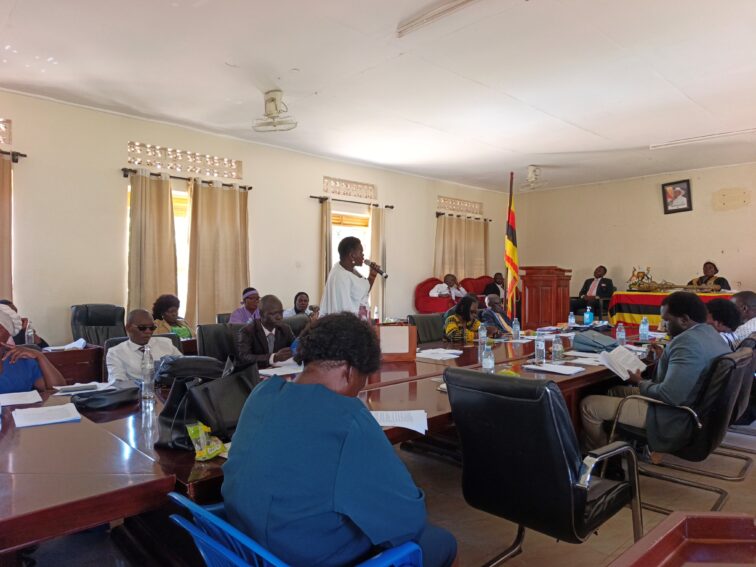
Councilors debating the recent Arua city council sitting in the city hall. Photo// Dramadri Federick.
By Dramadri Federick
Arua City councillors have questioned the recruitment and deployment of a personal assistant and a personal secretary in the city mayor’s office, raising concerns over possible irregularities, duplication of duties and the potential misuse of public resources.
The controversy took a new turn after Arua City Council Speaker Yako Teddy Gloria ruled that the proposed arrangement was illegal and directed that the existing staffing structure be maintained.
The councillors say the two individuals have been working in the mayor’s office since he assumed office in May 2026, despite the existence of a government-employed secretary already assigned to the same office.
The concerns emerged during a recent council sitting on October 8th, 2026, where an attempt was made through the Leader of Government Business to seek council approval for the two positions to be incorporated into the local government staffing structure, potentially paving the way for the individuals to receive government salaries.
However, the proposal attracted objections from councillors who questioned the recruitment procedures followed, the source of funding for the positions and whether the arrangement complied with established public service regulations.
In her ruling, Speaker Yako Teddy Gloria declared the proposed arrangement illegal and directed that the current staffing structure be maintained, effectively rejecting the move to introduce the additional positions through the process presented to council.
Alioni Hitler, the workers’ representative to Arua City Council, questioned how the two individuals were engaged without the knowledge of council, particularly when a government-employed secretary was already serving in the mayor’s office.
“We have learnt of a personal assistant and a secretary to the mayor who have been employed and are working in the city council without council knowledge. What is the recruitment procedure used? What is the salary source? Under which vote are these people paid?” Alioni asked.
He questioned the transparency of the recruitment process and demanded clarification on the employment status of the individuals and the budget under which any salaries or related expenses were being charged.
Inzikuru Millicent Milly, the female councillor representing Ayivu North East, described the arrangement as a possible duplication of responsibilities and warned that approving positions tailored to the needs of an individual officeholder could expose the city to audit queries.
“If we are going to approve positions specifically to suit the needs of the officer, in this case the city mayor, if tomorrow another city mayor comes, shall we approve another secretary? These matters should be scrutinised carefully to avoid audit queries,” Inzikuru said.
She argued that any proposal to introduce additional positions should be carefully assessed against the existing staffing structure and the financial implications for the city.
The councillors’ concerns also centre on whether the proposed positions are necessary when the mayor’s office already has a government-employed secretary, and whether their introduction would create additional expenditure without a clearly established institutional need.
When challenged by councillors, Arua City Mayor Lawrence Alionzi appeared to question the need for council to debate the staffing arrangements in his office.
“Let’s have a debate befitting Arua City Council. What are these people doing in the mayor’s office? Should the city leadership be debating what is happening in the mayor’s office, really?” Alionzi argued.
His response did not provide a clear explanation of the recruitment procedures followed, the employment status of the two individuals or the source of funding for their engagement.
The dispute highlights the oversight role of Arua City Council in scrutinising administrative decisions that may affect public expenditure, staffing structures and accountability.
Uganda’s Local Governments Act, Cap. 138, provides the legal framework for local government administration, while public service appointments and staffing arrangements are governed by applicable laws, regulations and procedures, including the responsibilities of the relevant service commissions.
Comments
Upcoming on 90.9 FM
Upcoming on 94.5 FM
Upcoming on 101.4 FM
Upcoming on 104.8 FM





















Elema Richard
22 October 2026 at 9:15 PM
Thanks to the city council because it’s the taxpayers money that needs accountability