
ASSOCIATE PROFESSOR ATIBUNI WINS RESEARCHER OF THE YEAR AWARD 2026 AT MUNI UNIVERSITY
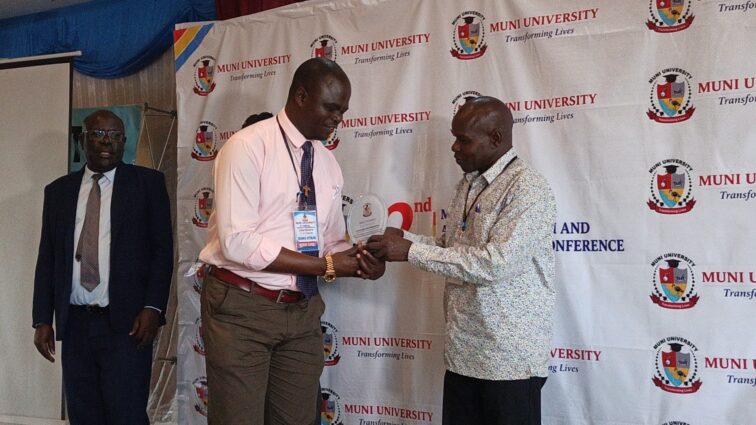
Associate Professor Dennis Zami Atibuni in Neck tie receive his Award from Dr. Moses Kibirai the Vice Chairperson Muni University Council. Photo// Dramadri Federick
By Dramadri Federick
Associate Professor Dennis Zami Atibuni has been named the overall Researcher of the Year 2026 at Muni University, emerging top at the institution’s Second Research Dissemination and Exhibition after scoring 34.50 percent in the assessment.
Atibuni, who also won the Best Education and Human Development category, was recognised alongside other researchers whose work spans education, agriculture, environmental conservation, natural resources management, basic and applied sciences, and emerging technologies and digital innovations.
The awards were presented by the Muni University Council at Hotel Desert Breeze in Arua City during the research dissemination and exhibition, an event designed to provide a platform for researchers to share findings, exchange knowledge and demonstrate how academic research can contribute to solving societal challenges.
Atibuni’s recognition highlights his contribution to educational research and scholarship. He holds a Doctor of Philosophy in Educational Psychology from Mbarara University of Science and Technology and has authored and co-authored several refereed books, academic journal articles and book chapters.
He also serves as a reviewer and board member for different international academic journals, contributing to the evaluation and dissemination of scholarly work.
His performance placed him ahead of other researchers assessed during the exhibition, which brought together research outputs from different academic disciplines.
Associate Professor Morgan Andama emerged second in the overall rankings, scoring 32.25 per cent for his presentation on the topic ‘Sanitary Risk, Bacteria Contamination of Drinking Water Sources and their health impacts in Selected Primary Schools in Arua District’. Mshilla Mghanga followed in third position with 31.17% for the Technological Innovations and Municipal Solid waste management: the case of selected cities in Northern Uganda topic and won the Best Emerging Technologies and Digital Innovations category, recognising research in an area increasingly associated with technological advancement and the development of solutions to contemporary challenges.
Akena Geoffrey Oyoo scored 29.33 per cent for the topic A dynamic panel threshold Analysis of Inflation and economic growth: the moderating role of financial sector development in sub-Saharan Africa, while Betty Akwong obtained 29.17 per cent for the Validating Traditional Medicines: Athnobotanical Solutions for Candidiasis in Northern Uganda topic and was recognised as the best researcher in Basic and Applied Sciences.
Whereas Dr Cyrian Osinde completed the top six overall rankings with 27.50 per cent and won the Best Agriculture, Environment and Natural Resources Management category for the research on Genetic and Volatile dense Determinants of Sorghum Susceptibility to Stem-Borer Herbivory.
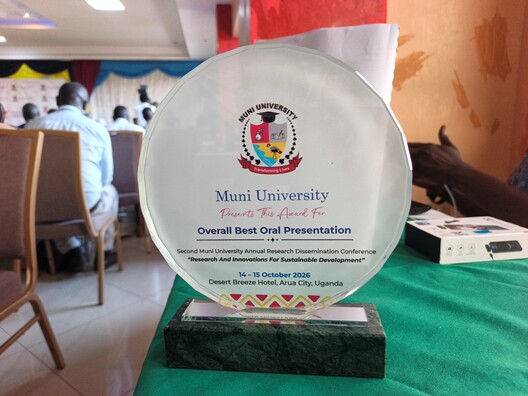
Winner’s plaque for the Overall Best Oral Presentation of research. Photo//Dramadri Federick
The exhibition recognised researchers in six major categories of Education and Human Development; Emerging Technologies and Digital Innovations; Basic and Applied Sciences; and Agriculture, Environment and Natural Resources Management, Health Medicine and Wellbeing, and Leadership, governance and Business based on seven parameters evaluated by a panel of three adjudicators reflecting the university’s broad research interests, ranging from human development and scientific inquiry to technological innovation, agricultural productivity and environmental sustainability.
According to the assessment framework presented for the exhibition, researchers were evaluated against seven assessment parameters by a panel of three adjudicators.
The use of defined assessment parameters and a panel of adjudicators provided a framework for reviewing the research submissions across the participating disciplines.
Speaking during the exhibition, Professor Robert Kajobe, Director of Graduate Training, Research and Innovations at Muni University, said the second edition attracted an overwhelming number of research abstracts from members of the public.
Kajobe said the response demonstrated the interest that people have in research and development, adding that the exhibition provides an opportunity for academics to present their work beyond the confines of academic institutions.
He explained that research dissemination enables scholars to share findings, exchange ideas and demonstrate the practical value of their work.
The platform also creates opportunities for research findings to reach people who may benefit from the knowledge generated, including policymakers, development practitioners, local communities and other institutions.
“This Conference is very important in that it has drawn researchers from within west Nile sub-region, from Muni University, and others from other universities across the country, NARO and Africa”. Professor Robert Kajobe, Director of Graduate Training, Research and Innovations at Muni University, explains the significance of the research exhibition.
Research dissemination is an important part of the academic process because findings can have limited practical value if they remain confined to academic papers and institutional libraries.
By presenting research to a wider audience, universities can encourage discussion, strengthen collaboration and create opportunities for evidence to inform decisions affecting communities.
For an institution such as Muni University, which serves communities in the West Nile sub-region and beyond, the exhibition offers a platform to connect academic research with challenges in education, livelihoods, agriculture, technology and environmental management.
However, the wider impact of such research depends on how findings are communicated, adopted and translated into practical interventions.
The Vice Chairperson of the Muni University Council, Dr. Moses Kibirai, said the university’s research capacity and outputs were beginning to generate impacts in communities.
Kibirai encouraged lecturers and researchers not to keep the knowledge they generate to themselves but to pass it on to students to ensure continuity.
He said sharing knowledge with students is important in strengthening academic development and preparing future generations to contribute to research and innovation.
“I participated in all these presentations keenly, trying to understand the extent we have gone, I think we are there, if I can see young researchers stand before the gathering to present their research topics without trembling, I think that is big achievement”. Dr Moses Kibirai, Vice Chairperson of the Muni University Council.
The call places emphasis on the relationship between research, teaching and community development.
Universities are expected not only to generate new knowledge but also to ensure that students acquire the skills and understanding required to build on existing research.
Knowledge transfer can take different forms, including classroom teaching, student research projects, mentorship, academic publications, community engagement and collaboration with organisations that can apply research findings.
When researchers involve students in these processes, they can help build a pipeline of emerging scholars while strengthening the connection between academic learning and practical problem-solving.
The council’s message also highlights the importance of ensuring that research achievements contribute to the university’s long-term academic development rather than remaining individual accomplishments.
The Chairman Scientific committee that Organized the 2026 Muni University Research Dessimination Conference Dr. Jonathan Izudi says, said the second edition attracted an overwhelming number of research abstracts from members of the public, demonstrating growing interest in research and development.
“We received 262 abstract papers and we were able to grade them, signifying the demand for research in this region”. Dr. Jonathan Izudi said
The breadth of the categories demonstrates the university’s interest in research across multiple disciplines, although the practical value of individual projects ultimately depends on their findings, relevance and uptake.
The assessment of research across different fields also provides an opportunity to recognise academic work that might otherwise receive limited public attention.
Muni University strengthens its research and innovation profile
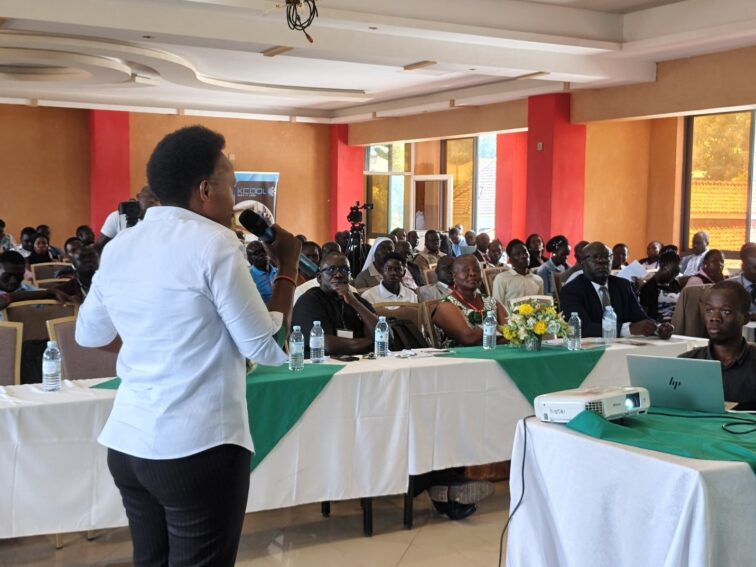
Participants pay keen attention during presentation at the conference. Photo// Dramadri Federick.
The recognition of researchers at the exhibition comes as Muni University continues to strengthen its profile in higher education, research and innovation.
In September 2026, the university received the inaugural Africa Higher Education for Transformation Prize, valued at three million US dollars, approximately 11.7 billion Uganda shillings.
The prize was established by the Mastercard Foundation and was presented at a ceremony in Accra, Ghana.
Muni University was recognised as the only Ugandan university among five institutions across Africa to receive the inaugural award.
The continental recognition adds to the university’s growing visibility in higher education and highlights the importance of institutional investment in research, innovation and academic development.
The Research Dissemination and Exhibition provides another opportunity to showcase research activities within the university and recognise individuals contributing to knowledge production.
While the continental prize recognises institutional achievement, the Researcher of the Year awards place the spotlight on individual researchers and their contributions across different academic disciplines.
Together, the two recognitions draw attention to the role universities can play in generating knowledge, nurturing future researchers and supporting solutions to challenges facing communities.
Research must translate into practical solutions
The Second Research Dissemination and Exhibition 2026 has reinforced the importance of creating opportunities for researchers to share their work and engage with wider audiences.
The recognition of Atibuni as the overall researcher of the year, alongside the category winners, celebrates academic work across education, science, technology, agriculture and environmental management.
The university leadership has also emphasised the need to extend research benefits beyond academic publications by sharing knowledge with students and ensuring that research contributes to community development.
The next challenge is to sustain this momentum by strengthening collaboration between researchers, students, policymakers, development partners and communities.
Such collaboration can help ensure that research findings are not only presented at exhibitions but also understood, tested and applied where they can make a difference.
For Muni University, the exhibition offers a platform to celebrate research achievements while encouraging continued investment in knowledge generation, innovation and the development of practical solutions to societal challenges.
Upcoming on 90.9 FM
Upcoming on 94.5 FM
Upcoming on 101.4 FM
Upcoming on 104.8 FM
















Comments
This post currently has no comments.