
CONCERN FOR TREE PLANTING INTENSIFIES AMONG STAKEHOLDERS
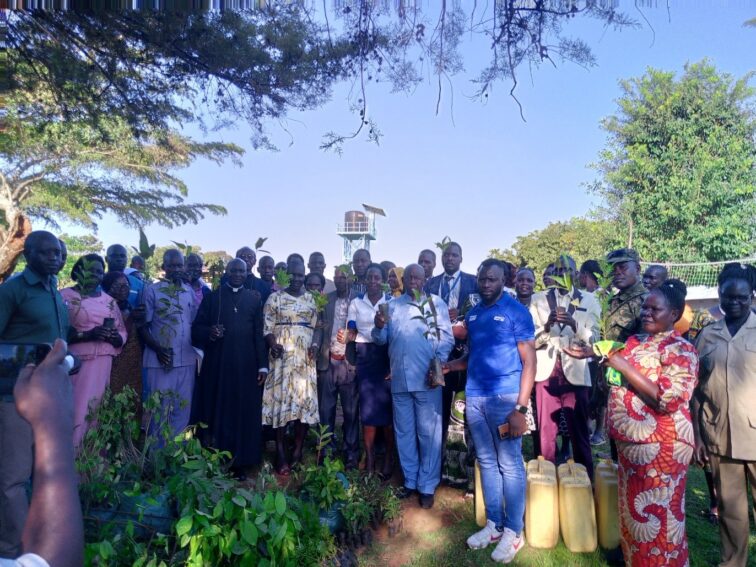
Stakeholders posed for a group photo at Logiri Girl’s SS with seedlings of different tree species for planting. Photo// Erema.
By Erema George
Arua City
The advocacy for tree planting in communities to tackle the shifting climatic conditions remains vital for the foresters and stakeholders in ensuring the environment is conserved and protected.
Addressing stakeholders during the Arua diocese education week on Thursday August 28, 2026 in Arua district, the District Forest Officer (DFO) Arua District Local Government (ADLG) Lillian Ayiru lamented on the human activities degrading the environment.
“There’s an impact of climate change on our environment which is caused by us human beings. We have cut down all the trees, we are excavating murram, we are on quarrying, we are mining sand at the river banks which is not a very good initiative; the foresters are saying cut one tree, plant five which we are not doing,” Ayiru lamented.
According to the records from the Arua Diocese Education office, tree planting has been a key activity on every education week, symbolizing the need to promote tree planting across the diocese of Arua.
Ayiru has urged teachers and parents to encourage students to take active part in tree planting in their homesteads as a way of promoting the mission of the diocesan education department;
“We are now going on ground requesting parents, we are requesting communities to embrace tree planting, to encourage our children to plant trees. When you have a candidate child, why don’t we encourage that child from p7, s4 and s6 to plant a tree and name it p7, plant a tree and name it s4 and plant a tree and name it s6 so that by the time maybe you complete university you will be also having your own children, you will be harvesting this and pay school fees,” Ayiru encouraged.
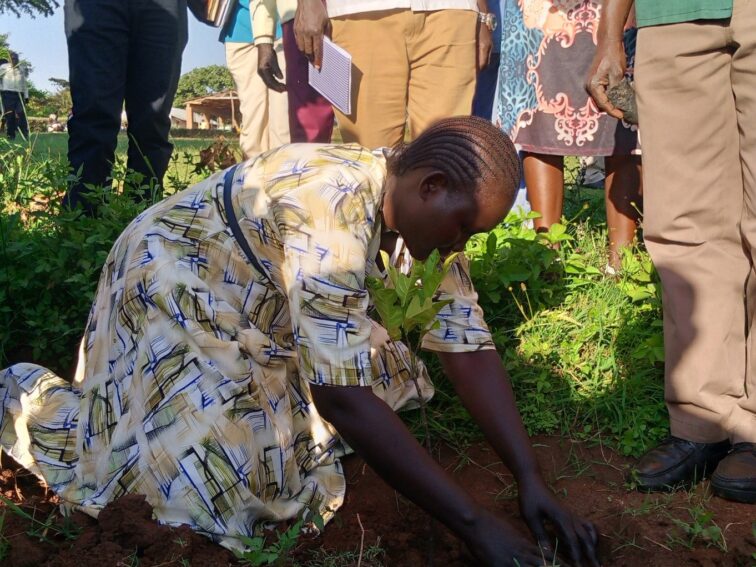
Arua District Local Government Forest Officer (DFO) Lillian Ayiru demonstrates tree planting. Photo// Erema.
Forests contribute over US$1.3 trillion annually to the global economy and sustain livelihoods for more than 1.6 billion people worldwide. In the West Nile sub-region of northwestern Uganda, forests serve as a foundational pillar for local economies, driving both informal and formal financial systems. It also has more other benefits for institution like school making it more ideal for schools to give priority to tree planting.
Different tree species including fruit trees were planted at Holy Trinity Logiri Girl’s secondary school to mark the 2026 education week and Rev. Fr. Emmanuel Asega, the diocesan education secretary said trees serve several purposes in schools encouraging schools in Arua Diocese to give priority to planting trees in the schools;
“It keeps very cool climate good for academic excellence. You sit for books and you really absorb, so we really need trees for so many purposes. We need wood fuel, we need fruits etc. And because of that we cannot do without planting trees. As we use trees, as we benefit from trees, we need to conserve trees and propagate them for these other purposes,” Fr. Asega noted.
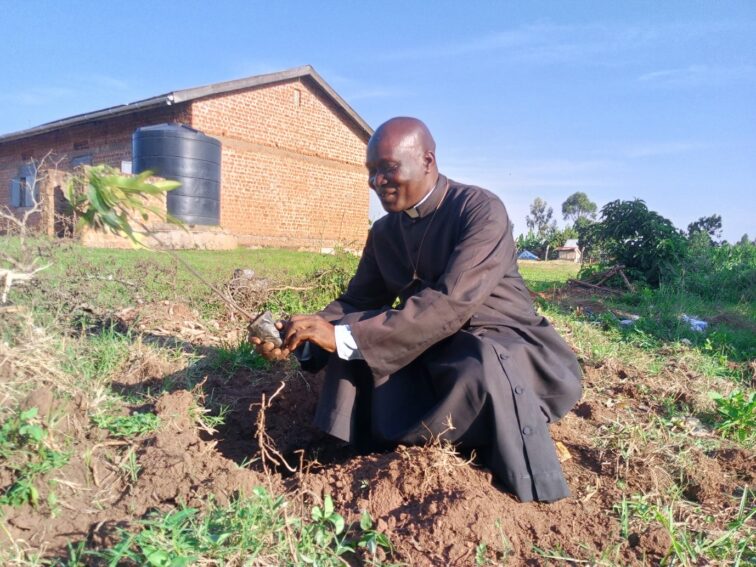
Rev. Fr. Emmanuel Asega, the diocesan education secretary of Arua planting a tree during the education week at Logiri Girl’s SS. Photo//Erema.
Meanwhile Francis Adrapi, the Board of Governor’s (BOG) chairperson of the school has urged learners to promote the tree planting initiative in their neighborhood in order to tackle the climate challenges.
“When they go back they also need to urge their parents to help them plant trees in their immediate neighborhood so that this tree planting should actually become a regular exercise in every home, every village if we are serious on improving our climatic condition,” Adrapi said.
Tree planting and landscape restoration efforts across the West Nile sub-region in Uganda is still challenged by rapid deforestation driven by high population pressure, refugee settlements, and wood-fuel demand characterized by charcoal burning.
And multiple government, None Government Organizations (NGOs), and community-led interventions have been implemented to promote tree planting and combat severe deforestation in the West Nile sub-region including National Forestry Authority (NFA) Collaborations, District-Led Campaigns in Arua and Yumbe local governments
The Forests and Protected Areas for Climate Smart Development (IFPA-CD) implemented via the Ministry of Water and Environment with World Bank funding, supporting commercial woodlots and landscape restoration across West Nile districts like Arua, Koboko, Yumbe, and Adjumani, UNHCR and NGO Greening Initiatives, Dan Church Aid (DCA) and World Vision in refugee communities.
Upcoming on 90.9 FM
Upcoming on 94.5 FM
Upcoming on 101.4 FM
Upcoming on 104.8 FM



















Comments
This post currently has no comments.