
DELAY IN OIL CASH COMPLICATES FOREIGN EXCHANGE AND RESERVE OUTLOOK
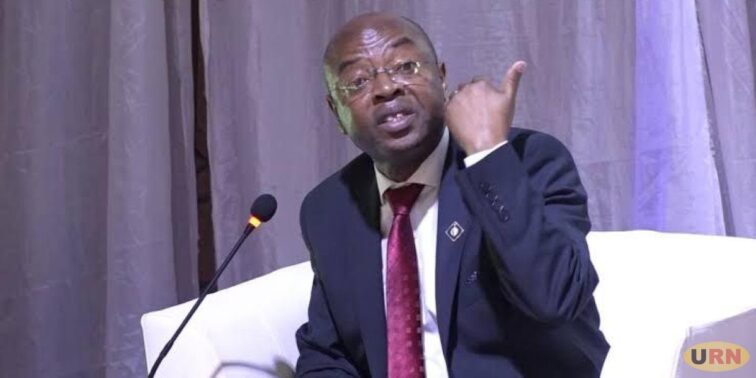
Bank of Uganda Deputy Governor Professor Augustus Nuwagaba
URN
The delayed start of commercial oil production is complicating the country’s efforts to rebuild foreign-exchange reserves and ease pressure on the balance of payments.
The Bank of Uganda warned that anticipated oil export earnings will not materialise in the current financial year as previously projected.
In the 2026/27 financial year, the government was expecting oil exports to contribute to its external financing position. The government had expected over four billion dollars from oil exports, but, going by the latest development, there will be zero dollars from oil exports.
With production postponed, the Bank of Uganda is confronting a weaker reserve accumulation outlook while trying to contain exchange-rate pressure through tighter domestic liquidity.
Bank of Uganda Governor Michael Atingi-Ego says the Central Bank had factored oil exports into its projections for the 2026/27 financial year, expecting the first shipments to provide additional foreign exchange at a time when the country’s external position was already weakening.
However, with first oil now unlikely before the next financial year, the expected inflows have been pushed further into the future, leaving a gap in the country’s balance of payments.
The development comes as the country deals with reduced foreign-exchange inflows, a widening current-account deficit and pressure on the Ugandan shilling, which depreciated from about 3,700 to 4,100 against the US dollar before recently experiencing some appreciation.
Addressing journalists after the November Monetary Policy Committee meeting, Atingi-Ego said the Bank’s projections for reserve accumulation in the current financial year were considerably weaker than those of the previous year, when Uganda accumulated about 2.4 billion dollars in reserves.
“Recall earlier on we had been told that we were expecting the first oil production in 26-27. Now certainly we had factored that we were going to get some money into our balance of payments through exports of oil. Now the latest we have is that the earliest this oil is going to come is, some are saying June. I don’t know when, but it’s not this financial year. This is what I understand,” Atingi-Ego said.
“Because of that gap, something has to be done. And that is why we are having these pressures,” he explained
He said the absence of the anticipated oil exports would create a gap that would require adjustments elsewhere in the economy.
“It means that all that we were expecting from oil is going to be zero and therefore creating a gap in the balance of payments. Now, how do we balance that gap? That gap, something has got to adjust, and that’s why we’re having all these pressures at the moment,” he said.
Atingi-Ego said oil exports could help ease the current-account pressures when production eventually starts, but cautioned that the relief would be temporary unless Uganda strengthens its other sources of export earnings.
He cited agro-industrialisation, tourism and mineral development, which are among the pillars of the government’s Tenfold Growth Strategy, as areas that could contribute to stronger export earnings. The country needs foreign exchange to finance imports, meet external obligations and build reserves, but its traditional sources of foreign-exchange earnings are facing an uncertain outlook.
Atingi-Ego attributed the shilling’s depreciation from approximately 3,700 to 4,100 against the US dollar largely to weakening conditions in the external sector, particularly the current-account balance.
He explained that dollar inflows had declined while demand for foreign exchange remained relatively strong, creating pressure on the exchange rate. “Because of the weakened external environment, the inflows reduced; the dollar inflows to Uganda reduced, but then the demand for these dollars did not reduce as much,” he said.
The Governor said the exchange rate had adjusted to the imbalance, with the depreciation reflecting the reduced availability of foreign exchange in the market.
There is uncertainty over international coffee and gold prices. Both commodities are important sources of export earnings, and any moderation in their prices could further constrain foreign-exchange inflows and reserve accumulation.
The Governor acknowledged that the external environment was not working in Uganda’s favour, raising questions about how the country would strengthen its external buffers in anticipation of possible shocks. Despite the underlying pressure on foreign-exchange inflows, the shilling has recently experienced appreciation pressures.
Atingi-Ego attributed this partly to foreign investors bringing dollars into the country to purchase government securities and partly to the Bank’s efforts to reduce the availability of Ugandan shillings in the market.
He disclosed that the government raised 1.8 trillion shillings through a recent Treasury securities auction, with non-resident investors accounting for approximately 12 to 13 per cent of the amount.
The foreign investors brought dollars into the market to acquire government securities, increasing the supply of foreign exchange.
At the same time, monetary policy tightening reduced the amount of shilling liquidity available in the banking system. With fewer shillings circulating, demand for foreign exchange also declined.
“The acquisition pressures we saw since then [were] attributed to two key factors. One, the improved supply of dollars in the market through the offshore players coming in for this auction. And then the other is the reduced demand because I talked about the shillings actually becoming scarcer,” Atingi-Ego said.
He said the combination of additional dollar supply and reduced demand for foreign exchange had contributed to the recent appreciation pressures.
The Governor, however, cautioned that the exchange rate remained volatile and that the full impact of the Bank’s previous monetary policy decisions had not yet worked through the economy.
The Bank increased the Central Bank Rate by 225 basis points to 12 per cent on October 14, 2026.
Atingi-Ego said the effects of that decision were still filtering through the financial system and that tighter conditions were expected.
The Bank’s efforts to reduce demand for foreign exchange and contain inflation through tighter monetary conditions could also affect businesses and households that depend on bank credit.
Professor Augustus Nuwagaba, who addressed questions on the monetary policy outlook, said the Bank was balancing the need to contain inflation against the possible effects of tighter credit conditions on economic growth.
He said private-sector credit was growing at approximately 20 per cent as of September, while lending interest rates averaged 17.4 per cent during the quarter to September.
The credit growth was above the Bank’s preferred range of 12 to 13 per cent, suggesting that tighter liquidity could moderate borrowing without necessarily undermining the Bank’s credit objectives.
Nuwagaba explained that the tightening measures would make Uganda shillings more expensive and require commercial banks to rely more on their own liquidity rather than borrowing from the Central Bank at a penalty.
“If a bank wants to borrow from Bank of Uganda, it will be at a penalty, so they have to use their own liquidity,” he said.
He added that the extent to which this would translate into higher lending rates and lower credit would depend on how commercial banks responded. The implications could be significant for businesses that depend on bank financing for working capital and investment, particularly if tighter liquidity persists.
The November Monetary Policy Committee maintained the Central Bank Rate at 12 per cent but widened the operating bands around the rate from two to three percentage points on either side.
The Bank also set the margins for the rediscount and bank rates at four and five percentage points above the Central Bank Rate, respectively. Nuwagaba said the Bank remained concerned about the inflation outlook, with core inflation projected to edge above six per cent in the coming months against the medium-term target of five per cent.
He said the Bank was also mindful of the consequences of tightening monetary policy too aggressively, particularly its effect on economic output. However, he warned that further increases in inflation could require another round of monetary tightening.
“Supposing core inflation was to edge up further to seven and headline into double digits, does monetary policy stand and pray that it will come down by itself? Obviously, no. So, it would require another round of action of monetary policy,” Nuwagaba said.
He said the Bank would continue adjusting its policy according to how inflation and other economic indicators evolve.
The delayed oil start therefore adds another complication to an economy already dealing with weaker external inflows, uncertainty over commodity export earnings and pressure on the shilling.
While future oil exports could provide some relief, the Bank of Uganda says strengthening the country’s other export sectors remains necessary to address the underlying current-account imbalance.
Upcoming on 90.9 FM
Upcoming on 94.5 FM
Upcoming on 101.4 FM
Upcoming on 104.8 FM







Comments
This post currently has no comments.