
EBOLA THREAT: UNMONITORED CROSS-BORDER TRADE UNDERMINES UGANDA’S HEALTH SECURITY EFFORTS
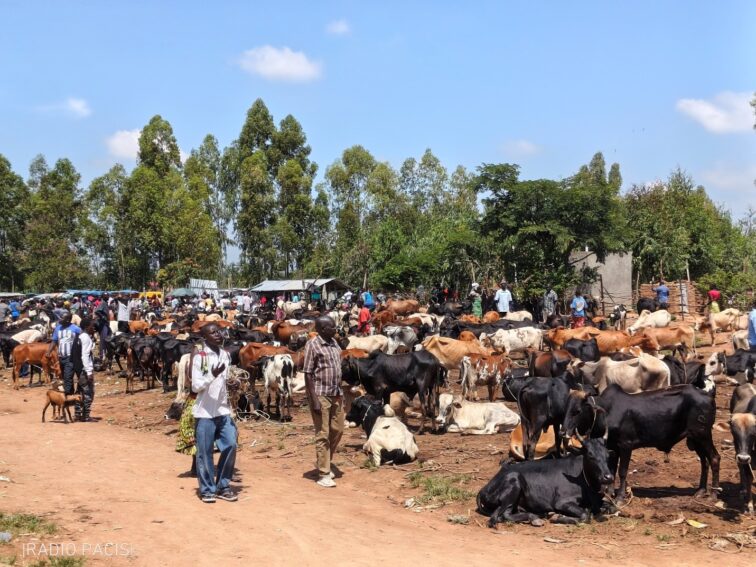
Booming cross-border livestock trade in DRC which shifted from Ugandan side attracting traders and buyers from both countries as of Monday November 09, 2026 (All photos by Onzoma Albert)
By Onzoma Albert
Arua City
The thriving cross-border trade at Odramacaku, along the Uganda-Democratic Republic of Congo (DRC) border is seriously undermining health protocols, despite Uganda’s efforts to maintain its Ebola-free status and enforce restrictions.
When the Ugandan government closed local border markets to prevent viral transmission, traders adapted and shifted their operations to the DRC side of the border. This shift has created critical challenges for regional health security.
Moses Adriko, a former Arua City councilor and now a trader at Odramacaku, appealed for concerted efforts from relevant authorities to contain the Ebola virus.
He highlighted that because the market now operates just across the thin border line in the DRC, traders and buyers cross back and forth using informal, unmonitored footpaths.
“Our fear as of now is the Congolese because as Ugandans we are trying our level best to observe the SOP’s but because of business we keep on mixing ourselves with them as our survival is across the border as they get survival from us we also get survival from them, we as traders pray that Ebola is seriously contained otherwise if Ebola virus happens to breakout here both Ugandans and Congolese will die and our people are operating on God’s mercy” he said.
This allows thousands of people daily to bypass mandatory temperature checks, symptom screenings, and the required 21-day self-isolation protocols established at official checkpoints.
Esau Juruni, a livestock trader, urged authorities to revive Ebola virus standard operating procedures and properly manage the uncontrolled cross-border movements along the porous border points between Uganda and DRC.
“Right now the items put in place for containing Ebola virus are not there as people are struggling by themselves, the movements from the border here is as usual, people behave as if there is no Ebola virus,” he said.
Cross-border trade is identified as the primary economic lifeline for communities in this region. The risk of goods spoiling and losing livelihood forces traders to find work around, making physical border market closures less effective.
Rt Maj Betty Akello Otekat, Arua City Resident City Commissioner and chairperson of the Arua City Ebola task force, encouraged the public to continue observing Ebola virus standard operating procedures and increase their vigilance to better manage the disease.
“We are closely monitoring the ongoing severe outbreak of Ebola virus in DRC which continues to create serious health threat to Uganda, our people should remain extremely vigilant, adhere to health guidelines issued by the ministry of health and report any unusual symptoms or health concerns to authorities immediately” she said.
The Odramacaku area is characterized by highly porous terrain, which makes formal enforcement incredibly difficult.
While official vehicle and cargo transit are subjected to tight regulations, pedestrian traffic to and from the shifted DRC market remains largely untracked.
Recognizing that blanket closures often drive trade underground and increase untracked transmission risks, health authorities are adjusting their strategies.
The World Health Organization (WHO) has highlighted Uganda’s direct collaboration with the DRC to strengthen cross-border health security.
This collaboration includes supporting the establishment of Ebola treatment and screening units in nearby Congolese health zones like Aru, aiming to capture and manage risks at the source before they cross the border.
Uganda had previously confirmed an outbreak of Bundibugyo virus disease on May 15, 2026, following a cross-border introduction involving DRC nationals seeking care in Ugandan hospitals.
Through a coordinated response, Uganda successfully interrupted local transmission and declared the outbreak over on July 28, 2026, with no subsequent confirmed cases.
However, the report emphasizes that the end of local transmission does not mean the risk has ended. Uganda shares a border with the DRC, where transmission continues, and communities remain closely connected through trade, travel, and family ties.
Recent cases involving travelers from the region further underscore the need for continued vigilance. As of early November 2026, the Democratic Republic of the Congo (DRC) had recorded 10,741 confirmed cases and 5,230 deaths related to the ongoing Ebola outbreak caused by the Bundibugyo virus, according to data from the African Centre for Disease Prevention and Control.
Upcoming on 90.9 FM
Upcoming on 94.5 FM
Upcoming on 101.4 FM
Upcoming on 104.8 FM







Comments
This post currently has no comments.