
FEATURE: NIRA TO HOST NATIONAL ID EXPO AS MILLIONS REMAIN OUTSIDE REGISTER
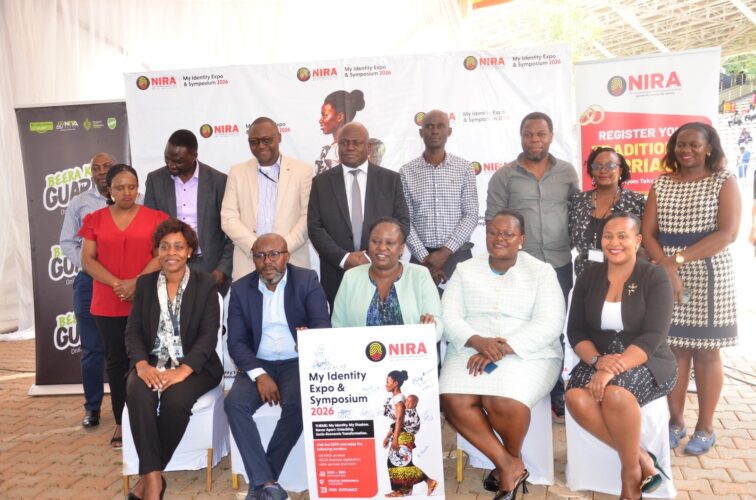
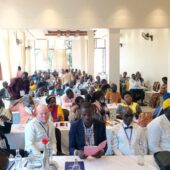
NIRA ED (centre sitting) and other officials after the launch of the Expo.
NILE POST
The National Identification and Registration Authority (NIRA) is set to host an Identity Expo and Symposium aimed at accelerating national identification coverage and bringing together public and private sector stakeholders to examine the growing importance of identity in Uganda’s economy and access to essential services.
The forthcoming expo set for September 24 to 26, 2026 will provide a platform for government agencies, private-sector institutions, citizens and other stakeholders to discuss the role of identification in areas including financial services, taxation, digital government, social services, citizenship and economic participation.
Speaking during the launch on Monday, NIRA Executive Director Rosemary Kisembo said Uganda currently has about 35.58 million people on the national register, representing approximately 75 percent of the country’s population.
However, she said millions of Ugandans remain outside the national identification system, creating an urgent need to accelerate registration as Uganda works towards the global target of providing legal identity to everyone by 2030.
“Uganda is currently at about 75 percent of the population on the national register, but we still have millions of Ugandans who have not been captured. The clock is ticking, and our objective is to ensure that everybody is on the register. We cannot talk about inclusive development when a significant number of people remain invisible in the systems through which government and the private sector deliver services,” Kisembo said.
She said the expo and symposium were conceived as a platform for stakeholders to move beyond discussions about the national ID as simply a document and examine the wider role of identity in people’s daily lives.
“We have had this conversation for many years, but we have also recognised that information about identity is sometimes concentrated in different sectors. We therefore wanted to create a platform where all stakeholders can come together, meet face-to-face and have a broader conversation about why identity matters, who needs to be identified, when identification should happen and how we can make the process work better for everyone,” she said.
Kisembo said the discussions during the expo and symposium would also seek to demonstrate the consequences of being excluded from formal identification systems.
“Imagine that you are physically present in this room, but nobody knows who you are and the systems around you cannot recognise you. You are there, but for purposes of accessing services, participating in the economy or being recognised by institutions, you are invisible. That is what happens when people are not properly identified,” she said.
According to Kisembo, reliable identification is increasingly important for ensuring that citizens can access government and social services.
“Everybody needs to be identified for access to government services and social services. Identification is also about recognising an individual as a person who has a purpose, a plan and a contribution to make to society. Your identity should enable you to participate, rather than become a barrier to participation,” she said.
The expo will also examine the importance of birth and death registration, citizenship, migration and contested identity.
Kisembo said NIRA intends to use the event to create an open discussion around cases where people’s identities or citizenship have been challenged.
“We shall have an open debate on contested identity. We want people who have had their identity contested to come and tell us their side of the story. Why was their identity contested? Was the process fair? What can we do differently? At the same time, there are situations where the authorities have a responsibility to establish that someone is not a Ugandan citizen. These are complex issues, and we need an honest conversation about them,” she said.
The symposium will also consider the relationship between national identity and the economy, including the use of the National Identification Number (NIN) in electronic Know Your Customer processes, financial services, taxation and other transactions.
Kisembo said the event would also provide an opportunity to reflect on the NIN’s development over the past decade.
“This year marks 10 years of the NIN, and that gives us an important reason to celebrate and reflect. The NIN is increasingly becoming part of the way a person’s identity is recognised across different areas of life — from your SIM card and financial services to taxation and other transactions. We want Ugandans to understand that their name and their NIN are increasingly becoming part of their identity and their ability to participate in society,” she said.
Andrew Philip Wabulya, Executive Director for Risk and Strategy at the Bank of Uganda, said harmonising identity information across institutions would make it easier to distinguish between individuals and establish that financial institutions are dealing with the correct customers.
“Identity gives institutions the ability to know that they are dealing with the right person. Today, an individual can have different documents or their name can appear in different forms across different systems. If those identities are not harmonised, it becomes difficult to establish whether two records belong to the same person or to different people,” Wabulya said.
He said the problem has implications for fraud prevention, credit assessment and access to financial services.
“One of the biggest reasons we need a reliable and harmonised identity system is to fight fraud and money laundering. Bank of Uganda and the Financial Intelligence Authority have a strong interest in Know Your Customer requirements because financial institutions must be able to establish who they are dealing with. If one person appears under different identities, it becomes possible for transactions, loans or other financial activities to be associated with different people when they are actually linked to one individual,” he said.
Wabulya said a unified identity could also help prevent multiple borrowing and improve the accuracy of credit histories.
“If someone borrows from one financial institution or through one mobile money channel and fails to repay, then goes somewhere else using another identity or number, the financial system needs a way of knowing that it is the same person. A reliable identity allows institutions to build an accurate credit history and make better decisions about whether someone can afford to take on additional credit,” he said.
He also pointed to potential benefits for people holding investments and financial assets.
“If you have savings, government securities or other investments and you pass away, your beneficiaries need to be able to establish that those assets belonged to you. Where names appear differently or there is no unique identifier, tracing ownership becomes difficult. A unique identity makes it easier to establish who owns an asset and who should legally benefit from it,” Wabulya said.
According to Wabulya, harmonised identification could also reduce duplication in the financial sector and make account opening faster.
“We want to move away from a situation where the same customer has to provide the same information repeatedly to different institutions. If the identity can be verified electronically, processes such as account opening and KYC can become much faster. Instead of filling several forms with essentially the same information, a verified identity can allow institutions to obtain the information they need more efficiently,” he said.
Wabulya said the benefits extend to the development of Uganda’s digital financial infrastructure and national payment systems.
“As the digital economy grows, identity becomes even more important. We need to know who is participating in the payment system, who is receiving money and who is authorised to use particular services. A trusted identity system gives financial institutions and the wider economy confidence that the person on the other side of a transaction is who they claim to be,” he said.
NITA-U links national ID to digital government
The Director of e-Government Services at NITA-U, Julian Rweju said national identification is increasingly becoming a foundation for accessing government services as more public services move online.
“One of our key responsibilities is to ensure that citizens can access government services seamlessly, and that requires government systems to be able to establish who the person accessing a service is. Without a reliable identity system, it becomes difficult to provide secure and trusted digital services,” Rweju said.
He said the importance of the national ID would become even more apparent as government continues to digitise its services.
“In the future, more government services will be accessed online, and citizens will increasingly be required to identify themselves digitally. The national ID is therefore not simply another document that you keep in your wallet. It is becoming a foundation for accessing services, proving who you are and interacting with government in a digital environment,” he said.
Rweju said NITA-U was working with government institutions to integrate systems and support digital authentication.
“We are integrating government systems so that citizens do not have to experience government as a collection of disconnected institutions. When you access a service online, the system should be able to securely authenticate you and establish that you are the person you claim to be. That is where the national ID and digital authentication become very important,” he said.
He added that a trusted identity system would also contribute to data security and strengthen confidence in online transactions.
“As we move more services online, trust becomes fundamental. Government needs to know who is accessing its services, and citizens need to trust that the systems they are using are secure. Reliable national identification helps us establish that trust while also supporting efforts to protect citizens’ data,” Rweju said.
She noted that NITA-U also sees national identification as important to efforts to strengthen the management of Ugandan data.
“We are increasingly talking about data sovereignty and the importance of having trusted data within the country. But before you can provide effective digital government services, you must first be confident about the identity behind the data. We need reliable information about our citizens so that technology can be used to provide better and more secure government services,” Rweju said.
Expo to bring stakeholders together
NIRA says the expo will bring together government agencies, financial institutions, businesses, technology companies, development partners and citizens to demonstrate how identity is already being used across different sectors.
The discussions are expected to cover financial inclusion, e-KYC, taxation, digital government, mobile communications, social services, citizenship and the broader economic value of reliable identification.
Kisembo said the event is ultimately intended to build a shared understanding of why every eligible person should be captured in the national identification system.
“We want this to be more than an exhibition. We want it to be a conversation about who we are as Ugandans, why we register, why births and deaths must be registered, why citizens and legally resident non-citizens need to be properly identified and how we can do things differently to ensure that nobody is left behind,” she said.
With Uganda still having millions of people outside the national register, NIRA is positioning the expo as part of a broader effort to close the identification gap before 2030.
“Ultimately, we want 100 percent of the population on the register. Your name and your NIN should not simply be numbers in a database. They should represent your recognised identity and enable you to access the services, opportunities and rights that come with being part of society,” Kisembo said.
Upcoming on 90.9 FM
Upcoming on 94.5 FM
Upcoming on 101.4 FM
Upcoming on 104.8 FM














Comments
This post currently has no comments.