
FEATURE: UGANDA TO SEND HEALTH WORKERS TO SOUTH SUDAN AS EBOLA THREAT GROWS
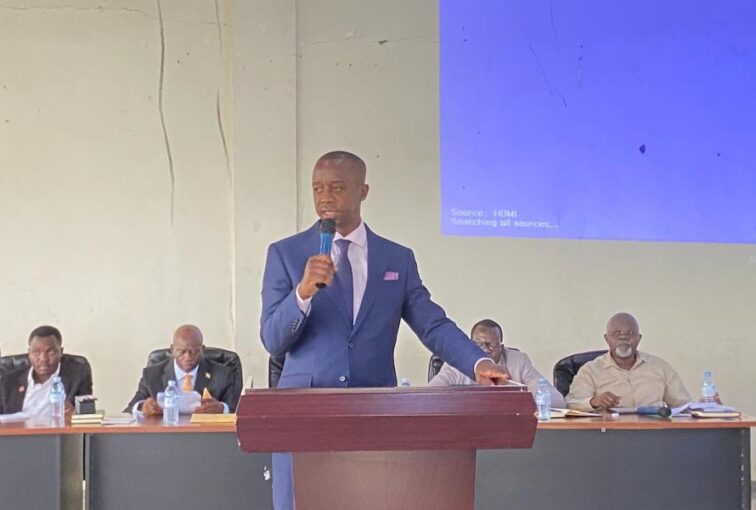
Dr. Charles Ayume speaking to stakeholders while announcing the plan at Muni University (Photo by Musa Sabir)
By Martin Anguyo
Arua City
The Ugandan government is preparing to deploy a team of health workers to South Sudan to support the country’s preparedness and response against Ebola, as the deadly disease continues to spread in the region and raises concerns about further cross-border transmission.
The announcement was made by the State Minister for Primary Health Care, Dr Charles Ayume, during a meeting on Ebola Virus Disease (EVD) with West Nile leaders held at the Muni University Conference Hall.
According to Dr Ayume, Uganda’s decision to extend technical support to South Sudan is part of a broader regional strategy aimed at stopping the virus before it crosses another international border.
“We are signing a MoU with S.Sudan because we don’t want to enter into Sudan and here we are free from the disease, and you know what it means. That is the strategy which we are going through in terms of health care,” Dr Ayume said.
The move comes at a time when health authorities across the region are increasingly concerned about the movement of people between Uganda, South Sudan and the Democratic Republic of Congo (DRC), where the current Ebola outbreak has continued to place pressure on already fragile health systems.
Dr Alfred Driwale, the Commissioner of Health Services at the Ministry of Health, says Uganda’s intervention beyond its borders is primarily aimed at protecting its own population by strengthening preparedness in neighboring countries.
“Our effort in fighting the disease in other countries is to prevent the disease from spreading further into Uganda, our aspiration is to ensure that Uganda lives long and happy lives so that they are productive and enjoy their country” Dr. Driwale said.
The argument reflects the growing importance of regional cooperation in containing Ebola, particularly in border communities where trade, migration and other forms of movement make it difficult to completely separate populations.
Jimmy Opigo, who has been placed in the DRC to oversee Uganda’s Ebola response efforts, also supports the deployment of Ugandan health workers to South Sudan, saying, the close economic and social bonds between Uganda and South Sudan mean that strengthening South Sudan’s preparedness could ultimately serve as an additional layer of protection for Uganda.
“Despite the fact that Uganda and South Sudan trade amongst themselves, this will prevent further spread of the disease. Diseases do not have transport, they are moved by other means of transport, so people movement and people congregation in markets, the disease then moves from one person to another” Opigo said.
The proposed deployment comes against the backdrop of a serious Ebola situation in the neighboring DRC. The World Health Organization has classified the risk of the outbreak in the DRC as very high, while countries sharing land borders with areas where the Bundibugyo virus has been detected face a high regional risk because of population mobility, cross-border trade and varying levels of preparedness.
A modelling study has also highlighted South Sudan as one of the countries facing a significant risk of Ebola importation from the DRC, estimating the probability of cross-border spillover at about 69.3 percent over the period assessed. The figure is a modelling estimate rather than evidence that Ebola is currently present in South Sudan.
As of the latest available assessments, South Sudan has not reported confirmed Ebola cases, but its geographical proximity to the DRC and the movement of people across the region continue to make preparedness a priority.
A Canadian public-health risk assessment also reported no cases in South Sudan as of July 2, 2026.
Uganda, meanwhile, declared its Bundibugyo Ebola outbreak over on July 28 after going 42 days without a new confirmed locally transmitted case.
However, WHO says the country remains at risk of imported cases and re-introduction of the virus because transmission is continuing in neighboring DRC.
The latest developments in the DRC demonstrate why Ugandan authorities are treating the threat as a regional rather than a purely national health emergency.
The deployment of Ugandan health workers to South Sudan would consequently represent more than humanitarian assistance.
It would be a preventive investment in regional health security—seeking to contain Ebola at the source or before it reaches another vulnerable population.
In statistics, the regional warning signs are clear: South Sudan faces an estimated 69.3% probability of Ebola importation in one modelling assessment, the DRC outbreak has so far recorded 5,105 cases and 2,420 deaths, while WHO continues to rate the regional risk as high.
With Uganda having already experienced imported infections from the DRC, health authorities argue that strengthening preparedness in neighboring countries may be one of the most effective ways of keeping the virus from gaining another foothold in the region.
Upcoming on 90.9 FM
Upcoming on 94.5 FM
Upcoming on 101.4 FM
Upcoming on 104.8 FM















Comments
This post currently has no comments.