
FROM NSENENE SALES TO LIVESTOCK OWNERSHIP: WOMEN IN ARUA TURN SEASONAL TRADE INTO WEALTH
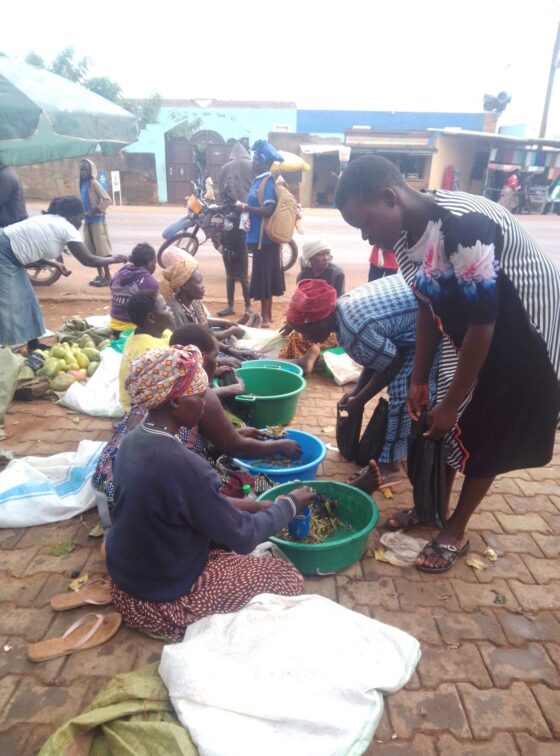
Some of the women doing the Nsenene business at Awindiri Market (Photo by Martin Anguyo)
By Martin Anguyo
Arua City
A seasonal delicacy is steadily changing the economic fortunes of women at Awindiri Market in Arua City, where the sale of grasshoppers, locally known as Nsenene, has enabled some vendors to acquire livestock, venture into poultry farming, purchase household assets and keep their children in school.
For many of these women, the seasonal grasshopper trade has grown beyond a means of earning daily income, becoming an investment opportunity that enables them to acquire domestic animals, meet household needs and pay school fees for their children.
Adania Hellen, a grasshopper vendor who has been in the business for nearly ten years, says the profits she has accumulated over the years have enabled her to acquire several domestic animals and improve her household assets.
“I have done grasshopper business for almost ten years, and every time I sell them, I make profits. This has enabled me to buy my own goats, sheep and pigs, as well as other household items such as mattresses,” Hellen says.
For Salome Oleru, the seasonal trade has become an important source of livelihood, helping her invest in livestock while supporting her children’s education.
She says the money earned from selling grasshoppers has enabled her to purchase chickens and goats, which have continued multiplying and providing additional economic benefits to her family.
“I am so grateful to God for bringing grasshoppers this season. From the money I get through the business, I have bought chickens and goats, and they are multiplying steadily. I also use the proceeds to pay school fees for my children,” Oleru says.
Similarly, Drciciru Esther says the arrival of grasshoppers presents an opportunity for vendors to generate income and invest in other businesses, reducing their dependence on the seasonal trade.
“We are happy about the coming of grasshoppers because it is one way of getting money, which we can later invest in other enterprises,” Esther notes.
Beyond its cultural significance as a traditional delicacy in Uganda, grasshopper consumption has also become part of a growing global edible-insect market.
According to reports, approximately two billion people, representing about 25 percent of the world’s population, consume insects as food. The global edible-insect market is also projected to reach 18 billion US dollars by 2032.
For the women at Awindiri Market, however, the value of Nsenene goes beyond its seasonal demand and taste. The business is increasingly becoming a stepping stone to household financial stability, livestock ownership and investments in other small-scale enterprises.
Upcoming on 90.9 FM
Upcoming on 94.5 FM
Upcoming on 101.4 FM
Upcoming on 104.8 FM



















Comments
This post currently has no comments.