
GULU ARCHDIOCESE RECORDS GROWTH IN SMALL CHRISTIAN COMMUNITIES, STRENGTHENS GRASSROOTS EVANGELIZATION
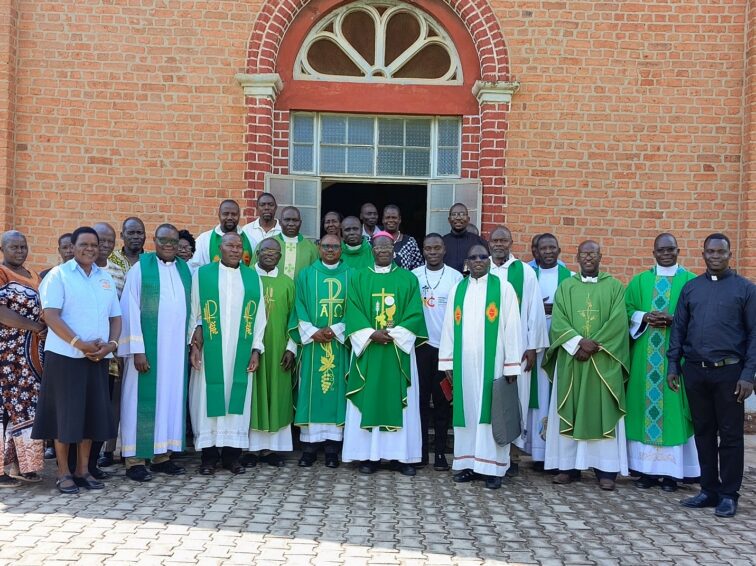
Members of the Archdiocesan Pastoral Council pose for a group photo with the Archbishop of Gulu, His Grace Raphael P’mony Wokorach, MCCJ, following the conclusion of their second meeting at the University of the Sacred Heart in Gulu.
By Proscovia Achomo
Gulu City
The Archdiocese of Gulu is making significant progress in strengthening Small Christian Communities (SCCs), with more than 2,000 communities now reported across the Archdiocese, marking renewed efforts to bring the Catholic Church closer to families and neighborhoods.
The development follows the implementation of a resolution adopted during the First Archdiocesan Pastoral Council Meeting held last year, which prioritized the establishment and strengthening of Small Christian Communities as a key approach to grassroots evangelization.
The progress was highlighted during the Second Archdiocesan Pastoral Council Meeting held from October 26 to 30, 2026, at the University of the Sacred Heart in Gulu under the theme, “Rooted in the Eucharist, United with St. Joseph.”
Although the initiative took time to gain momentum in the Archdiocese of Gulu, recent developments indicate that it is gradually taking shape, with parishes reporting growing numbers of communities and increased participation in prayer, evangelization and charitable activities.
Presenting the implementation progress, Rev. Fr. Philip Apiya, Parish Priest of Amuru Parish and representative of Lacor Deanery, expressed satisfaction with the growing acceptance of the initiative, although he noted that some communities were yet to become fully active.
He reported that Anaka Parish has 27 active Small Christian Communities, while Alero Parish has 35. Lacor Parish has 99 communities, of which only 14 are active, while Amuru Parish has 94, with 19 currently active. Atiak Parish has registered 10 communities.
“We are grateful that Small Christian Communities are gradually taking root in our parishes. Although the growth may not be as fast as we would wish, we are optimistic that with time, more communities will be established across our deanery,” Fr. Apiya said.
In Kitgum Mission Deanery, the Dean, Rev. Fr. Daniel Comboni Okello, who is also the Parish Priest of Lukung Parish, described Small Christian Communities as the Church at the grassroots, noting that they provide Christians with an opportunity to actively participate in the life and mission of the Church.
He reported that the deanery has 613 Small Christian Communities, with Kitgum Mission Parish accounting for 210, Madi Opei Parish 26, Padibe Parish 193, Palabek Parish 68 and Lukung Parish 115.
Of these, Madi Opei has 24 active communities, Padibe has 118 active and 75 dormant, while Lukung has 98 active and 17 dormant communities.
In Gulu Cathedral Deanery, Rev. Fr. James Okello, Parish Priest of Paicho Parish and the Dean, reported that Koch Goma Parish has 177 Small Christian Communities, which he described as particularly active in supporting the Church.
He revealed that the communities once mobilized and contributed 10 million shillings towards the construction of their parish church, demonstrating the impact of collective responsibility and self-reliance in supporting Church development.
Other figures presented for the deanery include 20 communities in Gulu Cathedral Parish, 10 in Awach, 17 in Layibi, 30 in Lukome and 15 in Paicho.
Meanwhile, Holy Rosary Deanery reported 165 Small Christian Communities, with Opit Parish accounting for 135 and Holy Rosary Parish recording 30.
However, the figures presented represent reports received from the participating deaneries and parishes, as some had not yet submitted their updates by the time of the meeting. The Archdiocesan Pastoral Coordinator noted that the overall number of Small Christian Communities could be higher once all outstanding reports are submitted, providing a more comprehensive picture of the initiative’s growth across the Archdiocese.
Beyond the growing numbers, the communities are increasingly becoming important centres of prayer, Christian formation, social support and evangelization.
Among their achievements is the revival of the spirit of prayer, with members gathering weekly to pray through the seven-step Bible-sharing approach and the Rosary. They also participate in animating Sunday liturgies, encouraging Christians to embrace the sacraments, including baptism and marriage, and strengthening biblical knowledge among members.
The communities have further extended charitable support to the elderly, sick and vulnerable, while promoting self-reliance through activities such as poultry keeping and savings initiatives. Others support catechists and contribute towards the construction of Church structures, with some gradually developing into chapels.
These activities have strengthened unity among Christians and encouraged greater ownership of the Church’s mission at the family and neighborhood levels.
Despite the achievements, the meeting also identified challenges affecting the effectiveness of some communities, including limited understanding of the concept of Small Christian Communities, difficulties in interpreting the Bible, inadequate religious materials, low participation, geographical barriers, limited youth involvement and insufficient leadership training among others.
According to the Archdiocesan Pastoral Coordinator, Rev. Fr. Samuel Ocaya Moi, the Archdiocese has so far registered more than 2,000 Small Christian Communities, describing the growth as significant progress in strengthening grassroots Christian fellowship.
“We have made significant progress in strengthening Small Christian Communities across the Archdiocese, with the number now exceeding 2,000. This is an encouraging development in bringing the Church closer to the people,” Fr. Ocaya Moi said.
Meanwhile, the Archbishop of Gulu, His Grace Raphael P’mony Wokorach, MCCJ, has called for sustained efforts to strengthen Small Christian Communities, describing them as essential pillars in deepening Christian faith and building vibrant parish life.
The Archbishop observed that the Church becomes more vibrant when Christian communities are firmly rooted in families and neighbourhoods, noting that their growth strengthens the spiritual life of chapels and parishes.
“At the centre of our apostolate is the strengthening of Small Christian Communities. It is amazing to see how vibrant the Church becomes when Christian communities are firmly rooted in families and neighbourhoods. This strengthens not only the faith of individual Christians but also the life of chapels and parishes,” Archbishop Wokorach said.
Drawing from his experience at the consecration of a new bishop in the Archdiocese of Kabale, the Archbishop said the vibrancy of Christian communities there demonstrated the importance of nurturing faith at family and community levels.
The growth in the Archdiocese of Gulu forms part of a wider Catholic Church pastoral approach that has been instrumental in strengthening grassroots evangelization across Eastern Africa.
The concept of Small Christian Communities developed following the Second Vatican Council (1962–1965), which emphasized the participation of the entire Christian faithful in the life and mission of the Church.
In Eastern Africa, the Association of Member Episcopal Conferences in Eastern Africa (AMECEA) adopted the promotion of Small Christian Communities as a major pastoral priority in 1973, with the aim of building a Church rooted in local communities and making Christians active participants in evangelization.
In Uganda, the initiative gained formal momentum in 1974 through pastoral resolutions adopted by the Masaka Diocesan Synod and the Kampala Archdiocesan Synod under the leadership of then Archbishop Emmanuel Cardinal Nsubuga.
This means that by 2026, Small Christian Communities have been part of the Catholic Church’s pastoral mission in Uganda for approximately 52 years, following the golden jubilee celebrations held in 2024.
The communities are designed to bring Christians together in manageable neighborhood groups where they pray, share the Word of God, support one another and take collective responsibility for the mission of the Church.
In the Archdiocese of Gulu, however, the initiative has taken time to gain consistent momentum, with renewed efforts now aimed at making it an integral part of parish life and ensuring that Christians actively participate in evangelization beyond Sunday Mass.
To consolidate the progress and address the challenges, the Second Archdiocesan Pastoral Council Meeting adopted additional resolutions aimed at improving the coordination, leadership and effectiveness of Small Christian Communities.
According to Fr. Ocaya Moi, the meeting resolved that each Small Christian Community should comprise between 15 and 20 households, with leaders undergoing proper training to strengthen their capacity to guide members.
The meeting also agreed that all communities should be registered using a common Archdiocesan template to improve coordination, documentation and monitoring of their activities.
Other resolutions include providing communities with essential pastoral materials such as Bibles, Rosaries, Sunday readings and seven-step prayer cards to support regular prayer and Bible sharing.
The meeting further resolved to introduce an annual celebration of Small Christian Communities around March 19, the Feast of St. Joseph, as a way of recognizing their contribution to the life of the Church.
In a move aimed at promoting youth participation and leadership, young people aged between 15 and 30 years will also be given leadership responsibilities within the communities, while coordinators will be appointed at parish and deanery levels to strengthen supervision and implementation.
The resolutions are expected to build on the progress already registered, address existing gaps and ensure that Small Christian Communities become stronger centers of prayer, evangelization, charity and Christian fellowship across the Archdiocese.
With more than 2,000 Small Christian Communities reported across its 35 parishes, the Archdiocese of Gulu is seeking to build on the progress registered and establish active, self-reliant and spiritually vibrant communities capable of sustaining the Church’s mission at the grassroots.
Beyond the discussions on Small Christian Communities, the council also deliberated on other key pastoral priorities aimed at strengthening the mission of the Church across the Archdiocese. These included improving the quality of education in Catholic-founded schools, strengthening youth and children’s ministries, enhancing the formation of catechists and promoting Christian burial practices.
The meeting also discussed preparations for the Archdiocese of Gulu’s Diamond Jubilee celebrations scheduled for next year, alongside strategies to strengthen financial sustainability and self-reliance. Members further emphasized the need to promote self-reliance initiatives and encourage the celebration of chapel feast days as opportunities to deepen Christian unity, faith and community participation.
Comments
Upcoming on 90.9 FM
Upcoming on 94.5 FM
Upcoming on 101.4 FM
Upcoming on 104.8 FM

















TABU MARVIN
4 November 2026 at 2:26 PM
Wow I like this 🥰