
GULU UNIVERSITY, EPIFLEX SIGN FIVE-YEAR DEAL TO TRANSFORM AGRICULTURAL TRAINING
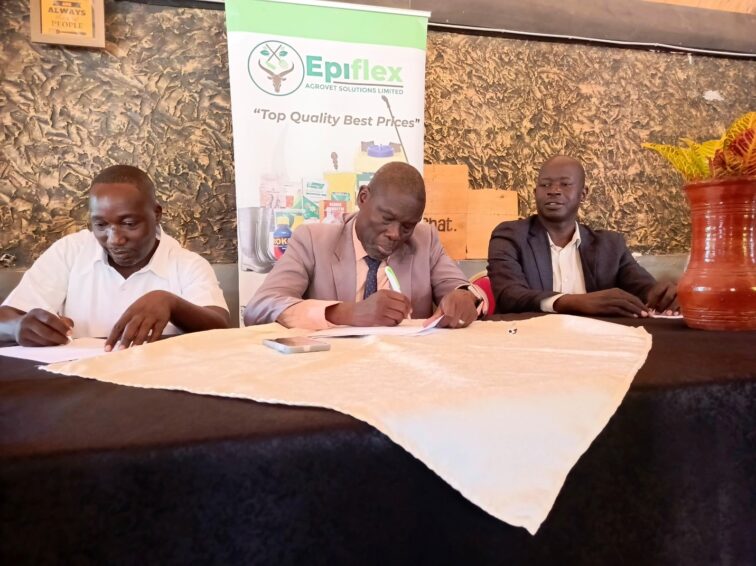
Gulu University Vice Chancellor Prof. George Openjuru Ladaah (centre) signs the Memorandum of Understanding with Epiflex Agrovet Solutions Limited.
By Proscovia Achomo
Gulu City
Gulu University and Epiflex Agrovet Solutions Limited have signed a five-year strategic partnership that will take agricultural training beyond the classroom through student internships, field placements, demonstration farms, joint research and exposure to modern farming technologies.
The partnership, formalized through a Memorandum of Understanding, is aimed at strengthening practical agricultural training while creating a direct link between the university, the private sector and farming communities.
Under the agreement, students will have opportunities for internships and field placements, while the two institutions will establish demonstration farms and field trials where agricultural practices and technologies can be tested under real farming conditions.
The partnership will also facilitate joint research projects, staff and student exchanges, farmer training and extension activities, as well as the development and testing of agricultural technologies.
The agreement further provides opportunities for commercialisation of university research, exposing students and researchers to farm machinery and digital agriculture in an effort to ensure that innovations generated within the university can move from research institutions into practical use.
Alex Sekanda, Chief Agronomist at Epiflex Agrovet Solutions Limited, said the partnership is intended to address one of the major gaps in agricultural training—the disconnect between classroom theory and what happens on the farm.
“Gulu University produces some of the best graduates when it comes to agriculture. What we want to do is take these students beyond the theories they learn in class and put them in the field, where they can see and experience what is actually happening,” Sekanda said.
He said students must be exposed to the changing realities of agricultural production, particularly as farmers contend with changing weather patterns, environmental pressures and new technologies.
“Things are changing. The environment is changing, the climate is changing and farming itself is changing. We cannot continue preparing students only from what is in the classroom. They need to understand the reality on the ground,” he said.
Through internships, field placements and demonstration activities, Epiflex will work with the university to give students direct exposure to farming operations and enable them to learn from farmers and agricultural practitioners.
Sekanda said this connection would help students understand agriculture not only as an academic discipline but also as a commercial activity and a livelihood for millions of people.
“The university is doing its part by teaching these students. Our role is to help take them into the field and bring them closer to farmers. We want to bridge that gap so that students understand agriculture not just as a subject, but as a real business and livelihood,” he said.
For Gulu University, the partnership is expected to strengthen the connection between academic training, research and industry.
Collins Okello, Dean of the Faculty of Agriculture and Environment, said the university intends to use the collaboration to expose students and staff to technologies that can increase agricultural production and improve farmers’ profitability.
“As a university under this collaboration, we are looking at engaging our students and staff in initiatives that will directly support increased agricultural production and profitability among farmers,” Okello said.
He said the partnership will give students and researchers greater exposure to mechanization, climate-smart agriculture and digital technologies, while also creating opportunities to explore artificial intelligence in agriculture.
Okello said field trials and practical engagement with farmers would be important in ensuring that technologies are tested against actual agricultural challenges before being taken to a wider audience.
“We want to work with Epiflex to make sure that farmers get the best out of their agricultural operations. Our students and staff must be part of developing and implementing solutions that respond to the realities farmers are facing,” he said.
The agreement also creates a platform for joint research, with university staff and Epiflex expected to work together on agricultural challenges and opportunities.
Research generated through the collaboration could also be developed into products and technologies with potential for commercialisation, creating a pathway between university research and the agricultural market.
Speaking at the signing ceremony, Gulu University Vice Chancellor Professor George Openjuru Ladaah said the collaboration was important because research must ultimately respond to the needs of communities and contribute to agricultural transformation. “The areas that we are coming to collaborate on are critical for the community, the university and Epiflex,” Prof. Openjuru said.
He said research in agricultural production and the development of new products from agricultural resources would be central to efforts to increase productivity and production. “Research in agricultural production and innovation of new products from agriculture are very important so that we can enhance the productivity and production of our farmers,” he said.
Prof. Openjuru said the university expects the partnership to produce practical results rather than remain a formal agreement between institutions.
“This collaboration must translate into action. We want to see our students gaining practical skills, our researchers working on real agricultural challenges, and farmers benefiting from innovations that improve production, productivity and profitability,” he said.
The Vice Chancellor said the commercialisation of university research would also be important in ensuring that knowledge generated by researchers reaches the market and ultimately benefits farmers and communities.
The partnership will also support farmer training and extension activities, creating opportunities for knowledge generated through research and field trials to be shared directly with agricultural producers.
Ultimately, the five-year partnership is designed to ensure that agricultural education and research do not end at graduation or in academic publications, but are translated into practical technologies, improved farming practices, commercially viable innovations and better agricultural outcomes for farmers and communities.

Comments
This post currently has no comments.