
GULU UNIVERSITY STUDENT’S KILLING LEAVES A FAMILY IN MOURNING, CAMPUS DEMANDING JUSTICE
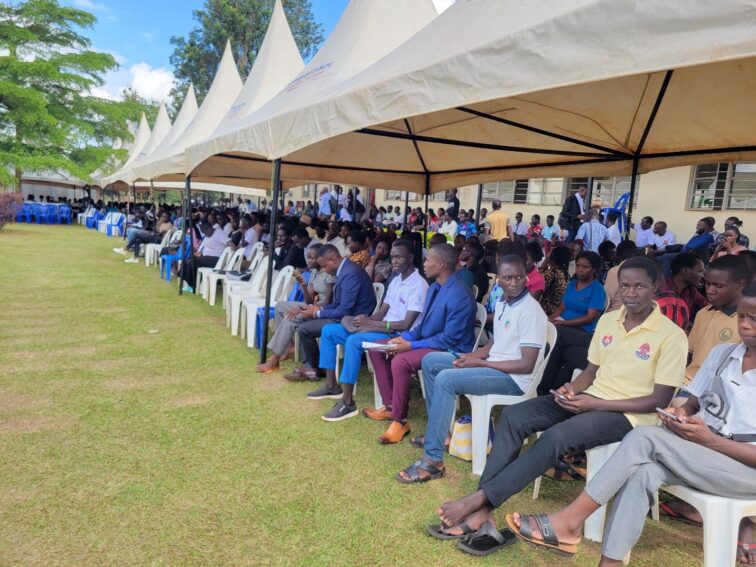
Gulu university students sited during the security meeting
By Biko Rombe
GULU CITY — For John Bosco Ngire, university was an opportunity to build a future. But his journey was cut short in a violent attack that has left his family grieving and the Gulu University community demanding answers over the safety of students living around the institution.
Ngire, a second-year student pursuing a Bachelor of Education, majoring in English, was reportedly attacked by unknown assailants in the early hours of Saturday, October 10, 2026, in the Agwee area of Laroo-Pece Division, Gulu City.
Reports indicate that he was struck on the head during the attack. His killing has reignited concerns about a wave of violent incidents affecting students and other members of the university community.
Three days after his death, university leaders, students and security officials gathered at the university’s main campus on Tuesday, October 13, for a security meeting convened to address the growing fear and frustration surrounding the attacks.
The meeting brought together the Resident City Commissioner of Gulu City, Onoria Ambrose, Vice-Chancellor Professor George Ladaah Openjuru, University Secretary David Obol Otori, Guild President Pius Onekgiu and representatives of security agencies and local leadership plus the students at the university.
For the university community, the gathering was about more than security arrangements. It was a demand for answers over the loss of a young life and a plea to prevent another family from experiencing the same grief.
“When we lose a student, when we lose a member of our beloved society, it’s not just numbers,” Obol said, stressing that every student represents a family, friends, classmates and a community whose hopes are tied to that individual’s future.
He said the university had previously lost a member of staff in similar circumstances, raising further questions about the safety of people living and working around the institution.
In May 2026, Christopher Nyeko, a staff member attached to the university’s health unit, was also killed near St Peter’s Church, a short distance from the main campus. University officials expressed concern that the earlier case had not produced satisfactory answers or visible progress in bringing those responsible to justice.
The two killings have intensified fears among students, many of whom live in privately owned hostels and rented accommodation outside the university’s immediate premises.
25th Guild President Pius Onekgiu delivered a strong message to the security leadership, saying students could not continue pursuing their education while living in fear of attacks.
Speaking on behalf of the university’s student leadership, Onekgiu said the institution had more than 10,000 students and argued that protecting their lives required coordinated action by university management, police, the military, local leaders and city authorities.
He questioned why the university had only two police officers stationed on campus and lacked a dedicated police patrol vehicle, despite the large student population and repeated reports of criminal attacks.
Onekgiu also questioned the apparent lack of progress in investigations into earlier cases, particularly the killing of Nyeko. He said students needed reassurance that investigations were progressing and that suspects would be held accountable where evidence established their involvement.
The Guild President further raised concerns about allegations that some students were asked to pay money in connection with the handling of cases and access to justice. He called for such claims to be investigated and warned against any unlawful financial demands on victims seeking assistance.
“Arrest of suspects should not be the end of the process,” Onekgiu said, calling for greater accountability and communication with victims and the wider community.
He urged security agencies to ensure that students could attend lectures, return to their hostels and participate in university activities without fear.

Ambrose Onoria the Gulu city RCC while addressing students
Responding to the concerns, Ambrose Onoria the gulu city RCC acknowledged the pain caused by Ngire’s death and said authorities were determined to address criminality in Gulu City.
He said security agencies had conducted operations and made arrests in efforts to tackle crime, but warned that identifying and apprehending the right suspects required intelligence and cooperation from the public.
Ambrose appealed to students and residents to share information with authorities rather than remain silent about suspected criminal activity in their communities.
He also cautioned students against turning their grievances into confrontations, encouraging dialogue and cooperation with security agencies.
The RCC disclosed that a police patrol vehicle specifically intended to support security operations around Gulu University was expected to be ready in November 2026.
The planned vehicle is expected to strengthen patrols and improve the response to security incidents around the university and neighbouring communities.
Professor Openjuru said the university was deeply concerned about the killings and called for greater vigilance by both security agencies and members of the university community.
He warned that frustration over repeated attacks could lead to retaliatory violence if authorities failed to reassure students that their safety was being taken seriously.
The Vice-Chancellor urged students to look out for one another, move in groups when necessary and report suspicious activity. He also cautioned against walking alone late at night and accepting assistance or accommodation from strangers without taking precautions.
Openjuru said some criminal suspects could blend into the university community by presenting themselves as students or other legitimate members of society, making vigilance and information-sharing particularly important.
He called for a coordinated response involving security agencies, university management, hostel operators, local leaders and students.
University management also highlighted the need to improve lighting around roads and accommodation facilities.
Gulu University Secretary David Obol Otori has outlined a series of measures aimed at improving student safety, including better street lighting, CCTV cameras in private hostels and the construction of two new student accommodation facilities, following the killing of a student in Gulu City.
Otori said the university had more than 10,000 students and approximately 700 staff members, with the growing population also attracting businesses and increasing demand for accommodation around the campus.
He noted that because Gulu University is a non-residential institution, many students live in privately operated hostels and other accommodation facilities outside the university’s immediate premises, making cooperation with local authorities and property owners essential.
Addressing concerns about poorly lit roads, Otori said the university had discussed plans to improve road infrastructure around the institution, including a road linking the Faculty of Medicine to the area behind the Faculty of Agriculture and connecting towards Pece.
He explained that the road was expected to be surfaced as part of preparations for the Africa Cup of Nations (AFCON) training facilities being developed at the university.
However, he acknowledged that some areas around the institution fall outside university jurisdiction, while privately operated hostels remain a concern because of inadequate security lighting.
Otori said the university, through the Dean of Students’ office, would engage hostel owners to invest in security lights and CCTV cameras to improve surveillance and deter criminal activity.
He noted that the Dean of Students’ office already works with student leaders to inspect and recommend hostels that meet the required accommodation standards, providing an existing framework through which additional security measures could be pursued.
The University Secretary also revealed that management was working through its holding company in collaboration with Uganda Development Bank to facilitate the construction of two new hostels, each with 1,000 rooms.
One facility is intended to accommodate female students, while the other will house male students, in a move expected to expand the university’s accommodation capacity.
Otori said the university was committed to guiding students on responsible behaviour and personal safety but stressed that students also deserved protection as they pursued their education and participated in university activities.
The security concerns extend beyond university grounds. Because Gulu University is a non-residential institution, many students live in hostels and rented accommodation within surrounding communities, where responsibility for their safety involves several authorities.
Onekgiu argued that while students must take reasonable precautions, personal vigilance cannot replace the state’s responsibility to protect life and maintain law and order.
He urged authorities to ensure that the meeting resulted in concrete action rather than a series of speeches and promises.
For the students, the stakes are high. They want to complete their studies, participate in university life and return safely to their accommodation without fearing that an ordinary journey could end in tragedy.
As investigations into Ngire’s killing continue, the university community is seeking accountability for his death and practical measures to prevent further attacks.
For now, his killing has left a painful question hanging over Gulu University: how many more lives must be lost before students can feel safe pursuing the futures they came to university to build?
Upcoming on 90.9 FM
Upcoming on 94.5 FM
Upcoming on 101.4 FM
Upcoming on 104.8 FM
















Comments
This post currently has no comments.