
JUDICIARY TAKES STRIDES IN ALTERNATIVE DISPUTE RESOLUTION TO CURB CASE BACKLOGS

Dr. Sylvia Namubiru, the CEO-LASPNET addresses stakeholders during a recent engagement in Arua district about ADR. Photo by Godwin Abedica.
By Godwin Abedican
Arua
Alternative Dispute Resolution (ADR) refers to any method of resolving disputes without litigation. ADR regroups all processes and techniques of conflict resolution that occur outside of any governmental authority. The most famous methods being mediation, arbitration, reconciliation, negotiation and transaction.
The public is therefore being encouraged to take up this as the government battles case back logs and delayed administration of justice by the judiciary.
Over the years issues of case backlogs have remained a hampering factor to quick access to justice and hence affecting transparent and fair trial of suspects in different courts across the country.
Through the plea bargain initiative, accused persons who are sure that they have committed offences sign up for the plea bargain program and the cases are concluded upon them pleading guilty to lesser charges for lighter sentences without long trial processes.
Jacquelyn Okui, the Public Relations Officer (PRO) of the office of the Director of Public Prosecutions (DPP), admits that taking steps such as plea bargain as a means of alternative dispute resolution can help in helping the ever increasing challenge of case backlog.
“The plea bargain initiative is one of the initiatives that we are employing to deal with the problem of case backlog. With sufficient funds, that will mean that we will be able to handle many more cases and therefore clear them and this will reduce tremendously the case backlog and hopefully even put an end to it,” Okui said in an interview.
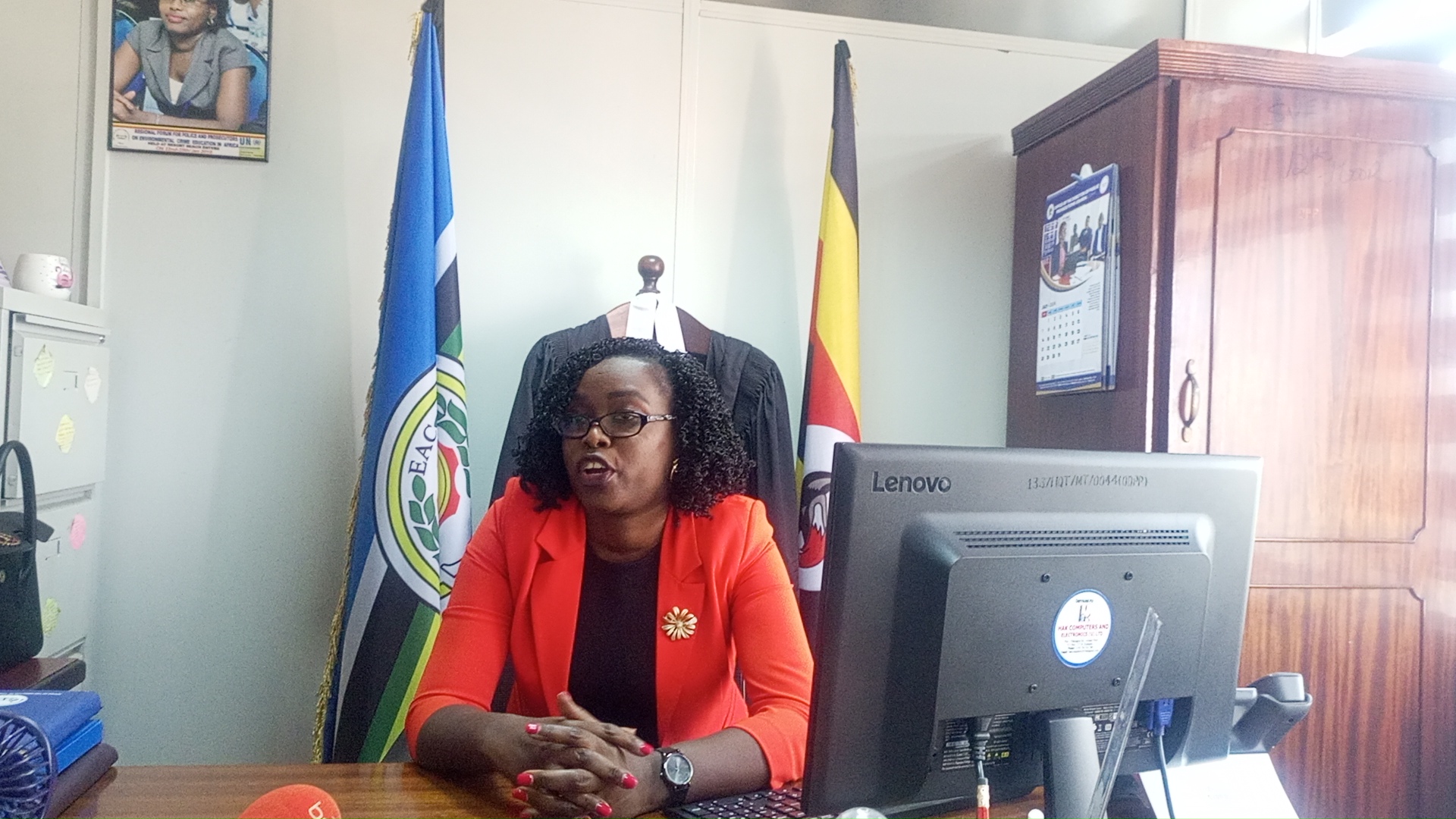
Jacquelyn Okui, the PRO office of the DPP speaking during an interview
at her office in Kampala. Photo by Godwin Abedican.
The plea bargain initiative fast trucks cases and is an initiative meant only for suspects or accused persons pleading guilty and are given lesser sentences saving court the time that could be spent in lengthy trials and testifying in court.
Elizabeth Aliano, a board representative for Northern Uganda under Legal Aid Service Providers Network (LASPNET) also formerly a probation and social welfare officer with justice law and order sector says maintaining high number of prisoners across the country has overtime become hard for the government
“The problem all goes around financing. A lot of money is spent by the government in keeping the prisoners in the cells in terms of food, space, water bills, electricity and others. That is why the government is coming up with the alternatives to justice which if accepted and taken up by the public, will save the government resources that can be channeled for provision of other services to the public,” Aliano said.

Elizabeth Aliano, a board representative for Northern Uganda under LASPNET.
Photo by Godwin Abedican.
However, Rogers Feni, a Legal Officer with Uganda Law Society says it has remained difficult for the public to accept alternative dispute resolution since many are not aware of the laws
“When someone is taken to court, it doesn’t mean the person has to end in prison. It is important for the public to know that, it doesn’t mean when someone is sent to do community service as punishment for a crime committed, the person is innocent. No, we have seen people killing others for stealing chicken and yet the value of chicken according to the law could mean subjecting such a person to community service, Feni explained.
He adds that due to fear over what the public can do to suspects through taking the law in their hands, many people are in cells on petty offences which could be handled thorough alternative dispute resolutions.
“Locally this has led to congestion in the prisons where you find our prison with a capacity of around six hundred to seven hundred prisoners is now accommodating over one thousand prisoners. Which means they are congested. Much as they are inmates, they deserve to live in good standards and they have rights. We need not to congest them. This therefore calls upon the public to consider embracing other forms of dispute resolution as a solution to this,” he said in an interview.
Rogers Feni, a Legal Officer with Uganda Law Society. Photo by Godwin Abedican.
ADR gives parties in dispute the opportunity to work through disputed issues with the help of a neutral third party. It is generally faster and less expensive than going to court. When used appropriately, ADR can save a lot of time by allowing resolution in weeks or months, compared to court, which can take years.
Dr. Sylvia Namubiru, the Chief Executive Officer, Legal Aid Service Providers Network (LASPNET) therefore encourages sensitization of the public for the success of this initiative
“We should look forward to alternative dispute resolutions as alternative to imprisonment and dealing with suspects. We have to look forward to creating awareness and sensitizing and show the dangers of wanting imprisonment for every single offence committed, so that we can reduce on the flow of cases in the system,” Dr. Namubiru appealed.
In the last financial year, about seven thousand (7,000) cases were concluded, about 1500 cases were concluded through ordinary sessions that cater for accused persons not willing to plead guilty because they are confident for not having committed the offences
Upcoming on 90.9 FM
Upcoming on 94.5 FM
Upcoming on 101.4 FM
Upcoming on 104.8 FM








Comments
This post currently has no comments.