
KILIMO TRUST ADVANCES CROSS-BORDER FISH TRADE, SUPPORTING WOMEN, YOUTH, AND MSMES ACROSS EAST AFRICA REGIONS
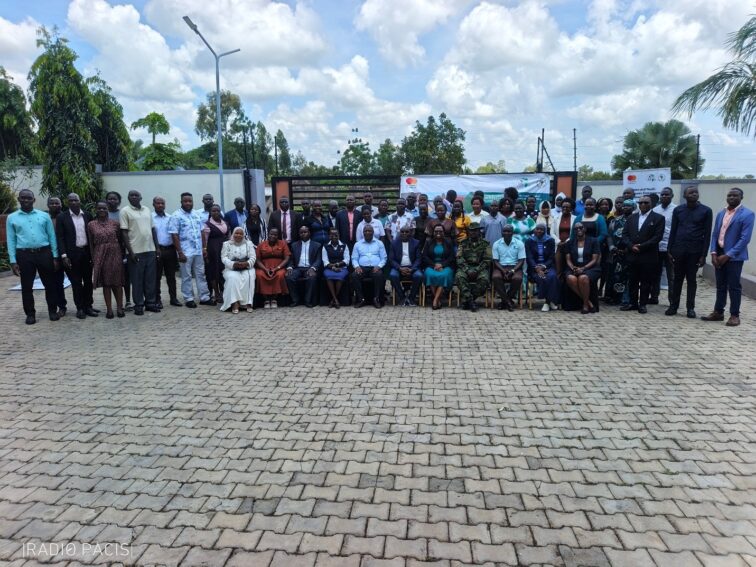
Kilimo Trust officials, representatives of consortium of partners, ministry of agriculture animal industry and and other stakeholders posing for a group photo (Photo by Onzoma Albert)
By Onzoma Albert
Arua City
The Kilimo Trust organized its third Uganda Women and Youth Dialogue on cross-border fish trade at Hotel Le-confidentiel in Arua City, under the WYEEFIMA program. This event convened a diverse group including traders, policymakers, regulatory agencies, border security personnel, local government officials, financial institutions, private sector representatives, and development partners. The primary goal was to review prior recommendations and identify practical actions to enhance the participation of women and youth in formal fish trade.
Women and youth play critical roles across the fish value chain—encompassing processing, post-harvest handling, marketing, and cross-border trade. Previous dialogues identified various barriers restrict their safety, profitability, and market access. These include inadequate storage and transportation infrastructure, limited access to finance, unclear trade procedures, harassment, corruption, and weak representation in decision-making processes. The WYEEFIMA initiative seeks to address these systemic issues by strengthening the capacity, voice, and inclusion of women and youth within fisheries markets.
Recho Ajambo, the Ugandan Country Team leader of Kilimo Trust, emphasized the importance of removing systemic barriers to unlock the potential of micro, small, and medium enterprises (MSMEs). She highlighted that improving trade around relevant hubs is crucial for fostering economic growth and empowerment, especially across borders.
“Fish been what it is, is the product that is employing a lot of people and therefore it involves all of us who intervening in the fisheries value-chain like Kilimo Trust and other partners, we need to be dealing with this matters amicably so that the value-chain with its opportunities can accrued to everyone who is involved in the trade” she said.
The first dialogue, held in Jinja on December 4, 2025, prioritized four key areas: storage and cold chain infrastructure; access to finance; taxation information and trade regulations, including the simplified trade regime (STR); and transport and logistics. Participants also flagged issues such as sexual harassment, insecurity, and inconsistent enforcement of trade requirements.
Tony Mathew, Chairperson of the South Sudan Fish Suppliers Association (SSFSA), shared specific challenges faced by cross-border fish traders, including difficulties with loading and off-loading, logistical hurdles, and regulatory complexities.
“The challenges that affect our movement as fish traders right from the point of loading and off-loading as we do the business with South Sudan, we face a lot of challenges such as unnecessary road blocks, undocumented payments ranging from 2,000-3,000 USD which is a big challenge to us the cross-border fish traders operating between Uganda and South Sudan” he said.
The second dialogue took place in Kasese in May 2026. It reaffirmed the earlier priorities and added concerns such as licensing delays, gender-based violence, corruption, dependence on middlemen, and insecurity. Traders in the Mpondwe-Kasindi corridor reported currency losses, language barriers, and difficulties with cross-border payments. Recommendations from this meeting included collective bulk buying and transport, improved access to finance, coordinated enforcement of regulations, and safer mechanisms for reporting issues.
Richard Rugadya, the Principal Fisheries Officer at Uganda’s Ministry of Agriculture, acknowledged these challenges and assured that the Ugandan government is actively collaborating with neighboring Eastern countries to find solutions, reflecting a commitment to regional cooperation.
“We have received those complaints on over taxation but those non-tariff barriers are charges that are not known but been charged on the value-chain on the cross-border trade especially in South Sudan where traders pay at every check-point, those are the things the government of Uganda needs to discuss with the government of South Sudan to resolve those non-tariff barriers” he said.
Building on these findings, the Arua City dialogue extended discussions to northern Uganda, involving districts such as Amuru, Pakwach, and Buliisa. Traders identified the most relevant routes and barriers impacting their activities, particularly those linked to South Sudan and the Democratic Republic of Congo. Reports from previous sessions verified action plans; however, they did not confirm full implementation of earlier recommendations. Progress reports indicated ongoing activities by stakeholders such as radio workshops, extension services, and trade information desks, but did not evidence completion of key infrastructure projects, disbursement of finance, safe trade systems, border harmonization, or joint transport/security arrangements.
Particular concerns raised in Arua included exchange rate losses, unreliable cross-border payments, and language barriers. These issues are documented but await concrete remedies. Participants and responsible institutions in northern Uganda are tasked with verifying how these problems affect trade with South Sudan and DRC and developing workable payment and information support systems.
The main focus for the October 21, 2026, review in Arua was to evaluate the status of earlier actions with traders and institutions. The aim was to verify what has been completed, what is ongoing, what has not yet started, and what remains unverified. The meeting prioritized addressing immediate trade-information gaps and unresolved issues by establishing an updated action tracker with clear responsibilities, deadlines, and evidence requirements. Special attention was given to barriers impacting northwestern Uganda’s trade routes linked to South Sudan and DRC, recognizing that challenges differ across regions.
An exchange visit on October 22, 2026, helped validate the critical trade routes, handling, market, and service delivery issues highlighted earlier. Observations from this visit, along with any follow-up actions, will inform the consolidated action plan aimed at reducing barriers for women and youth in the cross-border fish trade.
The overarching theme of this third national dialogue was “reducing barriers to women and youth participation in cross-border fish trade in East Africa through dialogue and networking.” The series of dialogues underscores the importance of multi-stakeholder collaboration to overcome systemic issues and unlock the potential of women and youth in regional fish markets.
While progress has been made in raising awareness and initiating conversations on these issues, tangible improvements—such as infrastructure development, financing, enforcement of harmonized border policies, and secure, efficient logistical systems—still require verification and implementation. Continued efforts and coordinated actions are vital for creating enabling environments that empower women and youth in the cross-border fish trade across Uganda and neighboring countries.
Upcoming on 90.9 FM
Upcoming on 94.5 FM
Upcoming on 101.4 FM
Upcoming on 104.8 FM
















Comments
This post currently has no comments.