
PAC QUESTIONS FINANCE MINISTRY OVER SHS357 BILLION TAX INCENTIVE COMMITMENTS
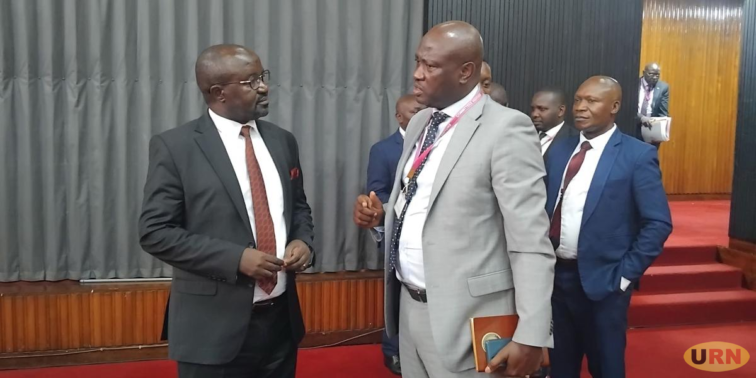
PAC- Central Committee Chairperson, Patrick Nsamba Oshabe (L) with the Under-Secretary MoFPED, Edward Sengonzi Damulira catching up after the committee meeting.
URN
The Public Accounts Committee (PAC-Central) has questioned the Ministry of Finance over Shs357 billion in new government commitments linked to tax incentives granted to companies during the 2024/25 financial year. The committee said the commitments appeared to have been incurred without corresponding budget provisions, raising questions about compliance with public finance laws and the accumulation of domestic arrears.
Finance officials, led by Under Secretary Edward Sengonzi Damulira and Head of Accounts Hilda Nyamaizi, appeared before the committee chaired by Patrick Oshabe Nsamba to respond to audit queries on the ministry’s financial statements. The committee was examining domestic arrears totalling about Shs995 billion and asked officials to isolate Shs357 billion described as new commitments incurred during the financial year under review.
PAC questioned why the ministry entered the financial year with an opening balance of about Shs638 billion in outstanding obligations but did not provide for the new commitments in its appropriation account.
The MPs cited provisions of the Public Finance Management Act requiring government commitments to be backed by available resources and questioned how the Shs357 billion could have been incurred outside the approved budget. Damulira, however, told the committee that the ministry’s accounts section did not originate the commitments but acted on instructions from higher authorities.
He said the obligations were largely related to tax incentives under which government had undertaken to meet tax liabilities on behalf of selected companies.
PAC also questioned why the ministry’s financial statements presented the broader figure of about Shs995 billion instead of clearly isolating the Shs357 billion incurred during the financial year. Nyamaizi was asked to guide the committee through the financial statements and identify the specific new commitments. However, MPs said the documents presented to them did not readily allow them to trace the Shs357 billion.
The committee resolved to dedicate a separate sitting to scrutinise the tax incentives individually and establish whether the beneficiaries complied with the conditions attached to them. The Auditor General has previously raised concerns about the management of tax incentives, including the absence of an adequate framework for monitoring beneficiaries and cases where companies failed to achieve outputs stipulated in their memoranda of understanding.
In an earlier value-for-money audit, the Auditor General found that 22 of the 36 companies assessed were performing below the 50 percent employment threshold. PAC said it would also require correspondence and approval letters relating to the incentives to establish who authorised the commitments and how the obligations eventually became government liabilities.
Oshabe said the committee was particularly concerned because the Ministry of Finance is responsible for managing government resources and controlling the accumulation of domestic arrears. He said the committee would summon the Permanent Secretary and Secretary to the Treasury, Ramathan Ggoobi, to respond to broader questions about the ministry’s management of the commitments.
The committee also questioned how a ministry responsible for controlling government expenditure could accumulate obligations without corresponding budget provisions. Officials told the MPs that efforts had been made to address the arrears, but the resources allocated for clearance remained far below the outstanding obligations.
Damulira told the committee that about Shs53 billion had been provided to address some of the outstanding obligations, compared with a stock that had continued to grow towards Shs1 trillion. The MPs said the issue was particularly concerning because unpaid government obligations affect companies supplying goods and services to government, while tax incentive commitments create another category of liabilities.
PAC resolved to pursue the two issues separately, including determining the criteria used to allocate the limited funds available for clearing outstanding obligations. The Ministry of Finance has previously acknowledged the problem of domestic arrears and announced measures to prevent their accumulation, including enforcement of the commitment-control system and sanctions against accounting officers responsible for creating new arrears.
The government allocated Shs1.4 trillion for domestic arrears clearance in the 2025/26 financial year as part of a three-year strategy to eliminate the backlog.
Upcoming on 90.9 FM
Upcoming on 94.5 FM
Upcoming on 101.4 FM
Upcoming on 104.8 FM















Comments
This post currently has no comments.