
POPE FRANCIS: AN ADVOCATE OF PEACE
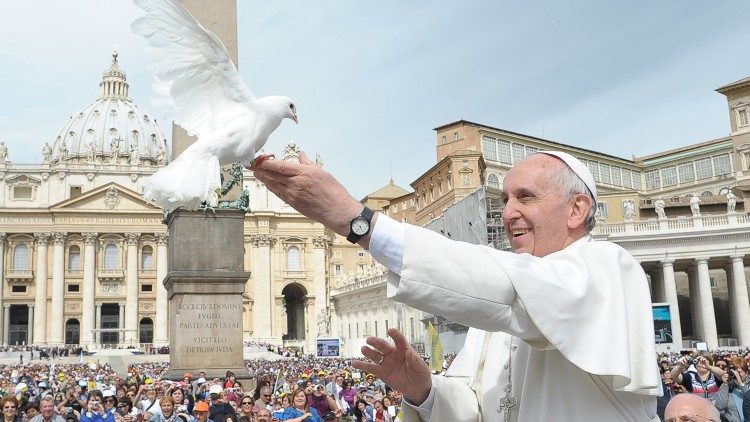
The late Pope Francis.
By Ambrose Okai
Oyam
Pope Francis died on April 21, as announced by the Vatican. At the age of 88, he had served the Roman Catholic Church as its Latin American leader for 12 years.
Following his death, nine days of mourning commence, as described by Reverend Monsignor Dr. Francis Omara, Judicial Vicar of Gulu Ecclesiastical Province, who spoke to Radio Pacis in an interview
Here is the full interview:
Radio Pacis: What happens when a sitting Pope dies?
Rev Monsignor Dr. Francis Omara: Now, when the Pope dies or resigns, as it was in the case of Pope Benedict XVI in 2013, the Cardinals are summoned to a meeting at the Vatican. So I think now the Cardinals are being called immediately to go to the Vatican, all the Cardinals will go there.
And what happens when a reigning Pope dies? The following thing happens. The Pope’s passing marks the beginning of nine days of mourning. His body is dressed in purple vestments and presents at Peter’s Basilica for public viewing.
Hundreds and thousands of people will line up to pay their respects. Here is what typically happens after a Pope dies away. The funeral will be elaborate, but for Pope Francis, he recently approved plans to make the whole procedure mess.
Just like previous popes were buried in three nested coffins made of cypress, lead and oak, Pope Francis has opted for a simple wooden coffin lined with zinc.
He has also scrapped the tradition of placing the Pope’s body on a raised platform known as catafalque in St. Peter’s Basilica for viewing. Instead, mourners will be invited to pay their respects while his body remains inside the coffin with the lid removed.
Francis will also be the first Pope ever, the first Pope in more than a century, to be buried outside the Vatican. In his will, he will be laid to rest in the Basilica of St. Mary Major, one of the four major purple basilicas in Rome. The Basilica is a church which has been granted special significance and privileges by the Vatican.
There are four major basilicas in Rome, so let’s be clear, not the Vatican’s purple chapel basilica St. Peter’s, but Pope Francis has chosen to be buried in St. Mary Major Basilica. So this is what really happens when a Pope dies.
Radio Pacis: What is the title of the caretaker of the Church in the absence of the Pope?
Rev Monsignor Dr. Francis Omara: When a Pope dies or resigns, the College of Cardinals becomes the caretaker of the Catholic Church, governing the Vatican and the Church until a new Pope is elected. The Senior Cardinal, known as the Card Lengo, acts as the Vatican’s temporary ruler, the overall ruler.
And when a Pope is reigning, he designates somebody to be the Cardinal Lengo in view that when he dies, that will take over. Now, the current Cardinal Cardinal Lengo is Cardinal Kevin Farrell. He was appointed to the position by Pope Francis on February 4th, 2019.
Before becoming Cardinal Lengo, Cardinal Farrell served as the Prefect of the Dicastery for late family and life. So, this is the title of the one, and it is Cardinal Kevin Farrell who is now the temporary leader of the Catholic Church.
Radio Pacis: Then, who presides over the burial of the Pope?
Rev Monsignor Dr. Francis Omara: The one who presides over the funeral, the burial of the Pope, the funeral is presided over by the Dean of the College of Cardinals. Cardinal is a college, and the one leading it is called the Dean of the College of Cardinals. If that is not possible, by the Vice Dean, or another Senior Cardinal, the current Dean is Italian Cardinal Giovanni Battista Re, who is 91 years old.
The Vice Dean is a Gentile Cardinal Leonardo Sandri, 81 years old. So, Cardinal Giovanni Battista Re is 91, and he still capable to perform the function. So, I think he will be the one probably to preside over the funeral of Pope Francis.
Radio Pacis: Thank you, Father. Have you ever met the late Pope Francis?
Rev Monsignor Dr. Francis Omara: Yeah, the last time I met Pope Francis, when he came to Uganda in 2015. He was still strong and energetic. He had a passion for the Church.
Radio Pacis: What do you remember about the late Pope Francis?
Rev Monsignor Dr. Francis Omara: About the late Pope Francis, or his legacy, briefly, he did so many things.
He’s a leader of one of almost 1.5 billion Catholics. What he did, he made lots of changes. He simplified, like canon law, he made the processes for annulment of marriages simple.
He reformed the Tribunal of the Church. He addressed past scandals, sexual scandals, financial scandals. He made a lot of replacements, others were defrauded and punished.
Particularly, he has embraced migrants, people fleeing from war-torn areas. He has been fighting left and right for migrants and the poor. Then also, yes, opening the doors, making calls and appeals to the European Union countries, and then also to the United States of America, and all over the world.
He opened the door for migrants and the poor because, fratelli tutti, he considered all of humanity to be one in Christ. Because of this, it was such a great Pope. One thing that was misunderstood, but it has been cleared in the final document of synodality, is simply for the gay and lesbian faithful.
In fact, he was not supporting homosexuality. The gay and lesbian, he was also supporting the art. He knows that it is intrinsically evil.
But what he wanted, he wanted an open door to receive them, to try to find a new evangelization. How do we approach these people? It’s not good to leave them out there. It’s good to show them love, but not by certainly condemning the evil acts, but opening to them, like in the Sacrament of Penance in the Holy Roman Catholic Church.
When you go to the Sacrament of Penance, your even blessed. You ask, bless the Father for our sins. So he’s blessing the sinner to convert and to be protected, to receive the mercy of God.
So he never advocated for blessing the marriages of the gay and lesbian, but he advocated for blessing them, for receiving them, for converting them to become holy people, so that they go to heaven. Now, there was a lot of doubt about this all over the world, but then now, in the final document, he’s talking about synodality and conversion, conversion of status and conversion of persons, conversion of people who are LGBTQ, conversion of criminals. That is synodality.
You have to convert everybody. So I think that the last part now, that is synodality, which has culminated in conversion of all of reality to Christ. And now, you know, this is culminated in the message, in the prayer, of the Holy Father brought for the Jubilee Year 2025, which this prayer states that thanking God the Father for the faith, in giving Father in heaven the faith you have given us in Christ, and the charity, the flame of charity from the Holy Spirit, and give us to be pilgrims of hope.
And then also, putting to the Father so that his grace may make us, to transform everybody to be tireless conservators of the seed, the seed of transformation, to transform the whole of humanity, and then to transform the whole of the cosmos, in hope that the evil, un-evil will be vanquished, and then the kingdom of God the Father will shine forever, with the blessing of the redeemed. But in the meantime, also the grace, so that we know we are suffering, we enjoy the hope, the joy of the power of the Christ, who protects us, even though we die, even though we suffer, the living Christ is our life, he protects us now. So I think, this is what I can say about the legacy of Pope Francis.
Radio Pacis: In the Eucharistic prayer, we have the provision where the priest is supposed to pray for the Pope. Now that Pope Francis has passed on, what is going to happen in this particular case?
Reverend Monsignor Dr. Francis Omara, Now that the Pope has died, the status quo now, we call it a sede vacante. That is when the papacy is vacant, the Pope is not there, and the Pope is dead. The name of the Pope is omitted from the Eucharistic prayer.
The prayer then focuses on the local bishop and the clergy. For example, in the Eucharistic prayer too, the phrase, with your servant, Francis our Pope, and, say, Sanctus Lino, our bishop, Raphael Pimony our archbishop, or Sabino Ochan, our bishop, or Constantine Rupiny, our bishop, now, the name of the Pope will be taken out. And so, this is roughly, for example, what will be said in the Eucharistic prayer.
It will be said, you leave out the name of the Pope, then you go straight to the name of the bishop.
Radio Pacis: Your Last words.
Rev Monsignor Dr. Francis Omara: What I would wish to share is that now the cardinals are being called to Rome. We should pray for peace and serenity. With the consecration, we should pray for Pope Francis, although he spoke of his holiness, that the Lord God may have mercy on him.
The Lord God may receive him in the eternal peace of his kingdom. Now, it happened that the risen Christ died. It’s a Monday.
Together with the risen Christ, the Lord Jesus Christ may reward him abundantly in the kingdom of heaven. And then also, I think that we continue praying for the cardinals to arrive safely in Rome, the Vatican. We are going to have nine days of mourning before the cardinals enter into the conclave for electing a new Pope.
After the nine days are over, the cardinals will enter into the conclave. So let’s pray for these nine days of mourning. Let us keep a serenity kind of situation of mourning for the Pope.
And then, we will also continue to pray for the cardinals so that the Holy Spirit bless them, Blessed Virgin Mary bless them, to come up with a Pope, to pick on the legacy of Pope Francis, and to guide it towards the end of time when Christ will come again. And maybe continue as we wait for the coming of the Lord and the coming of the kingdom of God in our meetings.
Radio Pacis: Thank you so much, Father, for your time, and we wish you the best.
Comments
This post currently has no comments.