
SOCIO-ECONOMIC HURDLES FUEL SURGE IN GBV CASES IN WEST NILE REGION
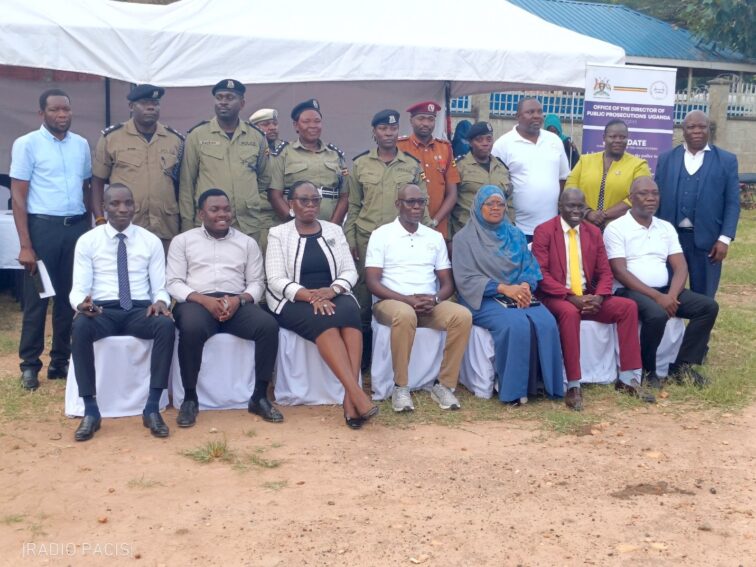
Officials from DPP and Partners, Arua City Leadership and Uganda Police Force after the regional ODPP Barraza in Arua City (Photo by Onzoma Albert)
By Onzoma Albert
Arua City
The West Nile region is experiencing a rise in gender-based violence (GBV), driven by ongoing socio-economic hardships, poverty, and pressures related to hosting refugees.
Despite efforts, GBV remains prevalent, leading to case backlogs in courts. These include severe crimes such as aggravated defilement, trafficking, murder, assault, and injuries.
This issue was highlighted during a regional Community Barraza held at the OPM Grounds in Arua City, organized jointly with the International Development Law Organization (IDLO) and the Embassy of the Kingdom of the Netherlands.
Under the theme “Tackling GBV, Land Crimes, and Refugee Protection,” the forum brought attention to the region’s challenges. Currently, the region has 355 cases awaiting trial, with 201 classified as GBV cases in the high court alone.
Recently, four high court sessions were held in February 2026, targeting GBV cases across different districts—Arua, Koboko, and Moyo—with a total of 160 cases disposed of, excluding those in Arua’s courts. These efforts underscore the scale of the backlog and the urgency of judicial action.
Lino Anguzu, Uganda’s Director of Public Prosecutions, urged the local population to embrace government initiatives aimed at promoting socio-economic transformation as a way to combat GBV.
“If we don’t empower ourselves economically there is nothing we are going to achieve so we need to adhere to socio-economic transformation initiatives because government is not going to bring food in our homes, government is not to bring law and order in our homes, government is not to take our children to school it is us individually to take our children to school to make sure that we empower our families” he said.
Hon Lady Justice Harriet Grace Magala, Resident Judge for Arua High Court, shared the challenges faced while presiding over GBV cases, emphasizing the need for more targeted intervention and support.
“GBV is a serious violation of rights but we have a problem while executing this GBV cases as many of this people don’t want to come and testify, many of those GBV cases have fallen on the wayside because that might be the star witness we may have for the case to proceed and if the witness cannot come we cannot prosecute the matter those are some of the challenges we are facing here in the region” she said.
Matua Job Richard, the Assistant Resident City Commissioner of Arua City, linked the surge in GBV to high levels of multidimensional poverty and youth unemployment, which leave households struggling to meet basic needs, thereby triggering domestic tensions and economic abuse.
“We must be able to understand that the GBV cases we have in the region is the symptom of socio-economic challenge, the office of DPP can also incorporate with its international partners to see how they can join me in the struggle to liberate our people socio-economically, because when we shall do that the rate of GBV cases in the region will drastically reduce” he said.
Environmental issues further exacerbate the problem; deforestation driven by increased demand for firewood and charcoal forces women and girls into remote areas where they face heightened risks of physical and sexual assault.
The influx of refugees into West Nile intensifies these vulnerabilities by overburdening local infrastructure, community structures, and household coping mechanisms, especially impacting women and young mothers.
These young women and teenagers often bear the heaviest burden, experiencing physical, emotional, and sexual violence and often find themselves trapped in abusive situations due to a lack of financial independence.
While cultural stigma historically discouraged survivors from reporting abuse, recent community sensitization efforts have led to increased reporting. Notably, more men are now coming forward to report domestic abuse, reflecting changing attitudes.
Nonetheless, significant gaps remain, including a shortage of safe shelters for survivors, delayed access to justice, and limited resources within law enforcement agencies, which hinder effective response and support for victims.
Addressing GBV in West Nile requires continued community engagement, strengthened judicial processes, and comprehensive support systems to protect vulnerable populations and reduce the prevalence of violence.
Upcoming on 90.9 FM
Upcoming on 94.5 FM
Upcoming on 101.4 FM
Upcoming on 104.8 FM














Comments
This post currently has no comments.