
STAKEHOLDERS RAISE CONCERN OVER RISING CANCER BURDEN IN WEST NILE REGION
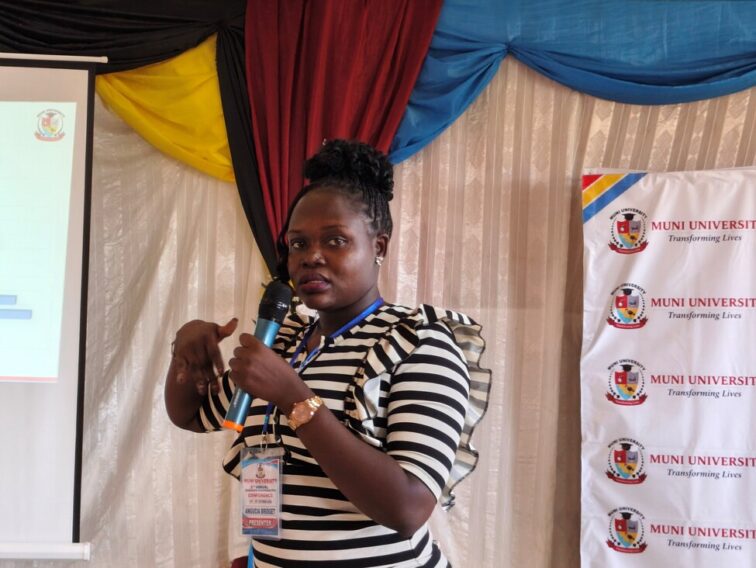
Bridget Angucia a biostatistician at the Uganda Cancer Institute, presenting the research results during the Muni University Second Research Dissemination and Exhibition 2026, attributes a significant proportion of liver cancer cases to gaps in hepatitis B prevention. Photo// Dramadri Federick
By Dramadri Federick
Stakeholders are expressing concern over gaps in cancer prevention, access to quality healthcare and the availability of specialised treatment closer to patients’ homes, following the recording of more than 1,000 cancer cases across four local governments in West Nile Region.
The study conducted by Uganda Cancer Institute on Cancer Pattern in Arua district covering Arua City, Arua, Terego and Madi-Okollo districts found that liver cancer accounted for 13.7 percent of 1,118 cancer cases reviewed between 2017 and 2021, making it the most commonly recorded cancer in the study population.
The research was monitored through six health facilities including Arua Regional Referral Hospital, Kuluva Hospital, Palliative Care Unit, Omugo Health Centre IV, Rhino Camp Health Centre IV and the Uganda Cancer Institute.
Liver cancer was followed by cervical cancer at 11.8 percent, breast cancer at 10.7 percent, oesophageal cancer at 10.5 percent and Burkitt’s lymphoma at 6.4 percent.
Bridget Angucia, a biostatistician at the Uganda Cancer Institute, attributes a significant proportion of liver cancer cases to gaps in hepatitis B prevention, including failure to vaccinate children, limited testing and inadequate screening services across the West Nile region.
“In total we got 1,118 cases of cancer, 52% were females and the males accounted for 48%. The common missed cancer is the cancer of the liver and it is not even captured anywhere by Ministry of health and that’s why is resource allocation to tackle the disease burden, the region is not supported. Why the liver cancer is high is because of the high prevalence of Hepatitis B in the region”. Angucia states.
The study found that adults aged 20 years and above accounted for approximately 85 percent of the recorded cases.
Among adults, liver cancer accounted for 16 percent, followed by cervical cancer at 14 percent, breast cancer at 13 percent and oesophageal cancer at 12 percent.
Among adult women, cervical cancer was the most common at 25 percent, followed by breast cancer at 22 percent and liver cancer at 13 percent. Among adult men, oesophageal cancer led at 22 percent, followed by liver cancer at 19 percent and prostate cancer at 11 percent.
Children aged zero to 14 years accounted for 138 cases, representing 12 percent of the total. Burkitt’s lymphoma made up 49 percent of cancers recorded in this age group, followed by other lymphomas at 13 percent and leukaemia at 12 percent.
Adolescents aged 15 to 19 years accounted for approximately three percent of cases, with other lymphomas and osteosarcoma among the leading cancers.
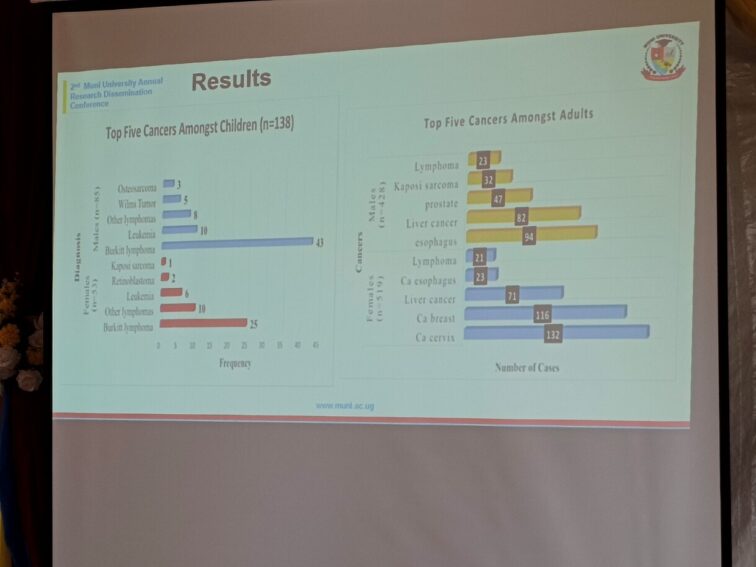
A screen projection of the cancer cases. Photo//Dramadri Federick
The researchers recommend hepatitis B vaccination, routine testing, improved cancer screening and further investigation into the high proportion of liver cancer cases recorded in the region.
Meanwhile, Arua District Chairperson Cosmas Ayikobua is calling for the acceleration of plans to establish a cancer institute at Arua Regional Referral Hospital.
Ayikobua says bringing specialised cancer services closer to patients would help reduce the financial burden on families who travel to Kampala for diagnosis and treatment, often at considerable cost as they struggle to save the lives of their loved ones.
“I see danger with this number 1,118 cases of cancer, this is threatening and I’m sure the number is beyond this because there’re people who do not go to health facilities, this is a health concern and needs attention urgently. We need to expedite the construction of the cancer center at Arua Regional Hospital and the upcoming one at Muni University such that these cases can be handled”. Ayikobua explains.
Afayo Geoffrey Aisua a Parasocial worker calls continues sentization of communities on health hazards of their eating practices.
“Most of the diseases people are battling are due to ignorance and we need to sensitize people because most people nowadays are depending on oil in every food they eat which is affecting their health”. Afayo noted
The researchers also recommend strengthening cancer diagnosis and treatment services, training more specialists and establishing a cancer registry to improve the tracking of cases and support evidence-based planning in the region.
The study cautions that some cases may have been diagnosed clinically without laboratory confirmation, while many records lacked information on the cancer stage. Researchers therefore call for further investigation to establish the factors contributing to the high proportion of liver cancer cases in Arua.
Upcoming on 90.9 FM
Upcoming on 94.5 FM
Upcoming on 101.4 FM
Upcoming on 104.8 FM
















Comments
This post currently has no comments.