
TAYEBWA THREATENS TO CUT PARLIAMENTARY COMMITTEE FUNDING OVER PERFORMANCE
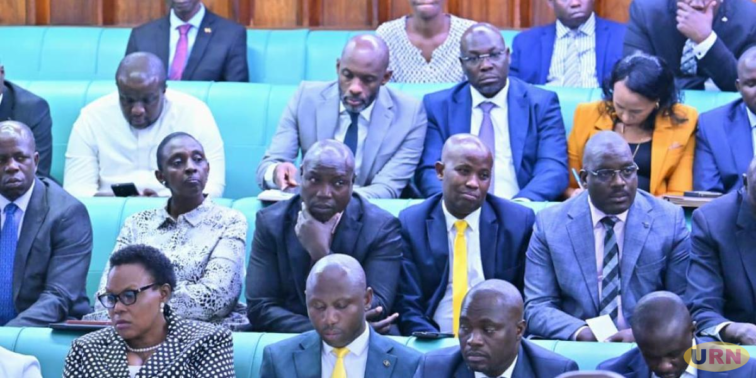
A section of Members of Parliament during a plenary sitting.
URN
The Deputy Speaker of Parliament, Thomas Tayebwa, has warned that funding for parliamentary committees will be tied to performance, directing committees that have failed to meet their reporting obligations to account for their work.
In his communication to Members of Parliament during the Tuesday afternoon plenary sitting, Tayebwa said some committees in Parliament had failed to present the minimum number of reports required under Parliament’s Rules of Procedure, undermining their purpose and keeping the House informed on special thematic areas.
He singled out the Committee on Climate Change, which he said had not presented a single report during the entire term of the 11th Parliament despite receiving and utilising funds.
“This is therefore to require committees to conform to the reporting requirements and justify their existence,” Tayebwa said.
He added that Parliament’s leadership would work with party whips to ensure that committee leadership positions are held by legislators who demonstrate commitment to their responsibilities.
“If your committee is not working, there is no reason for giving you money,” Tayebwa said.
He warned that committees whose leaders consistently fail to report but continue to receive and seek additional funding would face scrutiny.
He said the leadership would engage party whips to reconsider the suitability of such legislators for committee leadership positions.
“We talk to whips and request that, please, this one is not suitable to be a leader,” Tayebwa said.
Tayebwa explained that Parliament created specific Standing Committees to help update the House and give greater prominence to thematic issues that risked being overlooked when handled by committees with wider mandates.
He cited the Committee on Equal Opportunities, the Committee on HIV/AIDS and Related Matters, the Committee on Human Rights, the Committee on Climate Change, and the Committee on Science and Technology as committees that were created and required to report to the House at least twice a year under the Rules of Procedure.
Tayebwa said these special committees were created to ensure that important policy areas received sustained parliamentary attention and that the House regularly received updates on developments and challenges in their respective sectors.
However, he noted that some of these committees had fallen short of the minimum reporting frequency required of them by the Rules of Procedure.
“The Committee of Climate Change, for example, did not present a single report in the entire life of the 11th Parliament, despite it receiving and utilizing funds during that period,” Tayebwa revealed.
He proposed performance-based funding approach is intended to strengthen accountability in the use of parliamentary resources and ensure that committees deliver on their mandate.
Parliament of Uganda has a total of 15 Standing Committees, and these last two and a half years.
They are set up at the start of a new term of Parliament and again after two and a half years.
These committees comprise about 30 members selected by party whips.
Upcoming on 90.9 FM
Upcoming on 94.5 FM
Upcoming on 101.4 FM
Upcoming on 104.8 FM












Comments
This post currently has no comments.