
UGANDA’S VANISHING INDIGENOUS SEEDS: IS DEPENDENCE ON MODERN CROPS DEEPENING FOOD INSECURITY?
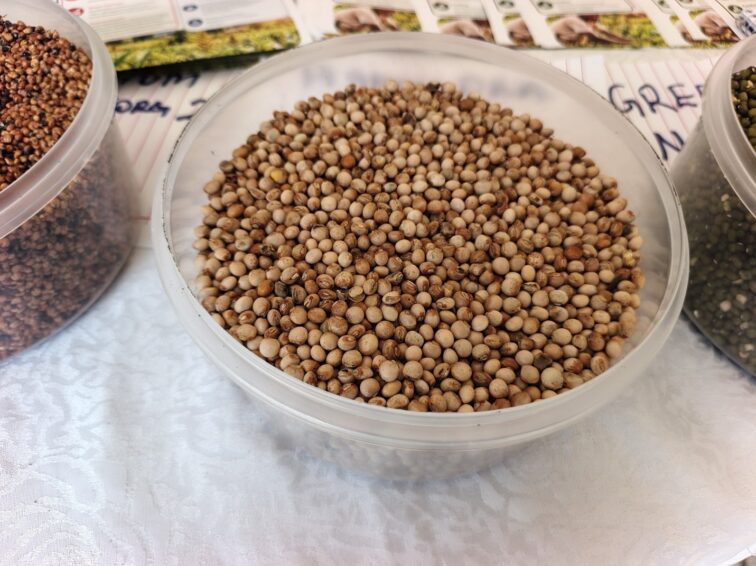
Some of the indigenous seeds on display. Photo// Dramadri Federick.
By Dramadri Federick
Residents in West Nile are calling on the government to protect indigenous crop varieties and establish systems for tracing traditional seeds, warning that growing dependence on modern high-yielding varieties could undermine local seed diversity and threaten household food security.
Tiyo Christopher, a resident of Logiri, says some farmers are experiencing declining yields after repeatedly planting newer crop varieties, unlike traditional seeds that communities preserved and replanted across seasons.
He argues that protecting indigenous seeds is essential to safeguarding food sovereignty and preserving crops known for their nutritional value.
“The new variety is no longer viable, and therefore it leaves the farmers’ food insecure and livelihood insecure, if possible we need varieties which don’t just collapse after planting.” Tiyo says
Christopher is urging the government to enact laws that protect indigenous seeds and ensure farmers can access, preserve and reproduce traditional varieties without losing them to the increasing dominance of commercial seed systems.
Meanwhile, the disappearance of traditional seed storage practices is raising concerns about communities’ ability to preserve indigenous crop varieties for future planting seasons.
In the past, several communities in West Nile relied on granaries to store harvested crops and seeds for future use. However, fears of theft and changing community attitudes have contributed to the decline of these traditional storage facilities.
Tutu John, Manager of the West Nile Lugbara Cultural Museum, says the negative perception and dismissal of communities that maintained granaries also discouraged the preservation of these cultural practices.
“Many people say it is a facility which is used by very poor people, people who has low economic status and that is what is in their mind yet the rich were judged by the number of granaries that had in communities.” Tutu says.
Tutu says reviving traditional seed storage systems could help communities preserve indigenous crop varieties, strengthen food security and pass agricultural knowledge to younger generations.
At Makerere University, efforts to conserve crop diversity are being supported through agricultural research and seed preservation initiatives at the Makerere University Agricultural Research Institute Kabanyolo, MUARIK, and the African Regional Centre of Excellence for Crop Improvement.
Dr. Richard Edema, Director of the Makerere Regional Centre for Crop Improvement, says improved crop varieties were introduced to boost agricultural productivity and farmers’ incomes, particularly through commercial production.
However, he says farmers should not abandon indigenous crops, which remain important sources of nutrients and contribute to agricultural diversity.
“We are actively taking steps to ensure that we collect the traditional seeds and store them in gene banks at Makerere University and these can preserve seeds for a long time and preserve it for posterity”. Edema explains
The calls come amid wider concerns about poverty, malnutrition and food insecurity in Uganda.
The 2025 Human Development Report ranks Uganda 157th out of 193 countries, while the 2025 Global Hunger Index categorises the country’s hunger level as serious. Available figures cited in the report indicate that 16.1 per cent of Uganda’s 45.9 million people live below the poverty line, while 26 per cent of children under five are stunted.
The campaign for indigenous seed protection is therefore calling for stronger government support for community seed banks, documentation and traceability of traditional crop varieties, and policies that allow farmers to preserve and exchange indigenous seeds alongside improved varieties.
Advocates say combining modern agricultural research with traditional farming knowledge could help protect crop diversity, improve nutrition and strengthen Uganda’s resilience to food shortages.
Upcoming on 90.9 FM
Upcoming on 94.5 FM
Upcoming on 101.4 FM
Upcoming on 104.8 FM




















Comments
This post currently has no comments.