
WEST NILE LEADERS CHALLENGE DRDIP EXCLUSION, CITING UNSEEN REFUGEE BURDENS BEYOND BORDERS
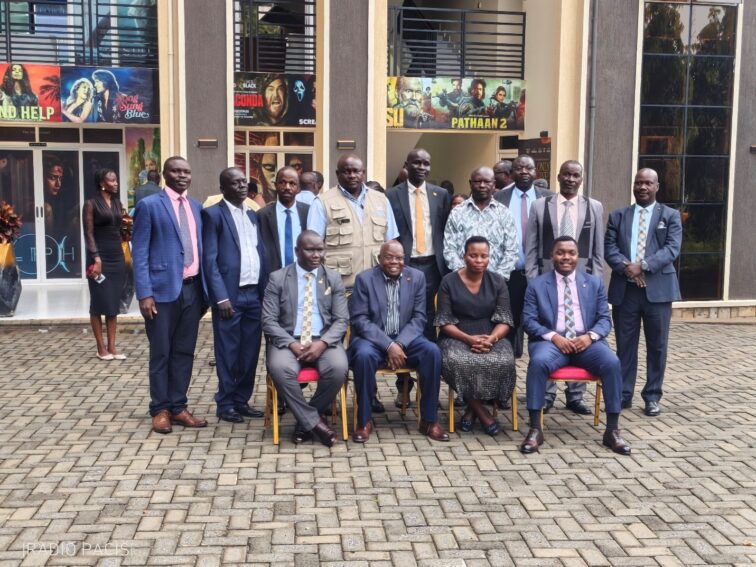
West Nile leaders together with the minister of state for Northern Uganda during their engagement on regional development at Hotel Le-confidentiel in Arua district (Photo by Onzoma Albert)
By Onzoma Albert
Arua City
The West Nile leaders from districts excluded from Uganda’s Development Response to Displacement Impacts Project (DRDIP) beneficiary lists are voicing concerns over their exclusion and challenging the criteria used for selecting districts to benefit from the program, as well as the fund distribution across the sub-region.
Historically, the Office of the Prime Minister (OPM) and the World Bank have limited DRDIP funding to officially designated refugee-hosting districts. However, leaders from neighboring districts, including Maracha, Nebbi, Pakwach, and Zombo, consistently argue that the pressures associated with displacement are not confined to the boundaries of these refugee-hosting areas.
Hon. George Othuba, LC V Chairman of Nebbi District, specifically questions the criteria for selecting beneficiary districts under the DRDIP project. He highlights the exclusion of districts like Nebbi, which directly borders the Democratic Republic of Congo (DRC).
“As leaders we might not know your parameters of selection but our health centers, security, schools and other services are all over burdened without giving us development aids, can’t you only give us the spillovers to help us because we are overburdened either as development initiatives or spillover projects or both because we are stressed, how did you choose the refuge hosting districts without the line refugees use to get there and guide us in case we don’t know what to do without eliminating us” he said.
Non-hosting districts situated along Uganda’s borders with the DRC and South Sudan frequently serve as the initial entry points and transit routes for asylum seekers before they are relocated to gazzetted settlements.
Her Worship, Jacklyn Opar, Mayor of Nebbi Municipality, underscored the presence of urban refugees in most urban centers within the region and appealed for the inclusion of Nebbi Municipality in the DRDIP project.
“Nebbi Municipality and any other urban center in the region we all have refugees but they have always been left out of such projects I need some help and understanding from those who have refugee camps and how they came on board, otherwise we have refugees who are scattered in the communities I don’t know what I should do count them so that Nebbi Municipality can as well get on board” she said.
Refugees regularly cross into neighboring districts and urban centers to access regional referral hospitals, secondary schools, and markets. This places significant demand on infrastructure in these areas, which currently receives no DRDIP compensation.
Hon. Emmanuel Wani, LC V Chairman of Maracha District, appealed to the Office of the Prime Minister and DRDIP project implementers to reconsider their decisions and include all West Nile districts in the DRDIP project.
“When the refugees were settling in Yumbe, Terego and other parts of the region the spillover effect was too much in the region, trees were bought from Maracha, our roads and culverts were destroyed and these were never taken into consideration, the designers of these project I want to appeal to you that you cannot leave out local governments such as Maracha which seats in between three powerful local governments which are getting additional funds from OPM to suffocate” he said.
Regional leaders have previously noted that the influx of humanitarian cash transfers and aid into hosting districts increases the demand for food and firewood across the entire West Nile sub-region. This contributes to localized inflation, food insecurity, and environmental degradation in non-hosting districts.
Dr. Robert Limlim, Director of the DRDIP Project, acknowledged the concerns raised by the district leaders of the West Nile sub-region. He tasked them with providing the OPM with current data on urban and self-settled refugees in their various districts for appropriate action.
“All governments use information that is officially available as a planning and decision making data on self-settled refugees to bring them to be registered and known, now I am requesting the districts that are not benefiting from the DRDIP project please get your planners, data teams to work with our department of refugees to handle, understand and recognize the new comes into to Uganda” he said.
The $328 million, five-year DRDIP II framework, which runs through 2031, categorizes eligible local governments into primary hosting districts, border transit districts, and secondary cities. Adjumani, Koboko, Madi-Okollo, Obongi, Terego, and Yumbe are among those listed. Zombo has been included as a Border Transit District, being one of six national entry districts where refugees first cross into Uganda. Arua City receives targeted support under urban displacement frameworks, although rural Arua District and Moyo saw shifts in classification compared to Phase I. Maracha, Nebbi, and Pakwach, however, remain omitted from the core DRDIP beneficiary lists.
Local government officials, including LCV chairpersons, Chief Administrative Officers, and Members of Parliament from non-benefiting districts, base their appeal on four key operational realities:
Firstly, districts like Maracha and Nebbi are located directly on the Democratic Republic of Congo (DRC) border. When conflict erupts in Ituri or North Kivu, asylum seekers enter through these districts. This necessitates local authorities to fund emergency reception, security screening, and disease surveillance, such as cross-border immunization buffers, before the Office of the Prime Minister (OPM) can transfer them to official settlements like Rhino Camp, Imvepi, or Bidibidi.
Secondly, refugees frequently move outside designated settlements to access better-equipped health centers, secondary schools, and maternity wards in neighboring districts and along the Pakwach–Nebbi–Arua highway corridor. Since Uganda’s Integrated Refugee Response Plan grants refugees free access to public services, these neighboring districts absorb higher patient and student loads without receiving DRDIP infrastructure grants to manage the increased demand.
Thirdly, deforestation for firewood, charcoal, and building poles, along with wetland encroachment, extends across district lines. Excluded districts contend that they suffer the same climate and biomass loss as hosting districts but lack access to DRDIP’s Sustainable Environment and Natural Resource Management (SENRM) funds, which are designed to mitigate these impacts.
Lastly, humanitarian cash transfers and food-assistance supply chains alter local commodity prices across the entire sub-region. Non-hosting districts face higher food prices and shifts in labor availability without benefiting from DRDIP’s community livelihood grants, which are intended to support local economies.
Despite political lobbying from the West Nile Parliamentary Caucus, implementing agencies maintain strict eligibility boundaries for three primary reasons:
The first reason is financial structure. Half of DRDIP II is financed through a concessional World Bank International Development Association (IDA) grant, and the other half is through a loan specifically tied to the Window for Host Communities and Refugees. World Bank rules prohibit the use of these funds for general regional development in areas without a verified, concentrated refugee presence.
The second reason relates to impact and funding limitations. With humanitarian funding declining globally and refugee numbers continuing to grow, OPM officials argue that distributing the $328 million across all 13 West Nile administrative units—plus other regions—would dilute the per-capita impact to negligible levels. This approach prioritizes concentrated support where the need is most acute and verifiable.
The third reason involves past performance and fiduciary concerns. During parliamentary reviews of DRDIP I, Members of Parliament (MPs) and auditors identified issues such as incomplete sub-projects, procurement delays, and weak maintenance plans in several local governments. Additionally, ongoing anti-corruption probes into local government fund management in districts like Maracha and Pakwach have reinforced donor reluctance to expand project footprints without the implementation of tighter fiduciary controls.
When rejecting appeals for full DRDIP inclusion, central government ministries often direct excluded West Nile districts toward parallel national programs. However, leaders from these districts have also disputed the adequacy of these alternative programs.
One such program is designed to address broader post-conflict and regional poverty across Northern Uganda. Nevertheless, West Nile leaders protested its 2026 allocation formula, deeming it disproportionately small given the region’s high poverty rankings. Another avenue is standard national intergovernmental fiscal transfers, which are intended to upgrade health centers, seed secondary schools, and household incomes across all districts equally. These transfers, however, may not specifically account for the unique burdens faced by districts bordering refugee-hosting areas or transit routes.
Upcoming on 90.9 FM
Upcoming on 94.5 FM
Upcoming on 101.4 FM
Upcoming on 104.8 FM




Comments
This post currently has no comments.