
ZAWEDDE URGES MEDIA, GOVERNMENT TO UNITE AGAINST MISINFORMATION
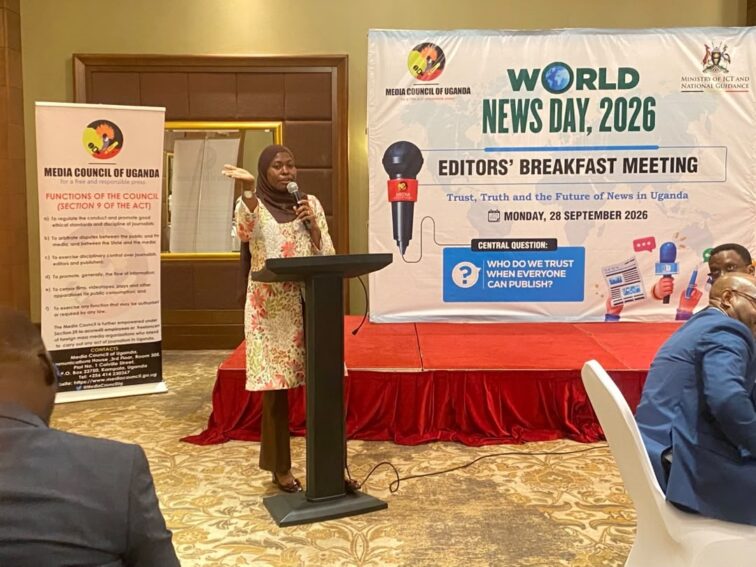
ICT Permanent Secretary Dr Aminah Zawedde has called for closer collaboration between government, media houses and regulators to tackle misinformation, disinformation and hate speech.
NILE POST
Permanent Secretary in the Ministry of ICT and National Guidance, Aminah Zawedde, has called for closer collaboration between government, media houses and regulators to address the growing challenge of misinformation, disinformation and hate speech in Uganda.
Zawedde made the call during the World News Day 2026 Editors’ Breakfast Meeting in Kampala, held under the theme, “Trust, Truth and the Future of News in Uganda.”
Zawedde, who represented the State Minister for ICT and National Guidance, Hon. Alioni Yorke Odria, said the gathering provided an important opportunity for government officials, media executives, editors, journalists and regulators to openly discuss challenges affecting Uganda’s information landscape.
She said the rapid development of technology has made it increasingly difficult to distinguish verified information from false reports, noting that news can sometimes circulate before facts are established.
“Technology is really running so fast beyond our imagination. News is running faster than reality, and then you don’t know what is factual and what is not,” Zawedde said.
She cited reports surrounding the health and death of King Oyo as an example, saying different versions of the story circulated, with some reports claiming he was still in intensive care while others reported that he had died.
Zawedde also questioned how the country defines a professional journalist in the current digital environment, particularly when individuals outside traditional newsrooms can publish and distribute information to large audiences.
She challenged the Media Council and other stakeholders to clarify who should be regulated and how regulation can effectively respond to the changing media environment.
“It’s high time we went down and sat at the table to clearly define this, so that we are all speaking the same language,” she said.
Zawedde acknowledged that the Media Council faces resource constraints in monitoring Uganda’s rapidly expanding media space, arguing that regulators require advanced technology to keep pace with emerging platforms and users.
She, however, said the responsibility to protect the integrity of Uganda’s information space extends beyond government and regulators to journalists, media houses and the wider public.
According to Zawedde, misinformation and disinformation can have consequences beyond the media industry, including affecting Uganda’s reputation, investment prospects and opportunities for citizens.
She urged media stakeholders to pay particular attention to young people, whom she described as the majority of users in the digital space.
Using a Ugandan proverb about guiding a growing seedling before it becomes difficult to correct, Zawedde called for early media and digital literacy among young people.
She cited the impact of misinformation surrounding Ebola as an example of how false information can have far-reaching consequences.
“We are still facing the wrath of the Ebola myths. Other countries shut us out because of this. But you know what? It has cost people businesses, it has cost people education, and so on and so forth,” she said.
Zawedde called for government, Parliament, regulators and media houses to use the World News Day engagement to identify practical solutions to misinformation, disinformation and hate speech.
She proposed that stakeholders agree on measures that can be implemented in the short, medium and long term.
“I believe we can pick out one thing that we can walk away with and try to come up with a solution in the long term that will address misinformation, disinformation and hate speech,” Zawedde said.
Upcoming on 90.9 FM
Upcoming on 94.5 FM
Upcoming on 101.4 FM
Upcoming on 104.8 FM














Comments
This post currently has no comments.