
REFUGEES DEMAND FOR INDEPENDENT LAW IN SETTLEMENTS
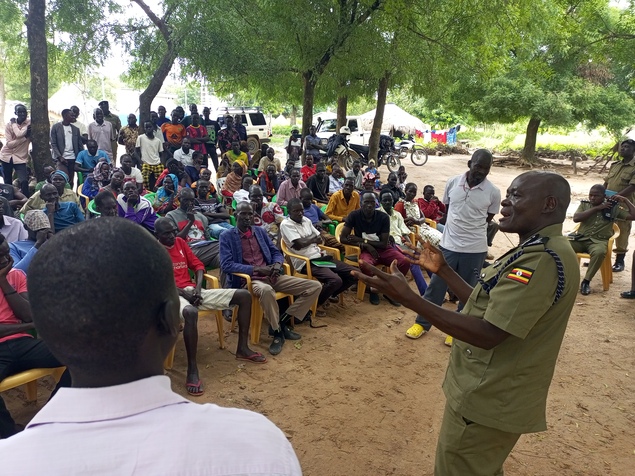
Muleterwa Anatoli Commissioner for community policing speaking to refugees in Ocea 16 recently.
By Godwin Abedican
Arua
A section of South Sudanese refugees is demanding for the establishment of local court systems in the settlements that will help in addressing cases of adultery. This as a result of what they describe as a joke of the Ugandan law against adultery.
Adultery is extramarital sex between a married women with another man who is not her husband or between a married man with another woman who is not his wife.
Previously, Section 154 of the penal code act provides that any man who has sexual intercourse with any married woman not being his wife commits adultery and was liable to imprisonment for a term not exceeding 12 months or to a fine not exceeding 200 shillings and in addition the courts would order such a man on first conviction to pay the aggrieved party a compensation of 600 shillings and on subsequent conviction pay a compensation not exceeding 1200 shillings, may also be ordered and any married woman who has sexual intercourse with any man not being her husband commits adultery and was liable on first conviction to a caution by court and on subsequent conviction to imprisonment for a term not exceeding 6 months.
However, in 2007, the Constitutional Court in Law and Advocacy for Women in Uganda Vs Attorney General, Constitutional Petition No. 13/05 and 05/06, Section 154 of the Penal Code and other provisions of the Succession Act were declared unconstitutional was scrapped off making adultery to cease being a crime in the country.
According to Simon Batali a refugee in Imvepi who was presenting the issue during a police community policing led by commissioner Muleterwa Anatoli, the commissioner police community policing in Uganda police, if not taken seriously, the revenge attacks among refugees as a result of adultery may not end soon.
“As South Sudan, we have different laws. There is this issue which is casing sicknesses and problems in the community. They say here if someone sleeps with your wife you should be paid 600 shillings yet this is a person I married and we agreed on payments of dowry. Someone just comes and takes over and you are given 600 shillings, is this really good? That’s why if someone’s wife is slept with here the person goes back to South Sudan and waits for the one who slept with his wife and the moment he sees the person who slept with the wife while in Uganda, he just kills. This is a very big problem amidst us the refugees and it’s the Ugandan law bringing this use. It better a court system be opened for us here. We have our leaders of South Sudan who will come and handle our marriage issues using our laws not the Ugandans handling using their law,” he called.
Section 266 of the penal code in South Sudan criminalizes adultery making it an offence stating that "Whoever, has consensual sexual intercourse with a man or woman who is and whom he or she has reason to believe to be the spouse of another person, commits the offence of adultery. Adultery is a criminal offence in South Sudan and is taken very seriously. The Penal Code Act makes it a crime in statutory law, punishable by a prison term and/or a fine or both.
Meanwhile in Uganda, in 2007, the Constitutional Court in Law and Advocacy for Women in Uganda Vs Attorney General, Constitutional Petition No. 13/05 and 05/06, Section 154 of the Penal Code and other provisions of the Succession Act were declared unconstitutional in 2017 this law was scrapped off making adultery to cease being a crime in the country. This to the refugee is one thing leading to reckless lifestyle among the married in Uganda and encourages adultery, which law they are being forced to follow and yet their culture and laws give so much respect to marriage.
Kanjaga Wani, an elder from the Pojulu tribe in South Sudan, also a refugee in Ocea A village, Rhino camp refugee settlement says that, creating a law would help in situations where some have ended up in killings
“The issues of marriages and adultery is a very crucial issue for us. Some years back some of our brothers killed themselves here in the settlement because of such issues related to marriage but it was very hard to reveal to the government. It is good for a strong committee to be formed to handle courts in the settlement, something that will look at generalizing all the tribes in South Sudan and the laws will be within the reach of all these tribes.”
“We should have this court system within the settlement where there is a uniform fine or compensation to a person whose wife has been slept with. The Ugandan law according to us the South Sudanese, is encouraging men to befriend people’s wives because the payment is very small and it’s also very hard for some of our tribes that take ladies as a source of wealth to just forget about all that and accept the current Ugandan law,” Wani said.
The demands of the tribes in regards to marriage and compensation differ from one tribe to another with others having very high demands, some moderate while others have very low demands on such.
However, Yien Nhial, a Nuer by tribe the RWC 1 secretary in Ocea looks at this proposal as a source of conflicts among the refugees as many other demands shall continue to be raised if such is effected.
”If we bring our issues of South Sudan here and begin applying the laws, it will bring a lot of violence here. We may see a lot of killings here if they bring that law of South Sudan because people will expect to be paid very high fines yet as refugees there is nowhere someone can get all that will be called for and definitely the end result will be clashes both within the same tribes sand intertribal clashes. It is impossible. We should maintain the laws being used here,” he opposed.
According to Superintendent of police Asea Collins, the police Spokesperson for West Nile region, policy matters cannot be bent towards the interest of particular groups of people.
“First of all, they must follow our laws. What does the Ugandan law say? They cannot come here and impose their laws. We have very clear court system and penalties for every offence are clearly stipulated. Even if we go the other side, their laws will work on us. So, they cannot come here with their laws. Our work is to constantly educate them. It is just a mentality. If we change people’s mindset, definitely they will leave whatever they are doing,” Asea said.
Muleterwa Anatoli, the commissioner police community policing in the Uganda police while responding to this demand noted that each country has its own set of laws that need to be followed
“One thing you need to know is that, in Uganda where you have come to settle, you need to appreciate the difference. In the context of your country if that works, in Uganda that does not work. You either want it or not but you must accept when you are in Uganda. When you are in South Sudan, you can practice what your law says but, when you are in Uganda, it’s a “NO”,” the commissioner told the refugees during a visit to the settlement.
Laws against adultery (extramarital sex) vary from country to country. Historically, many cultures considered adultery a very serious crime. Some subject the perpetuators to severe punishment, with penalties including capital punishment, mutilation, or torture.
Upcoming on 90.9 FM
Upcoming on 94.5 FM
Upcoming on 101.4 FM
Upcoming on 104.8 FM





Comments
This post currently has no comments.