
SOLAR ENERGY POWERS BETTER EDUCATION AND HEALTHCARE IN GULU ARCHDIOCESE
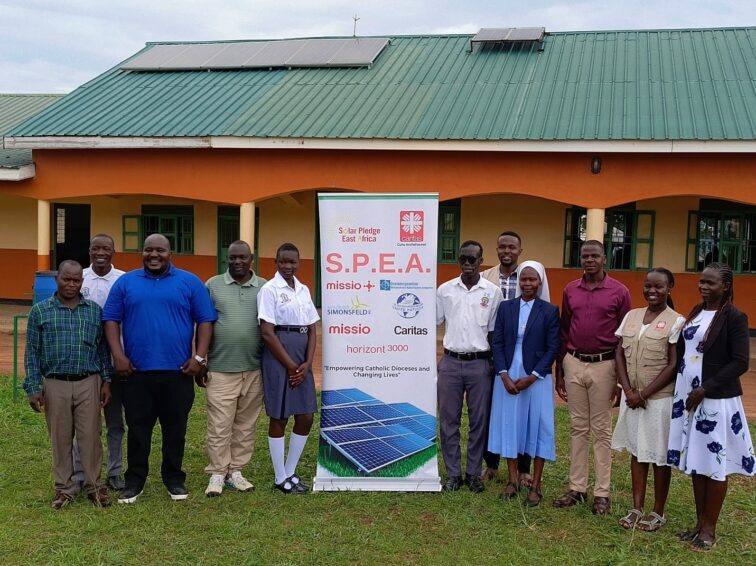 The administration and students of St. Theresa of Calcutta Secondary School with Caritas Gulu Archdiocese staff during a field visit to assess the impact of solar energy on learning and institutional operations.
By Proscovia Achomo
Gulu city
From improved digital learning in classrooms to safer maternity services in health facilities, access to reliable solar energy is transforming the delivery of education and healthcare in Catholic institutions across the Archdiocese of Gulu.
For Catholic schools and health facilities across the Archdiocese of Gulu, unreliable electricity has long presented challenges to effective service delivery, affecting teaching and learning, limiting access to digital education and constraining the provision of essential healthcare services.
Today, that situation is changing as solar energy brings renewed hope and opportunities for improved service delivery.
Through the Solar Pledge East Africa Project, Caritas Gulu Archdiocese, with support from HORIZONT3000, is extending access to clean, reliable and sustainable electricity to selected Catholic Church institutions, addressing longstanding energy challenges and strengthening their capacity to fulfil their educational and healthcare missions.
Beyond providing an alternative source of electricity, the intervention is reducing operational costs, improving institutional efficiency and creating more conducive environments for learners, teachers, healthcare workers and patients.
The transformation is already evident in beneficiary institutions, where administrators, teachers, learners and healthcare workers are experiencing firsthand the difference reliable electricity makes in their daily operations.
Transforming learning through reliable solar energy
At Rev. Fr. Raphael Debari Memorial Nursery and Primary School in Awach Parish, Gulu District, the installation of a solar power system has significantly improved the school’s learning environment while reducing operational expenses.
Richard Okello Bob, the school’s Director of Studies, explained that unreliable electricity previously disrupted lessons and increased operational costs, particularly when the school needed power for printing examinations and learning materials.
The situation was especially challenging for Primary Seven candidates preparing for their examinations, as interruptions in electricity affected the smooth delivery of academic activities.
With the solar installation, the school now enjoys a more reliable electricity supply, ensuring uninterrupted lessons and printing of examination papers and other learning materials.
The intervention has also reduced the school’s monthly electricity expenditure, which previously ranged between UGX 200,000 and UGX 300,000.
Bob appreciated Caritas Gulu Archdiocese and HORIZONT3000 for the support, noting that the solar system had addressed an important challenge affecting the school’s operations.
At St. Theresa of Calcutta Secondary School, the impact is particularly evident in the Information and Communication Technology (ICT) department, where learners now enjoy improved access to computers and digital learning resources.
For Petra Aloyo, a Senior Three student, reliable electricity has removed a major barrier to practical ICT learning.
“Before the solar installation, our access to computers was very limited because the generator could not generate enough power to support all the students during ICT lessons. This made it difficult for us to fully engage in practical learning. However, with the new solar system, we now have a reliable electricity supply, allowing more students to access computers, practice our ICT skills and learn with greater confidence,” she said.
The school’s Headteacher, Rev. Sr. Mary Jackline Angee, explained that the institution, established in 2019, has a population of 605 learners in both day and boarding sections.
Located in an area without access to the national electricity grid, the school previously faced considerable challenges in meeting its electricity needs.
The solar installation, comprising six panels and other accessories, has enabled the school to conduct examinations, operate computers and heavy-duty printers, and print examination papers on-site.
Previously, the school spent between UGX 2 million and UGX 3 million on external examination processing. With the ability to print examination materials internally, these resources can now be redirected towards other pressing school needs.
The benefits also extend to learners’ welfare and security. Improved lighting in the girls’ dormitory has created a safer and more comfortable environment, reduced complaints from learners and strengthened security within the school.
At St. Theresa Nursery and Primary School in Otumpili, solar energy is similarly creating opportunities for improved teaching and learning.
The school’s Headteacher reported that the installation of four solar panels and other accessories has improved the working environment for teachers and created additional opportunities for learners.
Reliable electricity has enabled some teachers who previously lived far from the school to reside within the school premises. This gives them more time in the evenings to scheme their work, prepare lesson plans and support learners’ academic progress.
Learners living within the surrounding community also benefit from the improved lighting, using the school premises for evening revision.
Beyond the school’s immediate needs, the solar installation has generated additional benefits for the surrounding community. Residents can charge their mobile phones, torches and radios at the school for a modest fee, with the proceeds contributing towards the maintenance of the solar system.
The improved lighting has also enhanced security within the school premises.
Strengthening the Church’s commitment to quality education
The improvements have been welcomed by the Archdiocesan Education Department, which recognises reliable electricity as an important investment in strengthening the quality of education provided by Catholic-founded institutions.
Rev. Fr. Stephen Raphael Kilama, Diocesan Education Secretary, expressed gratitude to Caritas Gulu Archdiocese and HORIZONT3000 for supporting Catholic schools with solar energy as an alternative and more affordable source of electricity.
He noted that the positive impact of the installations was already evident, particularly in improving teaching and learning environments and reducing the financial burden associated with electricity.
He expressed hope that the intervention would be sustained and extended to more Catholic institutions, while appealing to school administrators to prioritise proper maintenance of the installed systems to ensure their continued functionality.
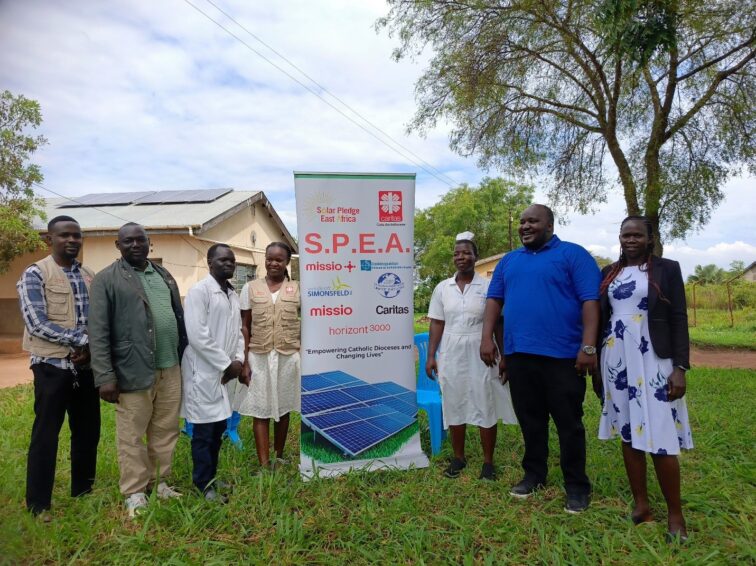
Caritas Gulu Archdiocese staff pose for a group photo with healthcare workers at St. Joseph Minakulu Bobi Health Centre II during a field visit to document the impact of the solar installation.
Strengthening healthcare delivery in Catholic health facilities
The impact of the Solar Pledge East Africa Project extends beyond education to Catholic health facilities, where reliable electricity is essential for patient care, safe deliveries, laboratory operations and other critical medical services.
At St. Joseph Minakulu Bobi Health Centre II, the solar installation has significantly improved the facility’s capacity to provide essential healthcare services.
Judith Acen, the facility’s In-charge, explained that the reliable electricity supply has enabled healthcare workers to conduct medical tests that were previously referred to other facilities. The improved lighting, particularly in the maternity ward, has also strengthened the facility’s ability to attend to mothers and other patients, including during night-duty hours.
Encouragingly, the facility has recorded an increase in deliveries, rising from an average of 12 to approximately 20 or more per month. Patient numbers in the inpatient department and maternity ward have also increased.
In addition to improving service delivery, the solar installation has reduced the facility’s electricity expenses, which previously ranged between UGX 60,000 and UGX 70,000 monthly.
Since the beginning of the year, the facility has paid electricity bills only twice, allowing it to redirect resources towards other healthcare priorities.
Similarly, at St. Francis Health Centre II in Anaka, reliable solar power has addressed electricity challenges that previously affected the efficiency of healthcare services.
Gloria Aloyotoo, the facility’s In-charge, said the improved power supply has enhanced lighting in the dispensary, eliminating the need for healthcare workers to rely on mobile phone torches when attending to patients.
The installation has also enabled uninterrupted laboratory operations, particularly the use of microscopes and other electricity-dependent equipment.
For healthcare workers, this means a more conducive working environment, improved efficiency and greater confidence in providing essential medical services. The facility has also been relieved of the financial burden of monthly electricity bills.
These improvements demonstrate the importance of reliable electricity in strengthening the capacity of Catholic health facilities to provide quality and dependable healthcare services to the communities they serve.
An investment in sustainable Church institutions
According to Moses Ojera, Diocesan Health Coordinator, many Catholic health facilities under Gulu Archdiocese have historically struggled with electricity challenges, particularly those located in remote areas beyond the reach of the national electricity grid.
He noted that the installation of solar power systems has improved the operation of essential medical equipment and strengthened the provision of night-duty services, which were previously constrained by inadequate lighting.
Describing the intervention as an important milestone for the Archdiocesan health sector, Ojera acknowledged the project’s contribution to four health facilities, including St. Peter and Paul Health Centre in Lamwo and Mary Queen of Peace Health Centre.
For Caritas Gulu Archdiocese, the intervention represents an investment in strengthening the capacity and sustainability of the Catholic Church’s educational and healthcare institutions.
Barnabas Oloya, Energy Officer for the Solar Pledge East Africa Project, explained that the initiative was designed to address electricity challenges affecting Catholic schools and health facilities, recognising the critical role reliable energy plays in improving service delivery.
He revealed that Gulu Archdiocese has 630 schools, of which 120 were shortlisted for potential support following an assessment to identify institutions with the greatest energy needs.
During the first phase, eight Catholic schools and two Catholic health centres benefited from solar installations. Each of the two health centres received six solar panels alongside other necessary accessories.
The second phase is expected to extend the intervention to an additional eight schools and two health centres, further expanding access to sustainable energy within Catholic institutions under the Archdiocese.
To promote sustainability, selected staff from beneficiary institutions have also received training in maintaining the installed solar systems. Furthermore, the installations come with a 10-year warranty, providing additional assurance of their long-term functionality.
Looking ahead: Sustaining impact through clean energy
Launched in June 2024 and scheduled to run until May 2027, the three-year Solar Pledge East Africa Project is implemented by HORIZONT3000 in partnership with Caritas Gulu Archdiocese and other partners.
The project seeks to expand access to reliable and sustainable solar energy, improve essential service delivery and strengthen the resilience of beneficiary Catholic institutions.
As the project progresses into its next phase, the experiences of the first beneficiary institutions offer encouraging evidence of the difference strategic investment in renewable energy can make.
For learners, it means greater access to computers, improved examination preparation and opportunities to develop digital skills. For teachers, it means a better working environment and more time to support learners. For healthcare workers, it means improved working conditions, functional medical equipment and greater capacity to attend to patients, including at night.
For the institutions themselves, it means reduced electricity costs, improved operational efficiency and resources that can be redirected towards other essential priorities.
Ultimately, the Solar Pledge East Africa Project is demonstrating how investment in sustainable energy can strengthen the Catholic Church’s mission of providing quality education and healthcare.
Through the continued partnership between HORIZONT3000 and Caritas Gulu Archdiocese, solar energy is doing more than lighting classrooms and health facilities. It is creating brighter opportunities for learners, strengthening healthcare delivery and building more resilient Catholic institutions for the communities they serve.
Upcoming on 90.9 FM
Upcoming on 94.5 FM
Upcoming on 101.4 FM
Upcoming on 104.8 FM












Comments
This post currently has no comments.